Locations

Hydroseeding in Saudi Arabia

Engineered surface systems for desertification control, urban cooling and large-scale development in an arid, high-growth market.

SRBT delivery capability in Saudi Arabia

SRBT can mobilize project-specific hydroseeding, dust-control and climate-adapted greening systems for projects in Saudi Arabia. Delivery begins with an assessment of substrate chemistry, salinity, irrigation-water quality, heat exposure and the required long-term function of the surface.

SRBT is currently in discussion with regional partners to bring its engineering approach to Saudi Arabia's market. These conversations concern potential cooperation, not an established local presence, completed projects or a confirmed partnership.

Equipment, application capacity and technical support can be coordinated through an international partner and equipment-fleet network. This describes international project capability, not a permanent local presence.

Where surface problems arise in Saudi Arabia

Climate

Saudi Arabia has an extremely arid climate with intense summer heat, high evaporation and minimal, irregular rainfall. Sustained high temperatures place severe stress on unprotected soil and newly established vegetation. Permanent greening therefore depends on engineered irrigation and a designed root zone rather than natural precipitation.

Dominant soils

Substrates are commonly shallow, calcareous, sandy, gravelly or gypsiferous, with low organic matter and limited biological activity. Fine-particle and coastal areas may be strongly saline. Reduced microbial activity in these substrates can significantly limit the breakdown of conventional wood-fiber mulches, meaning a growth medium engineered for biologically inactive conditions is often required rather than a standard hydroseeding mixture.

Vegetation zones

Natural vegetation is sparse and adapted to severe aridity, including desert shrub and grass communities, wadi vegetation and limited oasis systems. Large-scale development and greening programs introduce a separate, irrigated vegetation category with different species selection, water demand and management requirements.

Water availability

Water is the defining design constraint. Treated wastewater and other non-conventional sources are increasingly important for large-scale planting programs, but salinity, sodium content and nutrient load must be verified before use. Neither hydraulic application nor moisture-retaining materials remove the need for a credible, project-specific long-term water budget.

Regulation

The National Center for Vegetation Cover Development and Combating Desertification (NCVC), working with the Ministry of Environment, Water and Agriculture (MEWA), coordinates national desertification-control and afforestation programs, including the Saudi Green Initiative. Individual projects may additionally require municipal planning, water-reuse, environmental and construction approvals.

Lead industries and development sectors

Relevant sectors include large urban and giga-project developments, transport infrastructure, tourism, industrial sites and public green-space programs. These projects increasingly combine surface cooling, dust reduction, erosion control and vegetation cover as coordinated requirements rather than separate treatments.

Topography and terrain

Saudi Arabia includes coastal plains, extensive desert basins, elevated plateaus and mountainous terrain in the west and southwest. Large, flat development sites can be highly exposed to wind, while remote or elevated locations may require long pumping distances and coordinated logistics.

Structural risks

Wind erosion, sand movement and dust deposition affect exposed land, construction sites and infrastructure corridors, including sand encroachment onto roads. Water erosion, salinity accumulation and vegetation failure from an inadequate root zone or irrigation design are additional risks. A green surface cannot remain functional if these underlying issues are unresolved.

Vision 2030 and the scale of the opportunity

Saudi Arabia's Vision 2030 and the associated Saudi Green Initiative set among the most ambitious land-restoration targets globally: 10 billion trees, rehabilitation of 40 million hectares of degraded land, and protection of 30% of land and sea areas. The National Center for Vegetation Cover Development and Combating Desertification reported that the program restored its first million hectares in early 2026, following an accelerating trajectory from roughly 18,000 hectares at the program's start to 250,000 hectares by 2024.

This progression demonstrates real acceleration, but it also shows the scale still ahead: one million hectares represents a small fraction of the 40-million-hectare target, and independent commentary on the program has noted that the majority of planting activity is expected in the second half of the decade and beyond. How much of the full ambition is ultimately achieved will depend on sustained implementation capacity over the coming years.

This context matters for project planning. Desertification control and vegetation establishment in Saudi Arabia's difficult substrate and climate conditions require a high degree of planning precision—engineered growth media, verified water budgets and realistic species selection—rather than standard hydroseeding specifications transferred from temperate climates.

Based on current market conditions, specialized technical capacity for this type of work remains limited relative to the scale of national ambition. This is SRBT's own assessment of the market opportunity, not an independently verified market statistic.
Dune stabilization as an emerging market

Alongside desertification control and urban greening, dune and sand stabilization represents a developing opportunity. National greening programs explicitly include protecting roads and infrastructure corridors from sand encroachment, reducing long-term maintenance costs for transport networks.

This application differs from urban cooling and permanent landscaping in its objective: the priority is reducing sand movement and wind exposure at specific infrastructure-adjacent locations, not necessarily establishing dense, irrigated vegetation cover across a wide area.

Hydroseeding in Saudi Arabia

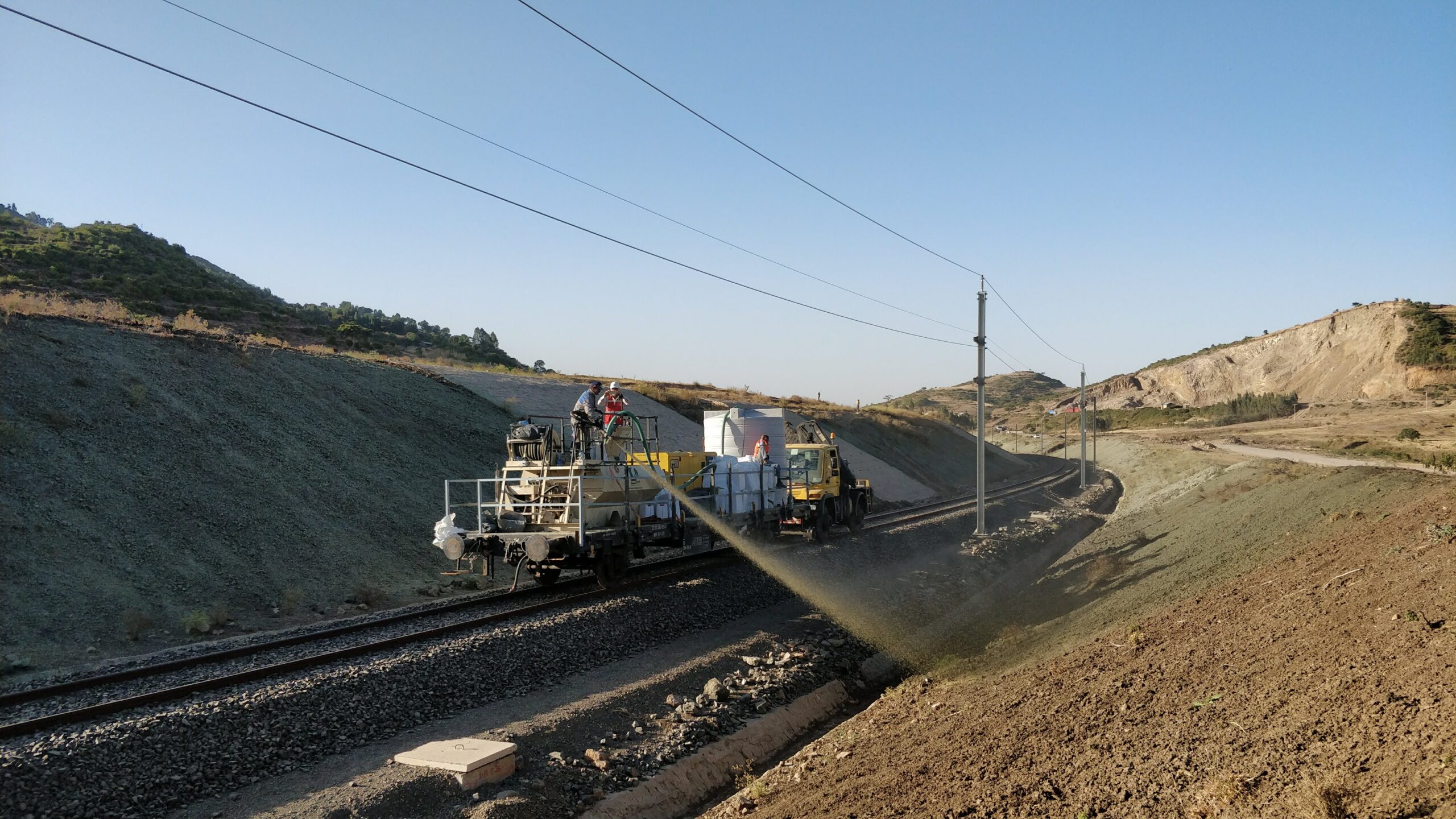
Hydroseeding in Saudi Arabia must be designed as a complete system rather than a standard seed-and-mulch application. Site assessment should establish substrate chemistry, salinity, sodium-related structural risk, compaction, infiltration, rooting depth, wind exposure and irrigation-water quality.

Where permanent vegetation is required, the system typically combines an engineered growth medium, moisture- and nutrient-management functions, a biologically based binder and vegetation selected for the site's water regime and salinity. On exposed, non-vegetated or dune-affected surfaces, a separate specification focused on controlled surface binding and wind-erosion resistance is generally more appropriate.

Hydroseeding cannot compensate for saline irrigation water, an unsuitable root zone or inadequate long-term irrigation and maintenance planning. Proprietary formulations remain project-specific.

Relevant applications

Climate Adaptation

Engineering permanent surface and vegetation systems for extreme heat, water scarcity and saline substrates, including urban cooling objectives.

Application
Read more →
Dust Control

Reducing wind-driven dust and sand movement on construction sites, infrastructure corridors and exposed development land.

Application
Read more →
Dune Stabilization

Protecting infrastructure corridors and development sites from sand encroachment and wind-driven surface movement.

Application
Read more →
Drought-resilient revegetation without irrigation

A methodology example examining how substrate preparation, moisture management and plant selection interact where permanent irrigation is limited or unavailable. It illustrates an applicable engineering approach and does not claim that the project was delivered in Saudi Arabia.

Case Study
Read more →
Water retention in hydraulic growth media

How substrate properties, fibers and moisture-management functions influence vegetation establishment under severe water limitation.

Engineering Insight
Read more →
Any questions?

A project, a partnership or a research collaboration — get in touch by phone or email.