Locations

Middle East & North Africa

Surface-engineering capability for rapidly changing markets under arid and water-limited conditions.

Engineering permanent surfaces in changing markets

Across the Middle East and North Africa, infrastructure development, urban expansion and long-term national development programs are creating new requirements for landscape establishment and surface performance. These changes are reflected in project inquiries involving transport corridors, industrial land, new urban districts and large areas exposed to heat, wind and limited water availability. SRBT assesses delivery capability according to project potential in each market; inclusion here does not indicate a permanent office, local branch or continuous local presence.

Rising heat loads also change the purpose of revegetation. Vegetated surfaces are increasingly considered not only for erosion protection or visual landscaping, but as part of permanent urban cooling and surface-stabilization strategies that reduce exposed ground and moderate ambient conditions.

Conventional hydroseeding methods often reach their technical limits under these conditions. Seed and standard wood-fiber mulch alone cannot compensate for saline substrates, rapid evaporation, extreme surface temperatures or soils with limited biological activity.

Successful arid-climate revegetation and desertification control therefore require a system designed around realistic water availability, substrate behavior, vegetation suitability and long-term maintenance—not a direct transfer of standard hydroseeding specifications from temperate climates.
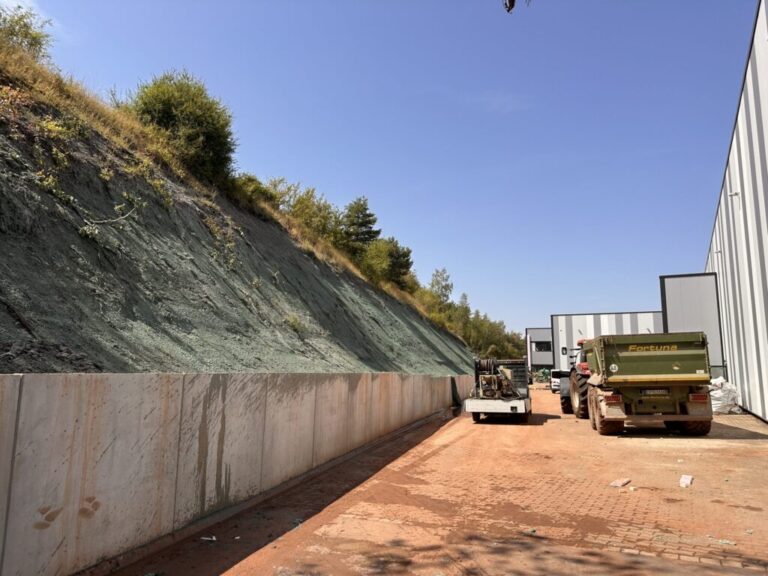
The technical challenge of arid substrates

Reduced microbial activity in arid, low-biological-activity substrates can significantly limit the breakdown of conventional wood-fiber mulches. Saline, fine-particle soils may also seal rapidly, restrict infiltration and provide little structure for root development.

The required system must balance functions that can otherwise compete. It may need to create a controlled protective crust or stabilized surface matrix while retaining sufficient permeability for water and root development. At the same time, the growth layer must store available moisture and nutrients without assuming continuous irrigation.

Material selection, vegetation strategy and application timing must therefore be coordinated around salinity, evaporation, water quality, substrate chemistry and the intended service life of the surface.

Where SRBT delivers

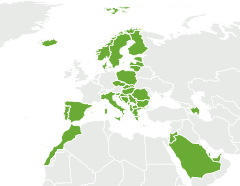
Map of Europe, the Middle East and North Africa with the countries SRBT delivers to highlighted
Countries with a delivery profile

Explore markets across the region

Revegetation of an industrial site
Hydroseeding in Azerbaijan

Engineered surface stabilization for remediated industrial land, saline soils and dust-exposed sites.

Open country profile →
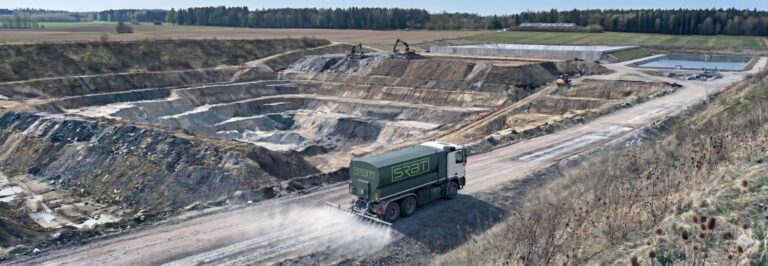
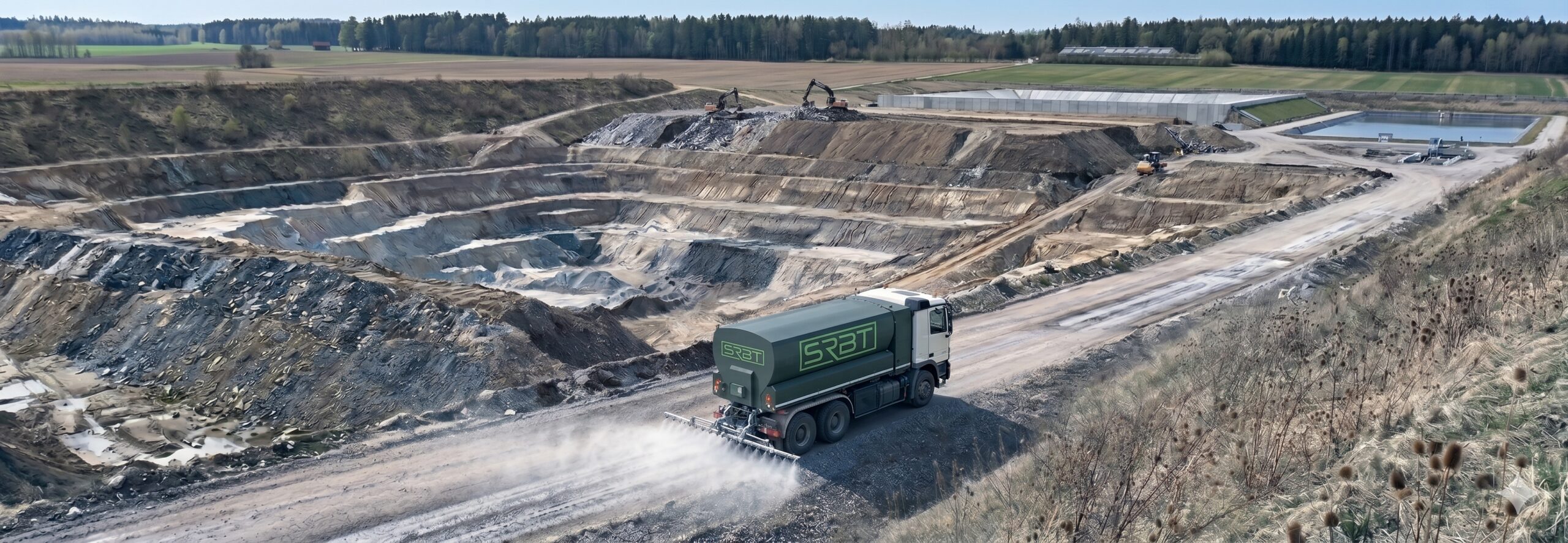
SRBT tanker spraying dust suppressant along a quarry haul road
Hydroseeding in Jordan

Engineered revegetation and surface protection for water-limited, erosion-prone and dust-exposed terrain.

Open country profile →
SRBT tanker spraying dust suppressant along a quarry haul road
Hydroseeding in Morocco

Engineered surface systems for water-limited revegetation, erosion control and climate adaptation.

Open country profile →
SRBT tanker spraying dust suppressant along a quarry haul road
Hydroseeding in Qatar

Engineered permanent greening and dust control for extreme heat, saline substrates and water-limited urban sites.

Open country profile →
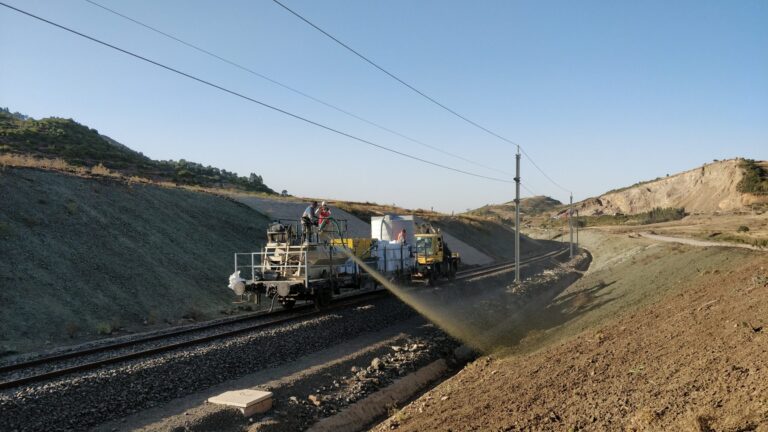
Railway track revegetation by hydroseeding
Hydroseeding in Saudi Arabia

Engineered surface systems for desertification control, urban cooling and large-scale development in an arid, high-growth market.

Open country profile →
Revegetation of an industrial site
Hydroseeding in the United Arab Emirates

Engineered dust control, surface stabilization and climate-adapted greening for arid urban and industrial sites.

Open country profile →
Any questions?

A project, a partnership or a research collaboration — get in touch by phone or email.