Locations

Czech Republic

Hydroseeding and engineered surface systems for post-mining, industrial and infrastructure landscapes in the Czech Republic.

SRBT delivery capability in the Czech Republic

SRBT can mobilize hydroseeding and environmental surface engineering projects in the Czech Republic through an international engineering, equipment and delivery network. Each project begins with an assessment of substrate properties, slope geometry, drainage, contamination status, intended land use and applicable reclamation requirements.

Depending on the assignment, SRBT can coordinate material-system design, application equipment, specialist personnel and regional implementation resources. This capability is relevant to post-mining rehabilitation, waste-rock slopes, industrial surfaces and erosion control on major earthworks. Delivery remains subject to technical feasibility, regulatory approval, site safety, logistics and an appropriate seasonal application window.

Where surface problems arise in the Czech Republic

Climate

The Czech Republic has a temperate climate with continental influences and substantial regional variation caused by elevation and topography. Cold winters, summer dry periods and intense rainfall can all affect vegetation establishment. Post-mining substrates often amplify these stresses because they may retain little water, heat rapidly or generate concentrated runoff before protective vegetation develops.

Dominant soils

Natural soils range from fertile lowland soils and loess-derived material to sandy deposits, clays, weathered rock and shallow mountain soils. Mining regions contain anthropogenically disturbed substrates such as overburden, spoil, waste rock, compacted fills and mixed Technosols. Their physical and chemical properties can differ fundamentally from natural topsoil and must be investigated before a vegetation system is specified.

Vegetation zones

The country lies mainly within the temperate mixed-forest zone, with deciduous lowland communities and mixed or coniferous vegetation at higher elevations. Post-mining land may be directed toward forestry, grassland, habitat creation, recreation or another approved use. In some areas, natural succession can create valuable habitats. Active hydroseeding should therefore support the defined reclamation objective rather than replace ecologically appropriate spontaneous development.

Water availability

Water availability varies by region, elevation and season. Drought can restrict establishment, while intense rainfall can erode newly graded surfaces. Mining may modify groundwater levels, drainage systems and catchment behavior. Water collected in pits or operational systems cannot automatically be assumed suitable for hydroseeding. Its salinity, pH, suspended solids and other relevant properties must be assessed before use.

Regulation

The Czech Mining Act requires mining companies to reclaim land affected by extraction and to establish financial reserves for reclamation. Mining authorities oversee mine operation, closure and compliance with applicable mining requirements. Environmental assessment and nature-protection requirements may involve the Ministry of the Environment and regional authorities. The approved reclamation plan and future land-use decision take precedence over a generic revegetation specification.

Lead industries

Surface lignite mining in the North Bohemian and Sokolov basins is central to the country's post-mining land profile. Other relevant sectors include underground mining, quarrying, power generation, manufacturing, waste management and transport infrastructure. These activities create different surface conditions, from large overburden dumps and residual pits to industrial deposits, embankments and temporary stockpiles.

Topography and terrain

The Czech landscape includes lowland basins, rolling uplands, river valleys and mountain regions. Mining creates additional artificial topography, including spoil heaps, benches, steep waste-rock slopes, residual pits and subsidence-affected ground. Application access, slope length, elevation difference and concentrated drainage may be more important to delivery planning than the surrounding natural relief.

Structural risks

Relevant risks include slope instability, differential settlement, subsidence, surface erosion and the mobilization of unsuitable or contaminated material. Some mine wastes may also present chemical, combustion or water-quality risks. Hydroseeding can address superficial erosion and vegetation establishment after these issues have been assessed. It cannot stabilize an unsafe spoil heap, remediate contaminated ground or replace an engineered drainage or cover system.

Hydroseeding in the Czech Republic

Hydroseeding can support the biological phase of mine rehabilitation once geotechnical stability, drainage and substrate suitability have been established. The assessment should distinguish between natural soil, overburden, waste rock, processed residues and imported cover material. Relevant parameters include particle-size distribution, compaction, pH, salinity, nutrient availability, potential contamination and water-retention capacity.

The first decision is whether active vegetation establishment is appropriate. Some post-mining areas benefit from planned grassland, forestry or rapid erosion protection. Others may have greater ecological value when selected zones are allowed to develop through natural succession.

Where hydroseeding is justified, the system may combine adapted seed, fibers, a hydraulic growth medium, moisture-management components and a biologically based binder. Its functions can include retaining fines, reducing rainfall erosion and creating an initial rooting environment on hostile mineral substrates.

Hydroseeding is not a substitute for grading, structural stabilization, capping or contaminated-land remediation. These measures must be resolved within the approved reclamation design before the biological layer is applied.

Material systems must comply with Czech and European environmental and chemical requirements. Biopolymer-based binders can provide an alternative where conventional synthetic polymers are unsuitable or restricted, but their functional lifetime must be stated realistically. Long-term protection must ultimately come from vegetation, an engineered cover or another permanent mechanism.

Application timing, water supply, equipment access and quality-control requirements form part of the delivery design. Proprietary formulations remain project-specific.
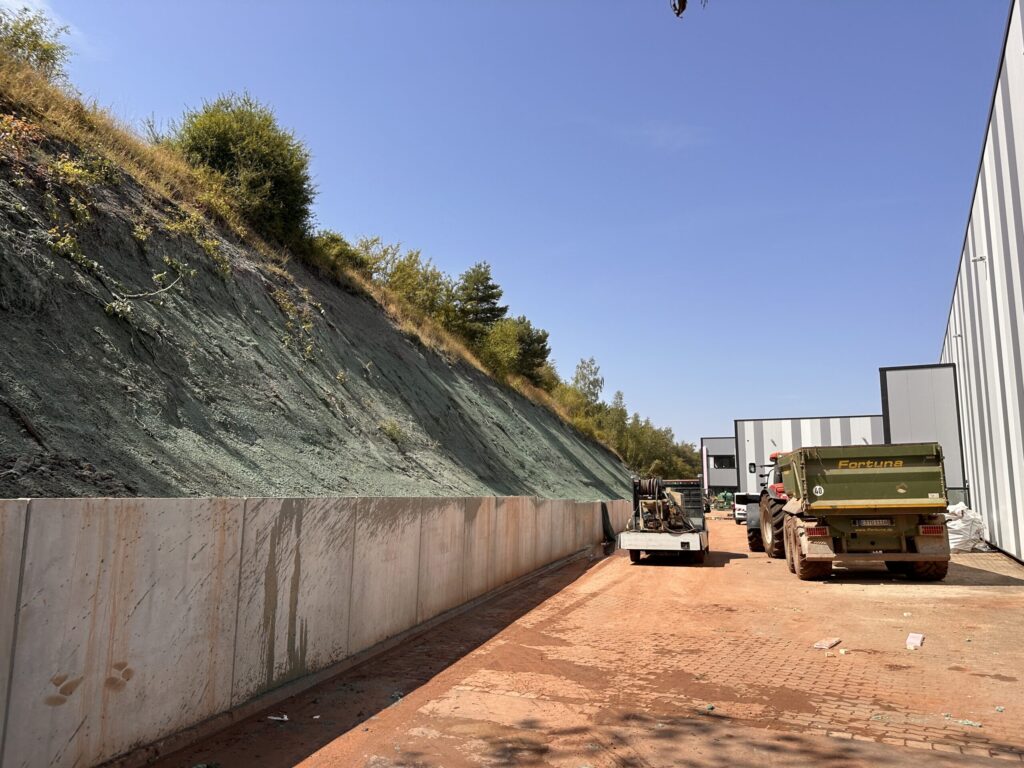
Hydroosev in the Czech Republic

In Czech practice, hydroosev is a widely established term for hydraulic seeding. Related terminology includes protierozní opatření for erosion-control measures and rekultivace, including rekultivace těžebních ploch, for the reclamation of mining land. Hydroosev describes one application method within a broader technical and regulatory rehabilitation process.

Relevant applications

Mine Rehabilitation

Engineered surface stabilization and vegetation establishment for waste rock, overburden and other disturbed post-mining substrates.

Application
Read more →
Guide to Mine Rehabilitation

How substrate assessment, stability, drainage, material systems and future land use combine in a post-mining rehabilitation strategy.

Engineering Guide
Read more →
Any questions?

A project, a partnership or a research collaboration — get in touch by phone or email.