Locations

Denmark

Hydroseeding, coastal surface stabilization and project-delivery capability for Danish site conditions.

SRBT delivery capability in Denmark

SRBT can mobilize environmental surface engineering projects in Denmark through an international partner and equipment-fleet network.

Delivery capability is assessed for each project according to the treatment area, substrate, terrain, required material system, equipment access, logistics and applicable regulation. A dedicated Denmark page describes technical capability and relevant project conditions; it does not imply a permanent office, local branch or continuous operational presence.

Projects may include dune and sand stabilization, temporary protection of exposed construction surfaces, difficult revegetation and erosion control. The appropriate solution is developed from site information and the intended outcome rather than selected from a standard product catalog.

Where surface problems arise in Denmark

Climate

Denmark's maritime climate exposes surfaces to recurring wind, rainfall and seasonal temperature changes. Coastal sites may experience particularly strong wind and salt exposure, while wet periods can create runoff and erosion before vegetation has established.

Dominant soils

Danish surface geology includes sandy coastal deposits and meltwater sands as well as clayey till, gravel and organic soils. Treatment design must therefore distinguish between rapidly draining sand, fine cohesive material and compacted construction substrates.

Vegetation zones

Relevant vegetation environments include coastal dunes, heathlands, grassland, agricultural landscapes and forest. Coastal revegetation must account for native plant communities, salt exposure, moving sand and the conservation requirements of protected dune habitats.

Water availability

Denmark has significant groundwater resources, but water availability for hydraulic application remains site-specific. Abstraction, transport distance, water quality, drainage and the protection of shallow or vulnerable groundwater must be considered during planning.

Regulation

Work near coastlines, protected habitats, groundwater resources or regulated industrial sites may require review by the relevant Danish authorities. Material selection and application must comply with project permits, environmental requirements and applicable EU chemical regulation.

Lead industries

Relevant project contexts include transport and civil infrastructure, construction, agriculture, renewable-energy development, utilities and mineral-material handling. Offshore-wind and coastal infrastructure can also create associated onshore requirements for temporary stabilization and rehabilitation.

Topography and terrain

Denmark is generally characterized by low relief, but dunes, coastal slopes, embankments, road and rail earthworks, stockpiles and graded construction surfaces create localized terrain challenges. Access and wind exposure may be more decisive than elevation.

Structural risks

Key surface risks include coastal erosion, wind-driven sand, rainfall erosion, localized flooding and the loss of exposed material during construction. Hydraulic treatments must complement—not replace—coastal nourishment, drainage or structural protection where those measures are required.

Hydroseeding in Denmark

Hydroseeding in Denmark begins with an assessment of substrate, wind exposure, salinity, drainage, slope, vegetation objective and the required duration of protection.

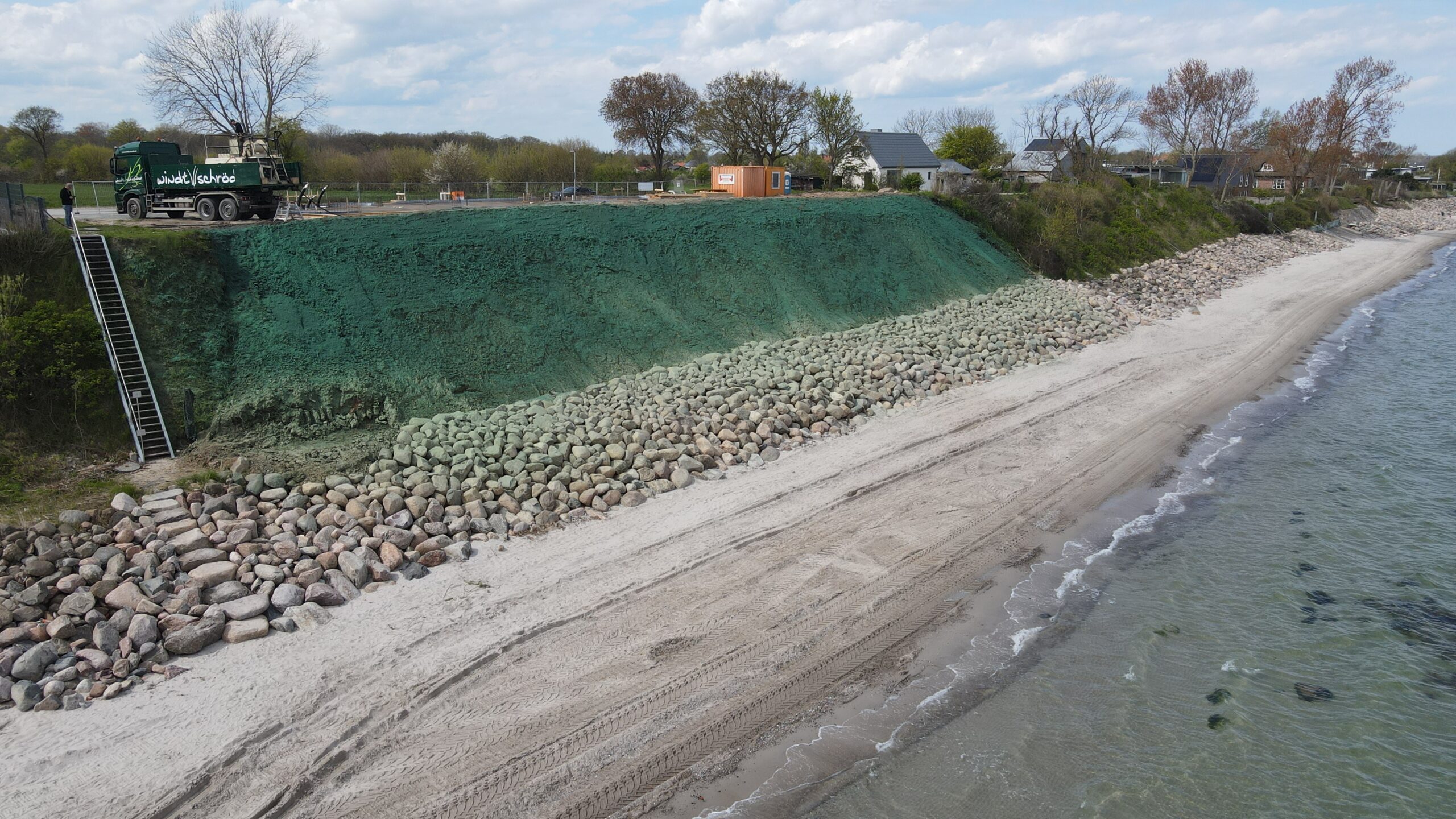
On coastal sand, seed application alone is unlikely to control an actively moving surface. The initial system may need to provide temporary cohesion while retaining seed, fibers and moisture until suitable vegetation can establish. Binding strength must remain compatible with infiltration, root development and natural dune processes. Stabilizing an entire dynamic dune system is not automatically the objective; treatment should be limited to areas where controlled surface protection is technically and environmentally appropriate.

Temporary construction surfaces require a different approach. Graded fills, stockpiles and exposed mineral materials may need short-term protection against wind and rainfall without compromising later excavation, grading or reuse.

The applied system may combine functional fibers, a hydraulic growth medium, moisture-management components, vegetation and a biopolymer-based binder. Material selection remains site-specific and must consider salinity, water quality, required service life and protected habitats.

Applicability depends on the properties and intended use of the individual formulation. Proprietary formulations remain project-specific.

Hydroseeding, erosionskontrol and jordforbedring

The international term hydroseeding is retained for Danish project communication. Depending on the application, related Danish search and project terminology may include erosionskontrol, jordforbedring and hydroseeding Danmark. These terms describe different functions and should not be treated as interchangeable methods.

Relevant applications

Dune Stabilization

Engineered temporary cohesion and vegetation establishment for exposed coastal sand.

Application
Read more →
Temporary Surface Protection

Interim erosion and wind protection for exposed fills, stockpiles and construction surfaces.

Application
Read more →
Any questions?

A project, a partnership or a research collaboration — get in touch by phone or email.