Locations

Hydroseeding in Bosnia and Herzegovina

Engineered revegetation for karst terrain, steep slopes and disturbed mining surfaces.

SRBT delivery capability in Bosnia and Herzegovina

SRBT can mobilize project-specific surface engineering systems for applications in Bosnia and Herzegovina. Delivery begins with an assessment of substrate continuity, slope geometry, drainage, karst features, water availability and the intended rehabilitation outcome. These parameters determine whether hydraulic application is appropriate and which material functions are required.

Projects may be implemented through qualified regional resources and SRBT's international partner and equipment-fleet network. This represents a delivery capability, not a claim of permanent local presence. Mobilization remains subject to technical feasibility, the applicable administrative and regulatory framework, project scale and the availability of suitable access, water and application infrastructure.

Where surface problems arise in Bosnia and Herzegovina

Climate

Bosnia and Herzegovina combines continental conditions in northern and central areas, mountain climates at higher elevations and Mediterranean influences in Herzegovina. Precipitation, temperature and establishment periods vary substantially with location and elevation. Dry conditions and wildfire exposure in the south contrast with intense rainfall, snow and freeze–thaw conditions in mountain regions.

Dominant soils

Soils are highly heterogeneous. In the Federation of Bosnia and Herzegovina, official planning documents classify approximately 90.85% of the land within the broad automorphic or terrestrial soil division. This category includes deep soils as well as shallow lithosols, rendzinas and terra rossa. The percentage must therefore not be interpreted as meaning that all these soils are shallow or equally difficult to revegetate.

Vegetation zones

Vegetation ranges from Mediterranean and sub-Mediterranean communities in southern Herzegovina to deciduous and mixed forest, mountain grassland and higher-altitude vegetation. Species selection must reflect elevation, exposure, available rooting depth and intended land use. Standard amenity mixtures are generally unsuitable for karst restoration or complex mine-rehabilitation projects.

Water availability

Major river systems provide substantial regional water resources, but karst hydrology complicates local availability and flow prediction. Rainfall may infiltrate rapidly through fractured limestone, leaving limited surface moisture. Underground pathways can extend beyond visible catchments. Water sourcing, process-water quality and possible connections to groundwater must therefore be assessed for each site.

Regulation

The regulatory framework is distributed across the Federation of Bosnia and Herzegovina, Republika Srpska and Brčko District, with additional responsibilities at cantonal and local levels. Mining, water, environmental and construction requirements therefore depend on the project location. Hydroseeding does not replace rehabilitation plans, environmental approvals, water permits or geotechnical verification.

Lead industries

Mining, mineral processing, energy production, quarrying and transport infrastructure create relevant rehabilitation requirements. Waste-rock slopes, disturbed industrial land, road cuts and construction fills may require biological establishment after technical preparation. Flood-recovery and river-basin infrastructure add surfaces where erosion protection must be coordinated with drainage and structural flood-management measures.

Topography and terrain

Mountain and karst landscapes dominate large areas. Within the Federation of Bosnia and Herzegovina, approximately 22.9% of the territory falls within a 17–24% gradient class described by the source as "very steep," with pronounced erosion processes. This is a Federation-specific classification and should not be generalized automatically to the entire country or an individual project.

Structural risks

Steep terrain can combine surface erosion with landslides, rockfall and debris movement. Karst adds cavities, sink features and discontinuous rooting substrates. Wildfire can remove vegetation and expose shallow soils before heavy rainfall. Hydroseeding can protect a stable, adequately prepared surface, but it cannot secure unstable rock, arrest a landslide or bridge an unsupported karst void.

Hydroseeding in Bosnia and Herzegovina

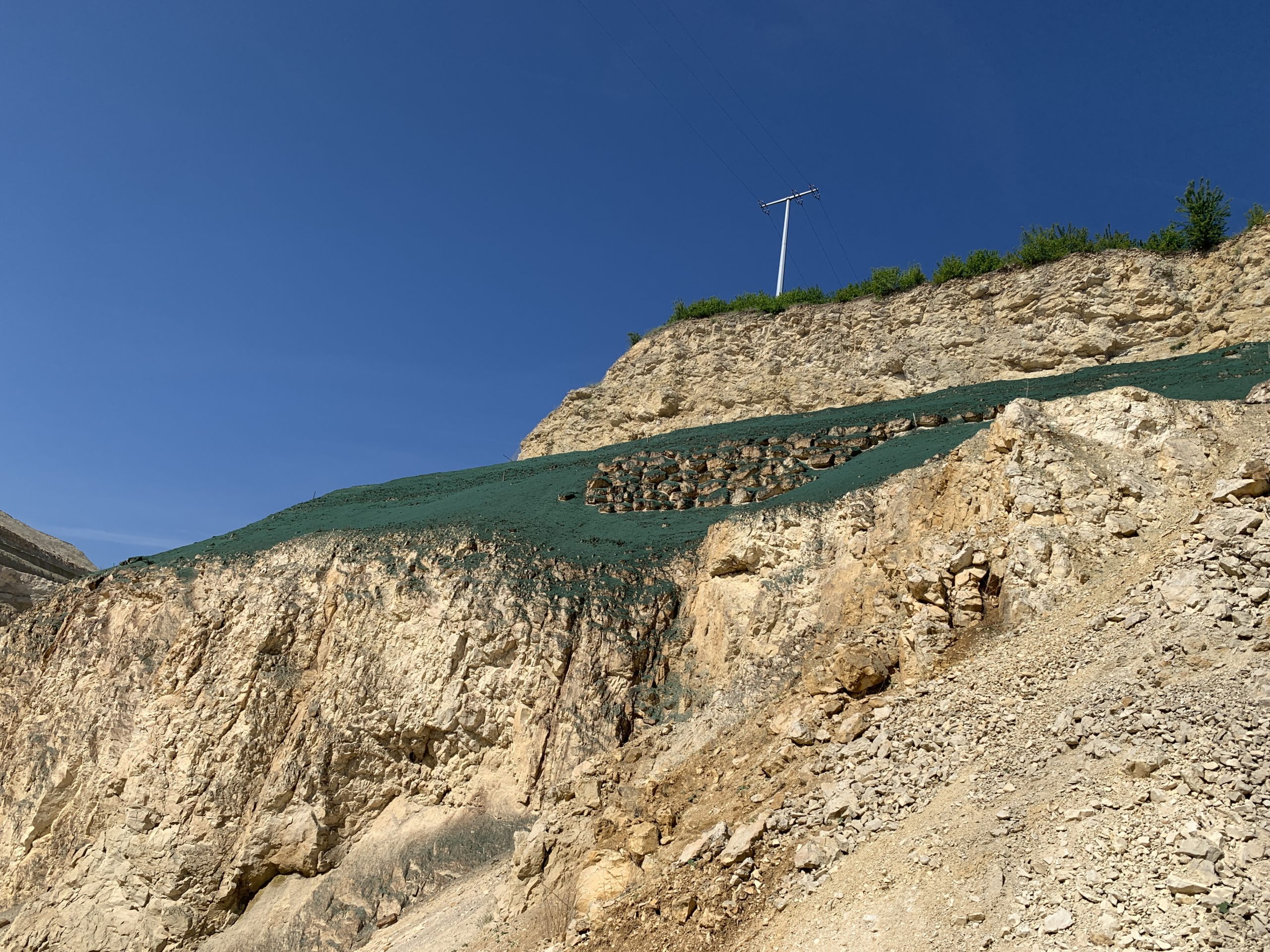
Hydroseeding in Bosnia and Herzegovina should begin by determining whether the surface provides sufficient stable rooting material. On karst terrain, exposed limestone and isolated soil pockets cannot be treated as one uniform substrate. Hydraulic application can distribute seed and functional materials across prepared areas, but it cannot create a continuous soil profile where suitable rooting material is absent.

Where adequate substrate exists, the engineered system may combine selected fibers, a biologically based binder, growth-medium components, moisture-management functions and vegetation adapted to the site. Material persistence must correspond to the expected erosion window and establishment period. Rapid infiltration and possible connections to karst groundwater must also be considered.

Mining applications require a defined sequence. Technical rehabilitation—including regrading, drainage, containment and geotechnical stabilization—must precede biological establishment where required. Hydroseeding can support the revegetation phase but cannot stabilize an unsafe dump, remediate contaminated waste or replace statutory mine-rehabilitation planning.

Steep-slope delivery additionally depends on equipment access, pumping height, hose distance and safe positioning. Applicable environmental and material requirements must be assessed for the relevant jurisdiction, and proprietary formulations remain project-specific.

Regional terminology

The term hidrosjetva is understood in regional technical usage, including water-management and erosion-control contexts. Available evidence is not sufficient to present it as a uniquely Bosnian, broadly established commercial term. Related functional terminology includes zaštita od erozije for erosion protection and rekultivacija for rehabilitation or reclamation.

Relevant applications

Difficult Revegetation

Vegetation establishment on thin, rocky, discontinuous or otherwise unfavorable substrates.

Application
Read more →
Mine Rehabilitation

Engineered vegetation establishment on waste rock, disturbed mining land and other hostile mineral substrates.

Application
Read more →
Guide to Slope Stabilization

How structural slope engineering, surface erosion control and vegetation establishment perform different but coordinated functions.

Engineering Guide
Read more →
Any questions?

A project, a partnership or a research collaboration — get in touch by phone or email.