Engineering Insight

Water Retention in Hydraulic Growth Media

How fibers, superabsorbent polymers and emerging biobased hydrogels manage water—and why absorption capacity alone does not determine plant availability

Water retention is frequently reduced to a single product value: how many grams of water a material can absorb per gram of dry matter. For hydraulic growth media, this figure is insufficient.

A material may absorb large quantities of water under laboratory conditions yet perform very differently in soil, saline water, a fiber slurry or an exposed slope. Water must not only enter the material; it must remain near the seed and root zone, be released at a usable suction level and avoid disrupting aeration, surface stability or application behavior.

Effective water retention therefore depends on the complete system: substrate, fiber structure, absorbent material, particle size, water chemistry, application method, climate and vegetation objective.
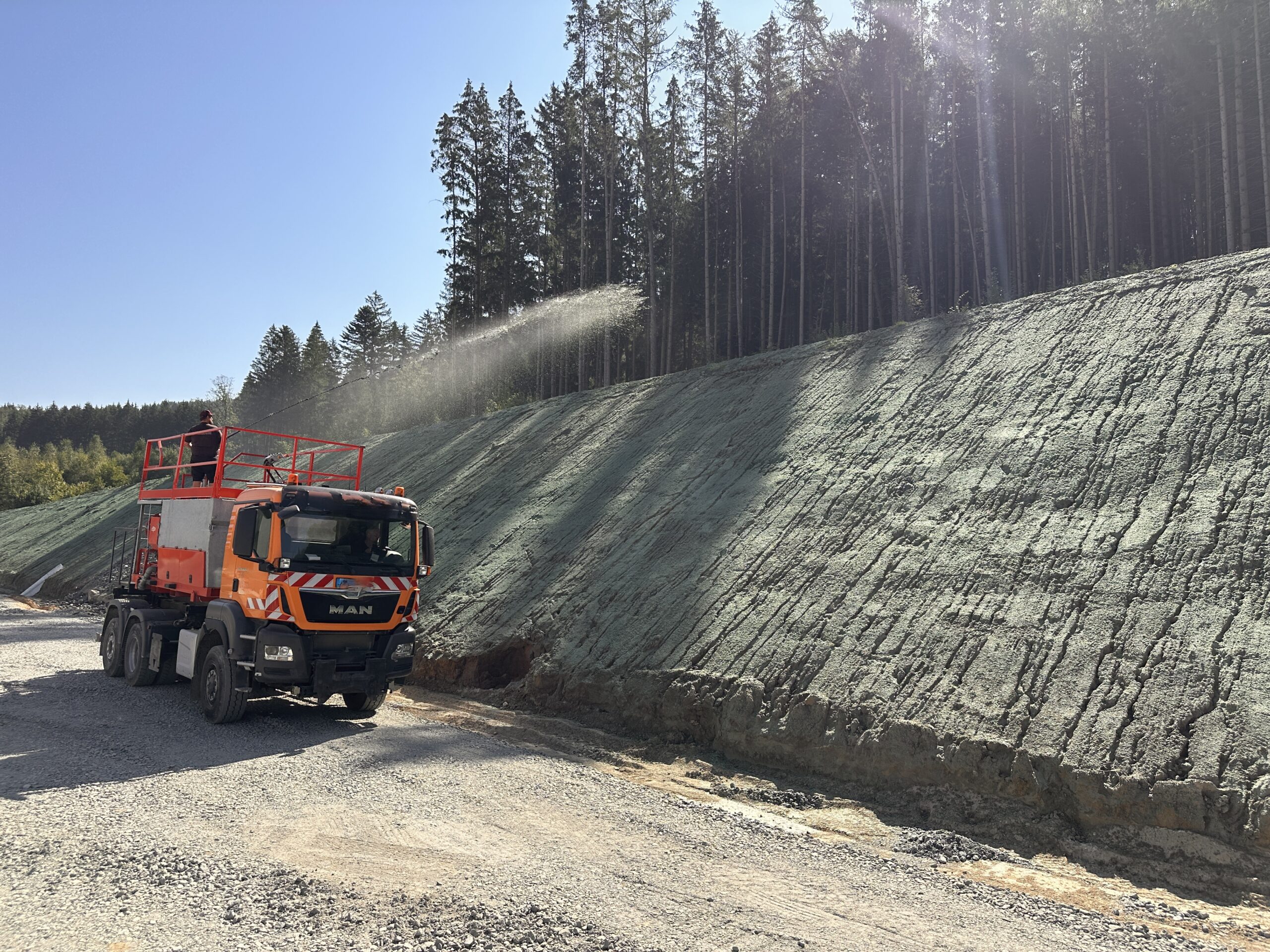
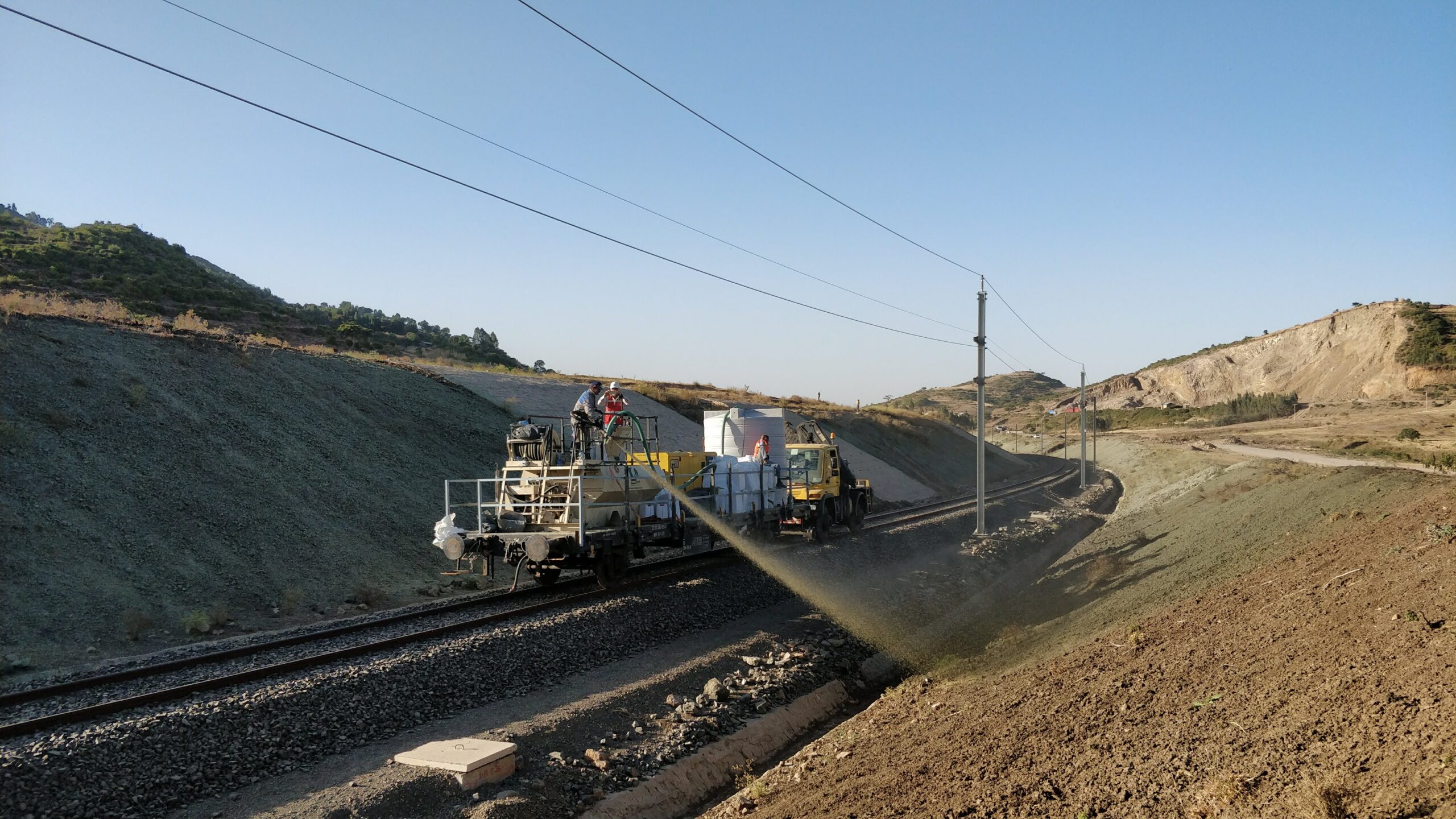
Railway track revegetation by hydroseeding

Technical guide

Three mechanisms of water retention

Hydraulic growth media can retain water through three main mechanisms:

These mechanisms are not interchangeable. Each influences water availability, slurry behavior and functional service life differently.

Fiber structure: mechanical retention near the surface

Fiber-based growth media retain water through capillary spaces, surface adhesion and the internal pore structure of the applied matrix.

Longer wood fibers can form a three-dimensional framework that:

Cellulose fibers generally provide rapid wetting and broad initial coverage. Longer wood fibers can create greater structural depth and stronger mechanical interlocking. Blended systems may combine these functions.

Fiber retention is finite. Once the available pore space has drained or dried, the matrix cannot generate additional water. Its effectiveness depends on fiber quality, installed dry mass, matrix thickness, surface contact, slope exposure and the interval between rainfall or irrigation events.

A fiber-rich system may therefore improve the establishment environment without replacing the need for realistic water budgeting.

Superabsorbent polymers: high capacity with system-dependent availability

Conventional superabsorbent polymers, or SAPs, are cross-linked hydrophilic materials that swell when exposed to water. Potassium polyacrylate and related acrylate-based products are widely used examples.

The swelling network can store water that would otherwise drain beyond the shallow root zone. As the surrounding soil dries, part of this water may be released back into the pore system.

Research confirms that SAPs can improve soil water retention and, under suitable conditions, crop performance and water productivity. A global meta-analysis covering more than 1,500 paired observations nevertheless found that results varied with the SAP, soil, crop and experimental conditions. SAP should therefore be treated as a functional component requiring site-specific selection—not as a universal drought solution.

Gel formation is both the function and the limitation

The formation of a hydrated gel is what gives a superabsorbent polymer its storage capacity. The same process can create operational and soil-physical limitations when the product, dosage or placement is unsuitable.

As SAP particles swell, they occupy pore space and alter the local relationship between solids, water and air. At an appropriate concentration this may increase plant-available water and reduce deep drainage. At excessive or highly localized concentrations, swelling can interfere with root-to-soil contact, modify infiltration pathways and temporarily reduce air-filled pore space.

This does not mean that SAP inherently causes poor aeration. The effect depends on:

In hydraulic application, an additional question arises: when does the material swell? A SAP that absorbs a substantial part of the carrier water inside the machine can increase slurry viscosity, change the spray pattern and reduce the water available for pumping and initial surface wetting.

Tank residence time, mixing energy, pump configuration and the order of material addition therefore affect both application performance and later water retention.

Stored water is not automatically plant-available water

Total absorption and plant-available water are different measurements.

A swollen polymer can retain a large volume of water, but vegetation can use only the fraction released within the suction range accessible to the roots. Some water may remain too strongly held within the gel as the surrounding substrate dries.

Particle size is particularly relevant. Research with sandy soil and guava seedlings found that hydrogel particle size affected water release and plant availability. Larger particles may hold considerable water internally while presenting less contact area to the surrounding dry soil. Smaller particles generally provide more distributed contact, although they can also change slurry viscosity and application behavior more strongly.

The correct question is therefore not:

"How much water can the product absorb?"

It is:

"How much of that water remains accessible to the target vegetation under the expected soil-water tension, salinity and drying cycle?"

Salinity changes swelling performance

Laboratory absorption values are often measured in deionized water. Field water contains dissolved salts, while mine substrates, coastal soils and arid-region materials may have elevated electrical conductivity.

Dissolved ions reduce the osmotic forces responsible for swelling. Multivalent ions such as calcium and magnesium can have a particularly strong effect on some polymer networks. A SAP that performs well in purified water may consequently store far less water in saline irrigation water or mineral-rich slurry.

Water-retention materials intended for coastal, mining or MENA applications must therefore be assessed using representative water and substrate chemistry. Deionized-water absorption values alone are not a sufficient design basis.

Dosage requires an optimum, not a maximum

Increasing the amount of SAP will generally increase total water storage only up to a practically useful range. Beyond that range, the system may become more expensive, more difficult to apply and less balanced physically.

Under severe drying, a highly absorbent amendment may also increase both field capacity and the amount of water remaining at the permanent-wilting range. Research on sandy soils has identified potential competition between plants and SAP for the final fraction of retained water under severe dry conditions. This is another reason to evaluate plant-available water rather than total retained water alone.

Overdosing should not be described simplistically as the polymer "drying the soil." The more accurate explanation is that additional retained water is not necessarily released within the range available to the plant.

Environmental persistence of synthetic SAPs

Synthetic acrylate-based SAPs are not one uniform material class. Their environmental behavior depends on polymer backbone, cross-linking, residual monomers, additives and degradation conditions.

Weathering, oxidation and mechanical stress can reduce polymer molecular weight over time. This does not necessarily mean rapid or complete biodegradation. Research on synthetic water-soluble polymers indicates that some materials undergo slow backbone degradation while mineralization remains limited.

Cross-linked particles and soluble degradation fractions also behave differently in soil. Their environmental fate should therefore be assessed through appropriate product documentation rather than inferred from the disappearance of visible gel particles.

This issue must not automatically be equated with conventional particulate microplastics or with every material falling under REACH Entry 78. The applicable regulatory status depends on the product's physical form, polymer characteristics, intended use and relevant jurisdiction.

Emerging biobased hydrogel systems

Current research is developing water-retention systems based partly or predominantly on renewable polymers. Relevant material families include:

Cellulose nanofibers are particularly interesting because they can combine water absorption with soil-particle binding. A 2024 study found that CNF amendments increased water-retention duration and improved aggregate stability in sandy and paddy soils. The result demonstrates technical potential, but it does not establish a universal application rate or field performance for hydraulic revegetation.

Chitosan and cellulose derivatives can be combined into porous hydrogel networks. Recent research on a chitosan–carboxymethyl-cellulose–silk-fibroin hydrogel reported improved water retention and early wheat growth in saline-alkali soil. The work is promising, but it remains a defined experimental system rather than proof of general field readiness across climates and application equipment.

Research has also evaluated whey–cellulose hydrogels as a way to combine water retention with the productive use of dairy-industry byproducts. These developments illustrate the range of potential raw materials, but their scalability, storage stability, biological behavior and compatibility with hydraulic application still require individual validation.

Biobased does not automatically mean biodegradable

A material may contain cellulose, starch, whey or another biological raw material while still incorporating a persistent synthetic polymer backbone or synthetic cross-linking system.

Three separate questions must therefore be asked:

Biodegradation values from activated sludge, laboratory soil burial or controlled composting cannot be transferred automatically to an exposed slope. Temperature, moisture, microorganisms, oxygen, pH and salinity can change degradation rates substantially.

A material that degrades quickly may reduce persistence concerns but fail to provide the required functional duration. Conversely, a persistent system may retain water longer while creating a less favorable environmental profile.

The design target is controlled service life—not simply the highest absorption value or the fastest degradation claim.

Compatibility with hydraulic application

A material suitable for incorporation into agricultural soil is not automatically suitable for a hydroseeder.

Hydraulic growth media require the water-retention component to remain compatible with:

Premature swelling can produce viscosity peaks, agglomeration or uneven distribution. Fine absorbent particles may disperse readily but hydrate too early. Coarser particles may remain pumpable longer yet distribute less uniformly or provide weaker contact with the final root zone.

The application system and the material system must therefore be developed together.

Comparing the three retention mechanisms

System comparison

MechanismPrimary functionMain advantageMain limitationSelection question
Fiber matrixMechanical retention within a porous surface layerImmediate protection and moisture moderationFinite storage and exposure-dependent dryingDoes the installed matrix provide sufficient depth and surface contact?
Synthetic SAPReversible gel-based water storageHigh potential absorption at low material massPerformance varies with particle size, dosage, salinity and water tensionHow much retained water is actually plant-available?
Biobased hydrogelWater storage through renewable polymer networksPotential combination of retention and improved environmental fateMany systems remain at laboratory or pilot stageIs the finished material field-ready and compatible with hydraulic equipment?
Hybrid systemCombines fiber structure with an absorbent componentMultiple retention mechanisms in one matrixMore interactions must be validatedDoes the combined system remain pumpable, stable and biologically suitable?

A practical selection sequence

  1. 1. Characterize the substrate

    Determine texture, organic matter, pH, salinity, compaction, infiltration and existing water-holding capacity.

  2. 2. Define the vegetation objective

    Establish species, germination requirements, rooting depth, establishment period and acceptable reliance on irrigation.

  3. 3. Assess the water source

    Test or confirm salinity, hardness, pH and other parameters that may influence swelling or slurry behavior.

  4. 4. Model the drying cycle

    Consider rainfall distribution, irrigation intervals, temperature, wind, slope exposure and evaporation—not only annual precipitation.

  5. 5. Select the primary retention mechanism

    Decide whether fiber structure alone is sufficient or whether an absorbent component provides a meaningful additional function.

  6. 6. Evaluate plant availability

    Use relevant soil-water data rather than relying solely on free-swelling capacity measured in purified water.

  7. 7. Verify equipment compatibility

    Confirm mixing behavior, tank residence time, pumpability, hose transport and spray pattern under representative conditions.

  8. 8. Assess service life and environmental fate

    Match persistence and degradation behavior to the required establishment period and applicable regulatory framework.

  9. 9. Validate under representative conditions

    Laboratory screening can eliminate unsuitable combinations. A controlled field trial remains more reliable than transferring results from another substrate, climate or formulation.

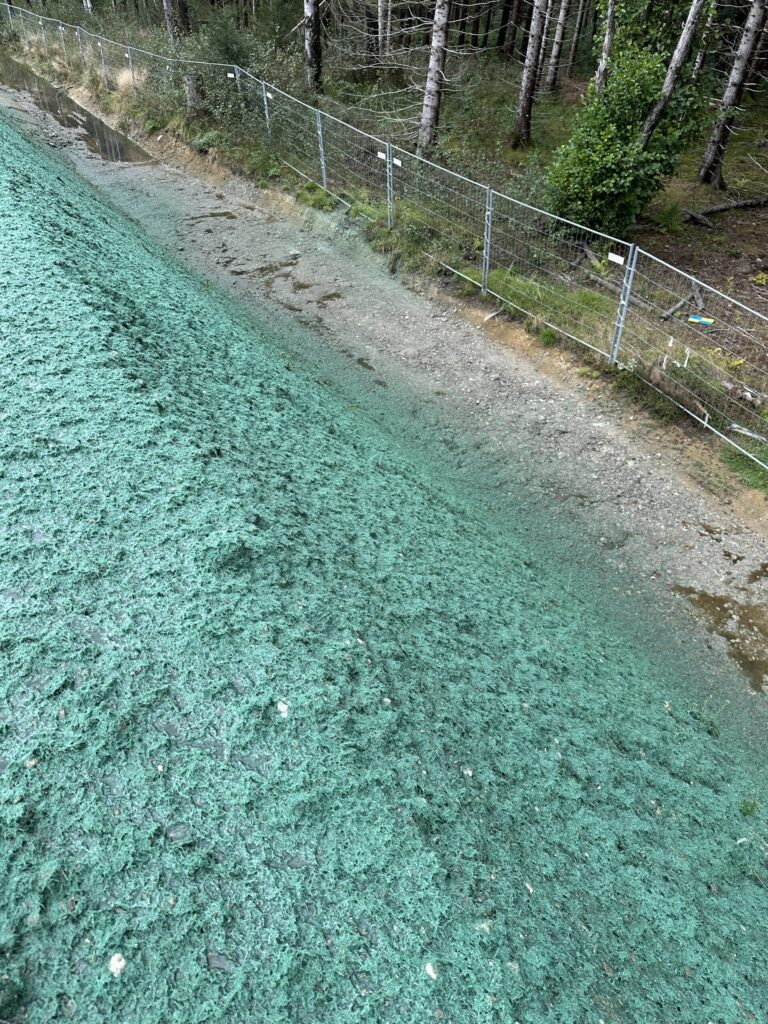
Slope revegetation by hydraulically applied seeding

The SRBT approach

SRBT treats water retention as a system function, not a product claim.

The design process considers substrate texture, water chemistry, climatic exposure, vegetation objective, fiber structure, absorbent behavior, tackifier and binder functions, application equipment and the required establishment period.

Conventional SAPs may remain appropriate where their water-release behavior, environmental profile and equipment compatibility are understood. Fiber-based retention may be sufficient where immediate surface moderation is more important than high storage capacity. Emerging biopolymer systems may offer future advantages, but research-stage performance is not presented as established field practice.

Proprietary formulations remain project-specific.

The objective is not to maximize the amount of water held inside the material. It is to retain the right amount of water, in the right part of the applied system, for release at the time and suction level required by the vegetation.

Related application

Railway track revegetation by hydroseeding
Difficult Revegetation

Application
Read more →
Railway track revegetation by hydroseeding
Drought-resilient revegetation without irrigation

Case Study
Read more →
Protective mulch layer for hydraulically applied erosion control
Nature-based binders vs. synthetic polymers

Engineering Insight
Read more →
Any questions?

A project, a partnership or a research collaboration — get in touch by phone or email.