Locations

Hydroseeding in Azerbaijan

Engineered surface stabilization for remediated industrial land, saline soils and dust-exposed sites.

SRBT delivery capability in Azerbaijan

SRBT can mobilize project-specific hydroseeding, surface-stabilization and dust-control systems for projects in Azerbaijan. Delivery begins with an assessment of contamination status, substrate chemistry, salinity, compaction, erosion exposure, water availability and the intended future use of the site.

Equipment, application capacity and technical support can be coordinated through an international partner and equipment-fleet network. The appropriate delivery model depends on technical feasibility, project scale, import requirements, access, water logistics and regulatory approval.

This describes international project capability, not a permanent local presence. A material system or mobilization route is proposed only after the site conditions and approved remediation status have been clarified.

Where surface problems arise in Azerbaijan

Climate

The Caspian lowlands and the Absheron Peninsula have predominantly dry and semi-arid conditions, with low precipitation, high evaporation and frequent wind exposure. Conditions become cooler and wetter toward the Greater and Lesser Caucasus. This climatic range creates different surface-management requirements: lowland projects must account for moisture limitation, salinity and wind erosion, while mountain and foothill sites may face concentrated runoff and short establishment windows.

Dominant soils

Substrates include gray and gray-brown steppe soils, saline lowland soils, alluvial agricultural soils and shallow mountain soils. Industrial areas add oil-affected soil, drilling residues, compacted fills and processed mineral material. A publication of Azerbaijan's Presidential Administration reports that, of the Absheron Peninsula's 222,000 hectares, 33,300 hectares were unused and approximately 10,000 hectares affected by oil pollution. Recorded contamination levels ranged from about 12% to 30–40%, with substantial local variation. These figures describe a documented regional problem, not the condition of every project site.

Vegetation zones

Semi-desert and dry-steppe vegetation dominate extensive lowland areas, while riparian vegetation, agricultural landscapes, mountain grasslands and forests occur under different elevation and moisture conditions. Vegetation design must reflect the intended land use, substrate condition and available water. A uniform amenity seed mixture is generally unsuitable for saline, remediated or industrial surfaces.

Water availability

Water availability is limited on the Absheron Peninsula and in other semi-arid areas, while agriculture creates substantial demand in the Kura-Araz Lowland. A hydraulic application therefore requires a verified water source, suitable quality, storage and refill logistics. Saline or contaminated water can interfere with plant establishment and material performance. Hydroseeding reduces installation constraints but does not eliminate the need for a realistic establishment-water strategy.

Regulation

Industrial rehabilitation and surface treatment may involve the Ministry of Ecology and Natural Resources as well as authorities responsible for land use, water, construction, oil and gas operations, waste and environmental assessment. Hydroseeding should be specified only within an approved remediation or site-management concept. Regulatory acceptance of the underlying remediation, cover system and future land use must precede biological treatment.

Lead industries

Oil and gas extraction, refining and associated industrial activity are central to the surface-management context, particularly around Absheron. Agriculture in the Kura-Araz Lowland adds challenges related to salinity, irrigation and soil degradation. Construction, logistics, quarrying and energy projects can create additional compacted fills, exposed mineral surfaces, haul routes and temporary storage areas requiring coordinated dust, erosion and cover management.

Topography and terrain

Azerbaijan ranges from the Caspian coastal lowlands and the broad Kura-Araz basin to foothills and high mountain terrain. Flat and gently sloping industrial sites can be highly exposed to wind, while steeper terrain creates runoff and access constraints. Long hose distances, elevation differences, restricted equipment positioning and the availability of process water must be considered during application planning.

Structural risks

Relevant risks include wind erosion, dust emissions, salinization, loss of soil structure, surface runoff and the movement of contaminated fine material. On rehabilitated industrial sites, erosion can damage the clean cover layer and expose underlying material. The performance of a cap also depends on drainage, settlement resistance and root compatibility. Surface treatment cannot correct defects in the engineered containment system.

Hydroseeding in Azerbaijan

Hydroseeding in Azerbaijan can support the final surface-management phase after contamination has been characterized and the required technical remediation has been completed. On oil-affected land, this may involve excavation, treatment, containment, capping or other measures specified by the approved remediation design. Hydroseeding does not remove, neutralize or encapsulate contamination.

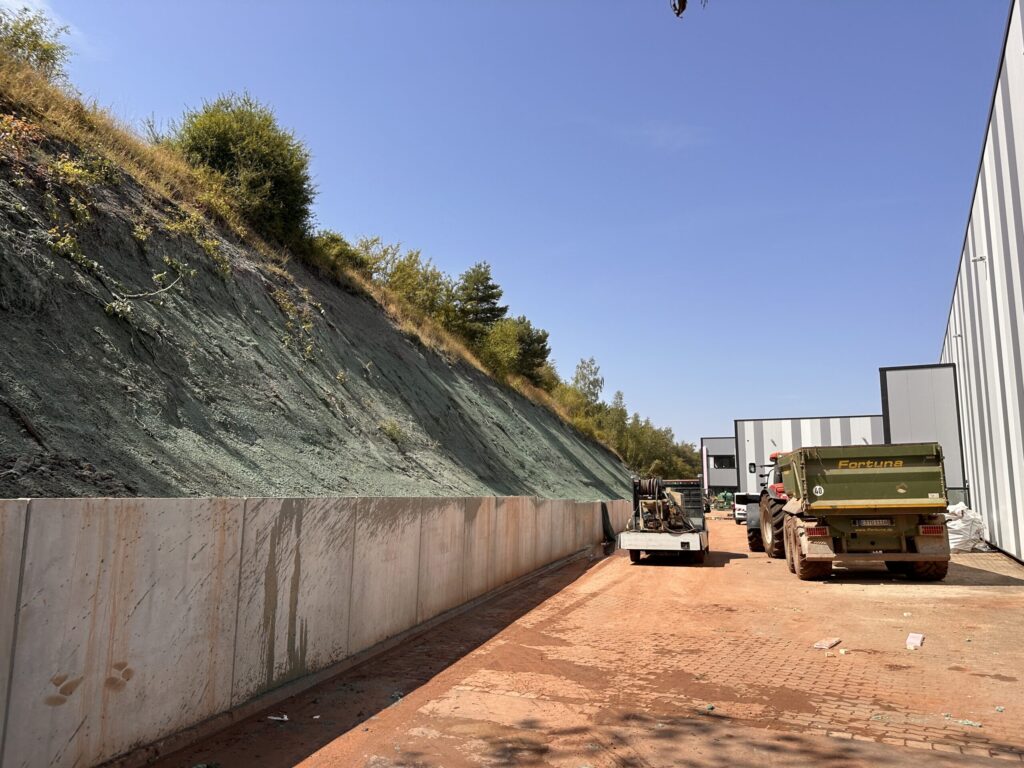
Where a clean, technically suitable cover layer is available, the hydraulic system may combine fibers, biologically based binders, growth-supporting components, moisture-management functions and vegetation selected for salinity, heat and restricted water availability. The applied matrix can protect the cover against wind and water erosion during the period before vegetation develops effective surface protection.

On non-vegetated operational areas, a separate surface-binding system may be designed for dust control. Dust suppression and revegetation should not be treated as the same specification: they have different requirements for infiltration, durability, traffic resistance and biological compatibility.

If an engineered cap is present, rooting depth and species selection must remain compatible with its containment function. Settlement, drainage, contaminated runoff and geotechnical stability require separate engineering. Proprietary formulations remain project-specific.

Terminology

No Azerbaijani-language expression is presented as a confirmed locally established commercial term for hydroseeding. The international term hydroseeding is retained. Functional descriptions such as industrial land rehabilitation, erosion control and dust suppression define the project objective more accurately than an unverified translation.

Relevant applications

Industrial Surface Management

Coordinating dust control, erosion protection, drainage and vegetation cover across complex industrial sites.

Application
Read more →
Dust Control

Reducing wind-driven and operational dust through project-specific surface binding and application planning.

Application
Read more →
Managing dust, erosion and cover on one site

Why industrial surfaces require coordinated management of several functions instead of unrelated individual treatments.

Engineering Insight
Read more →
Any questions?

A project, a partnership or a research collaboration — get in touch by phone or email.