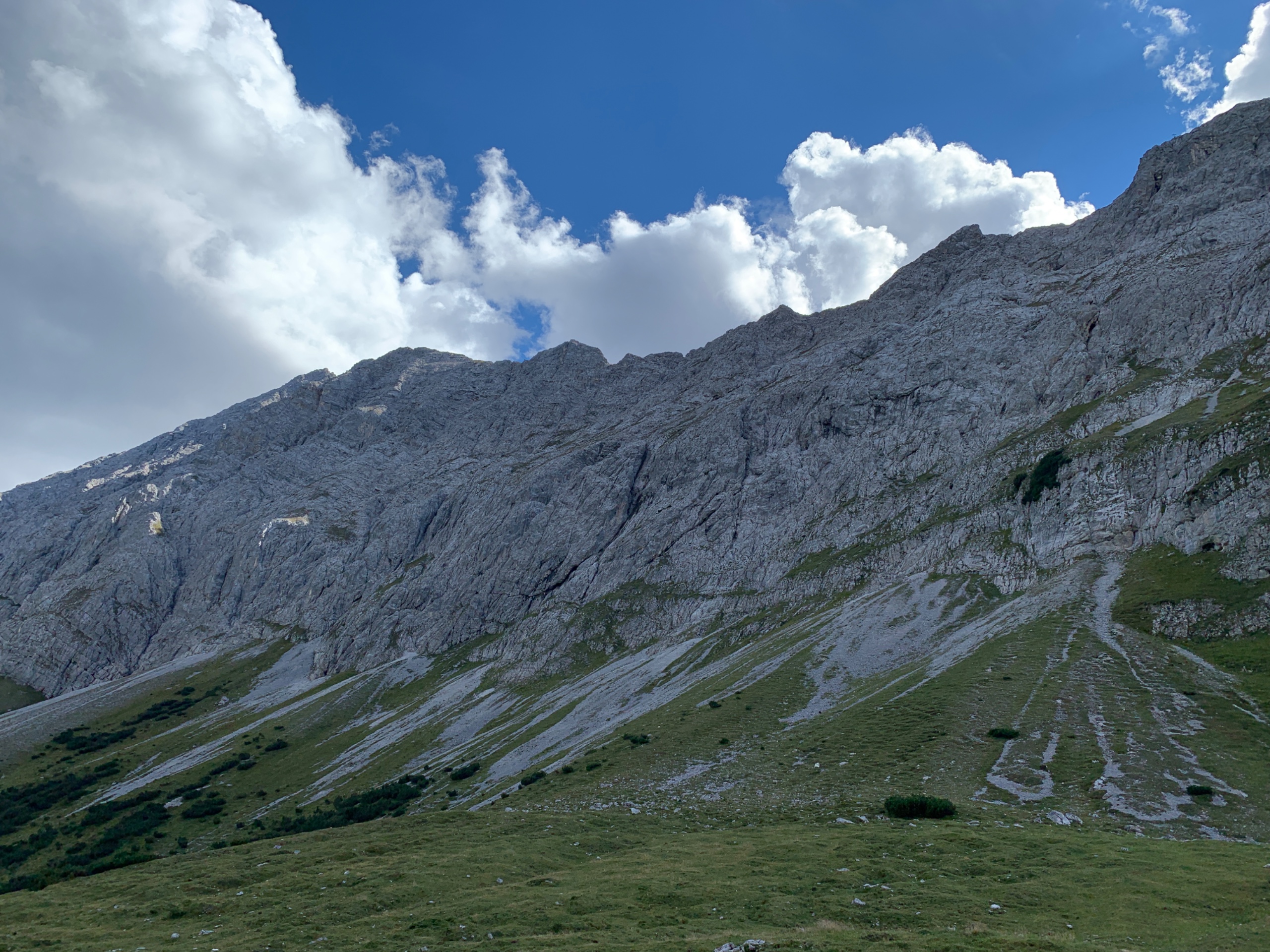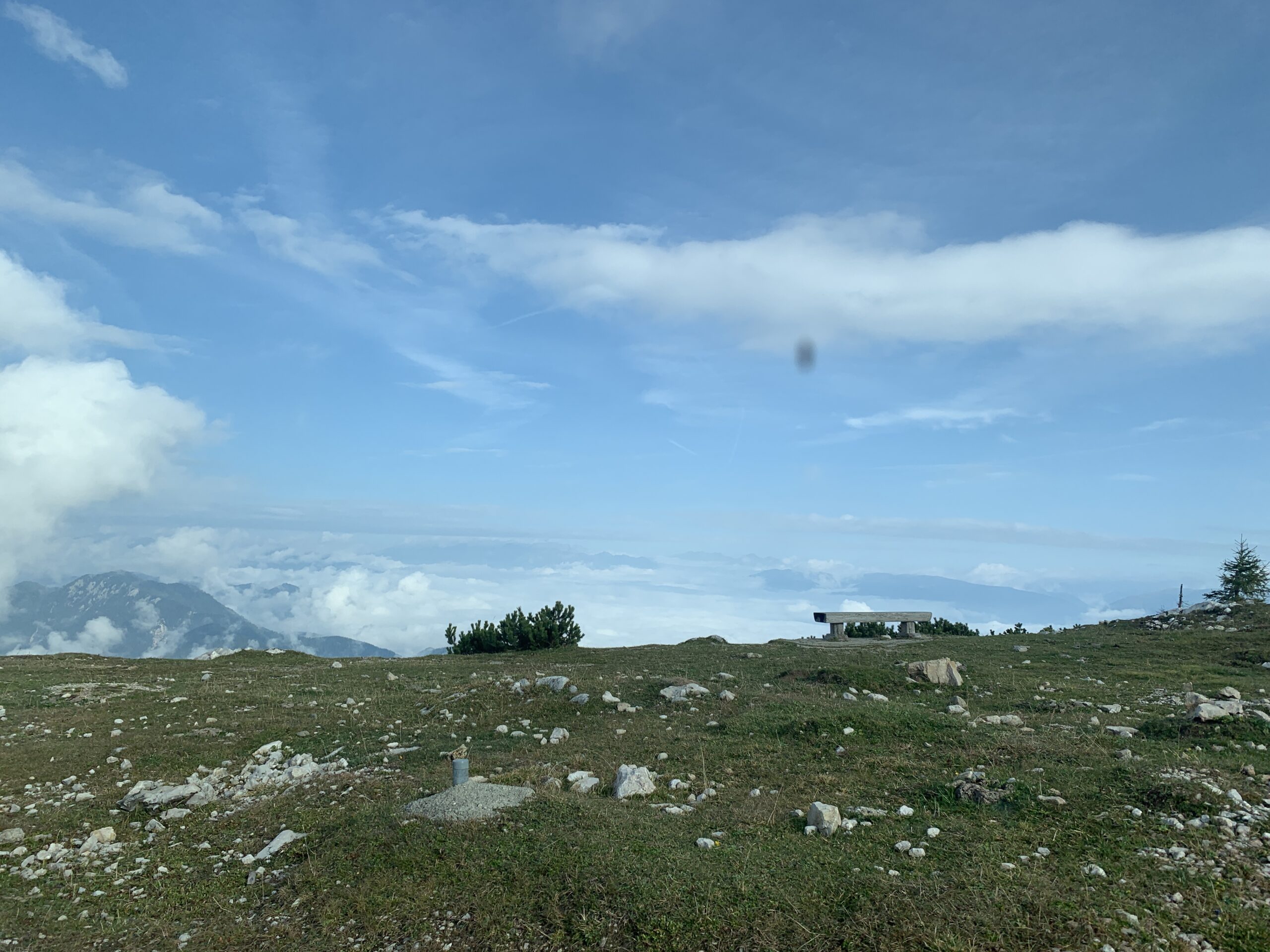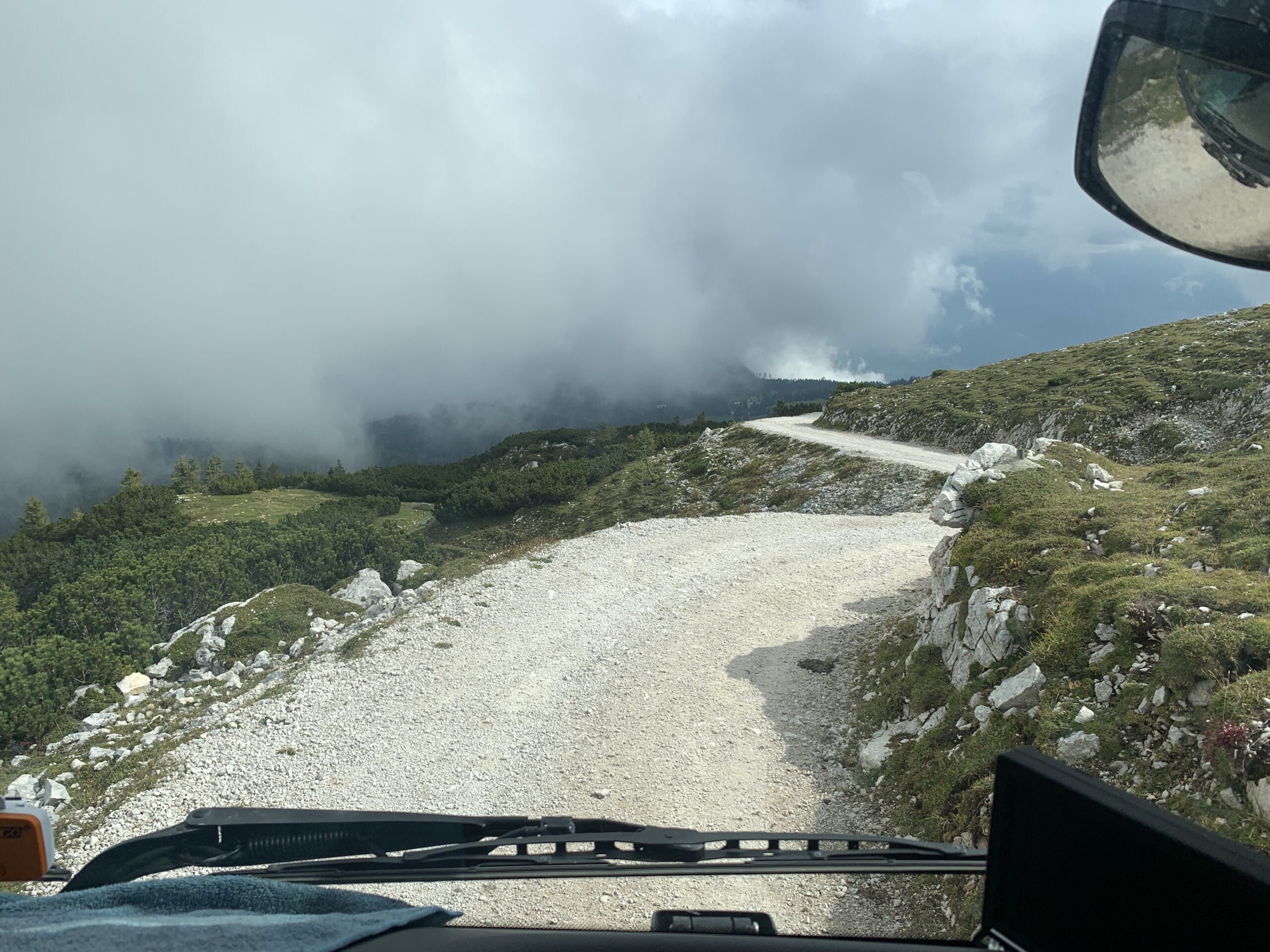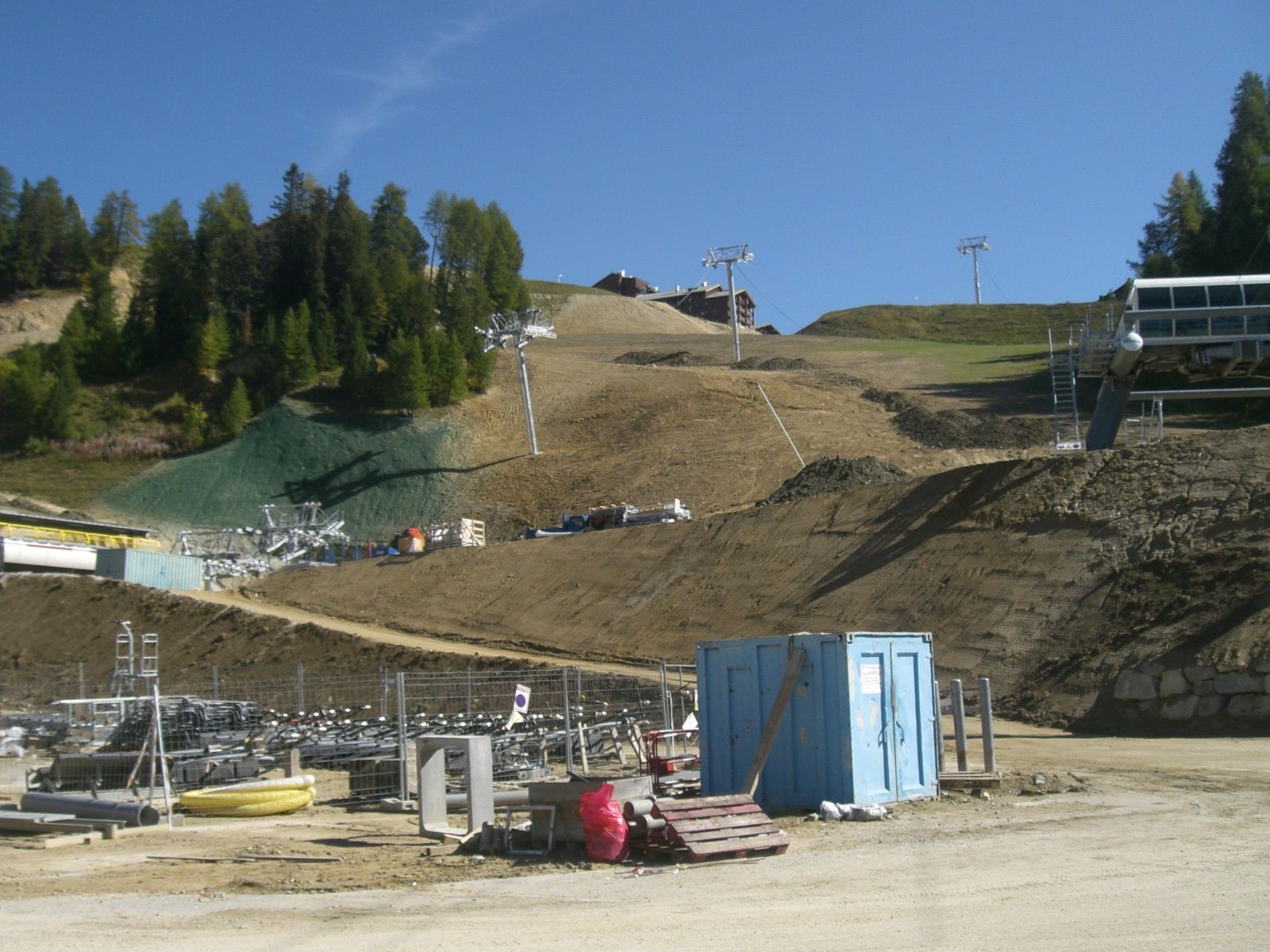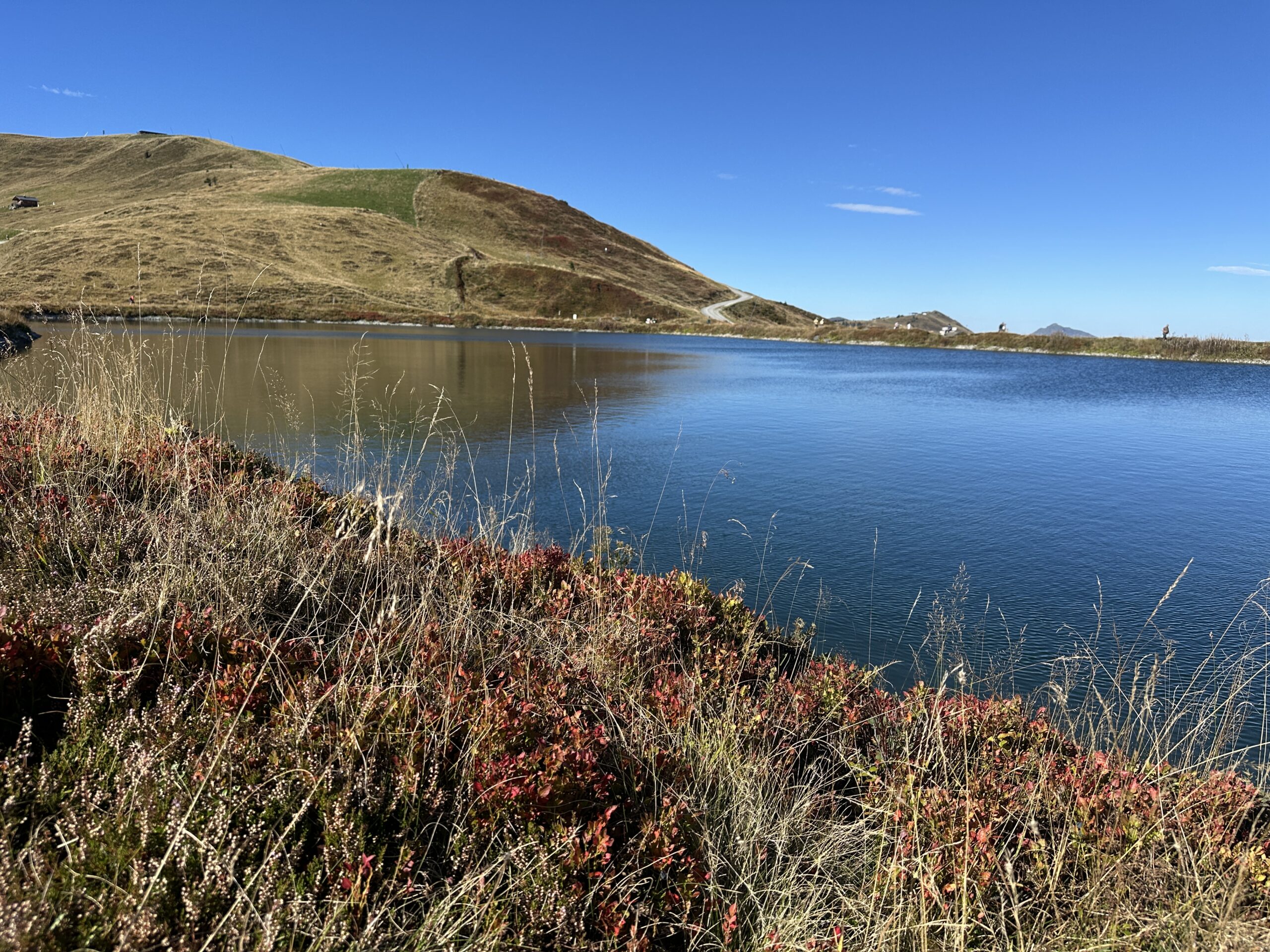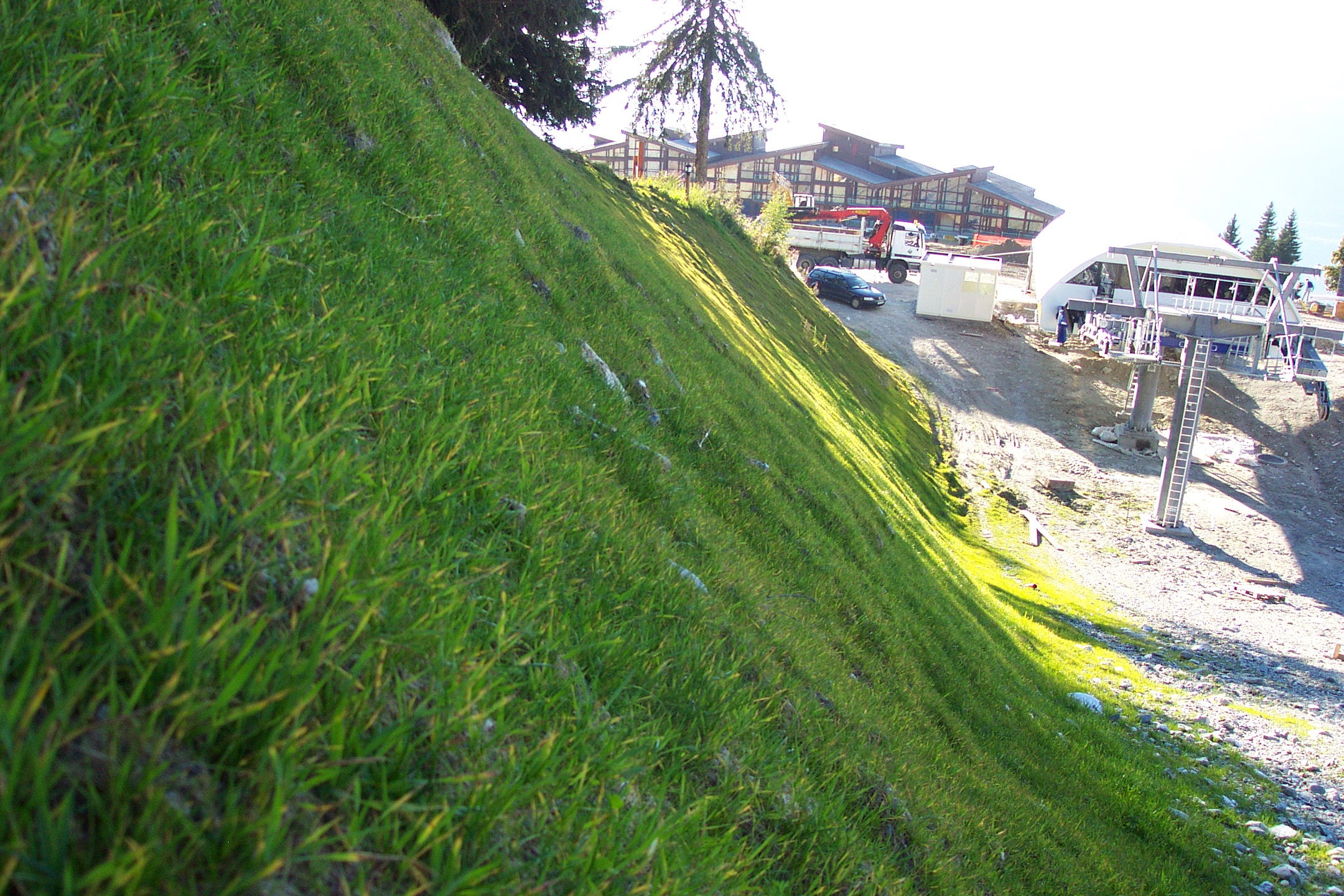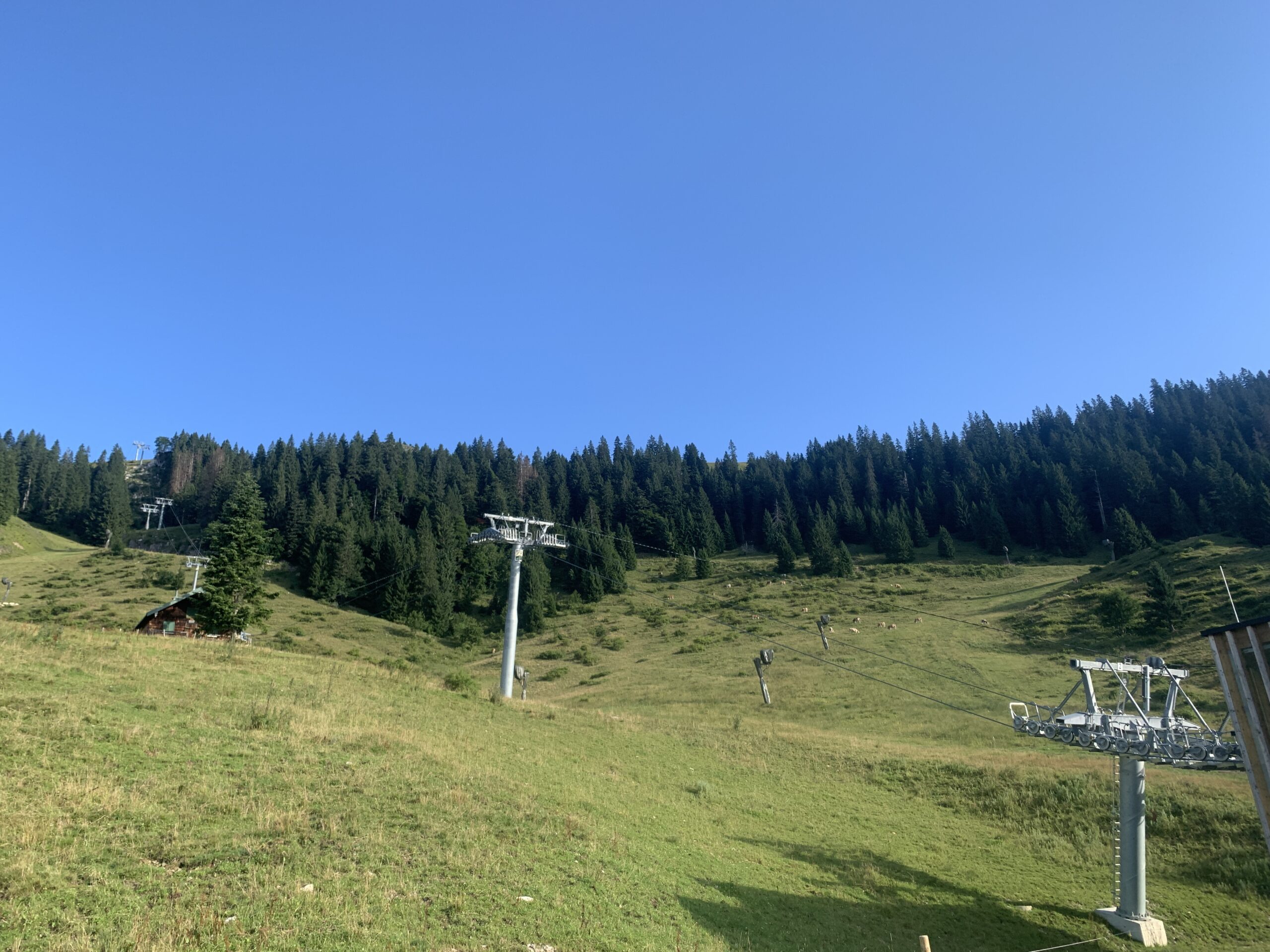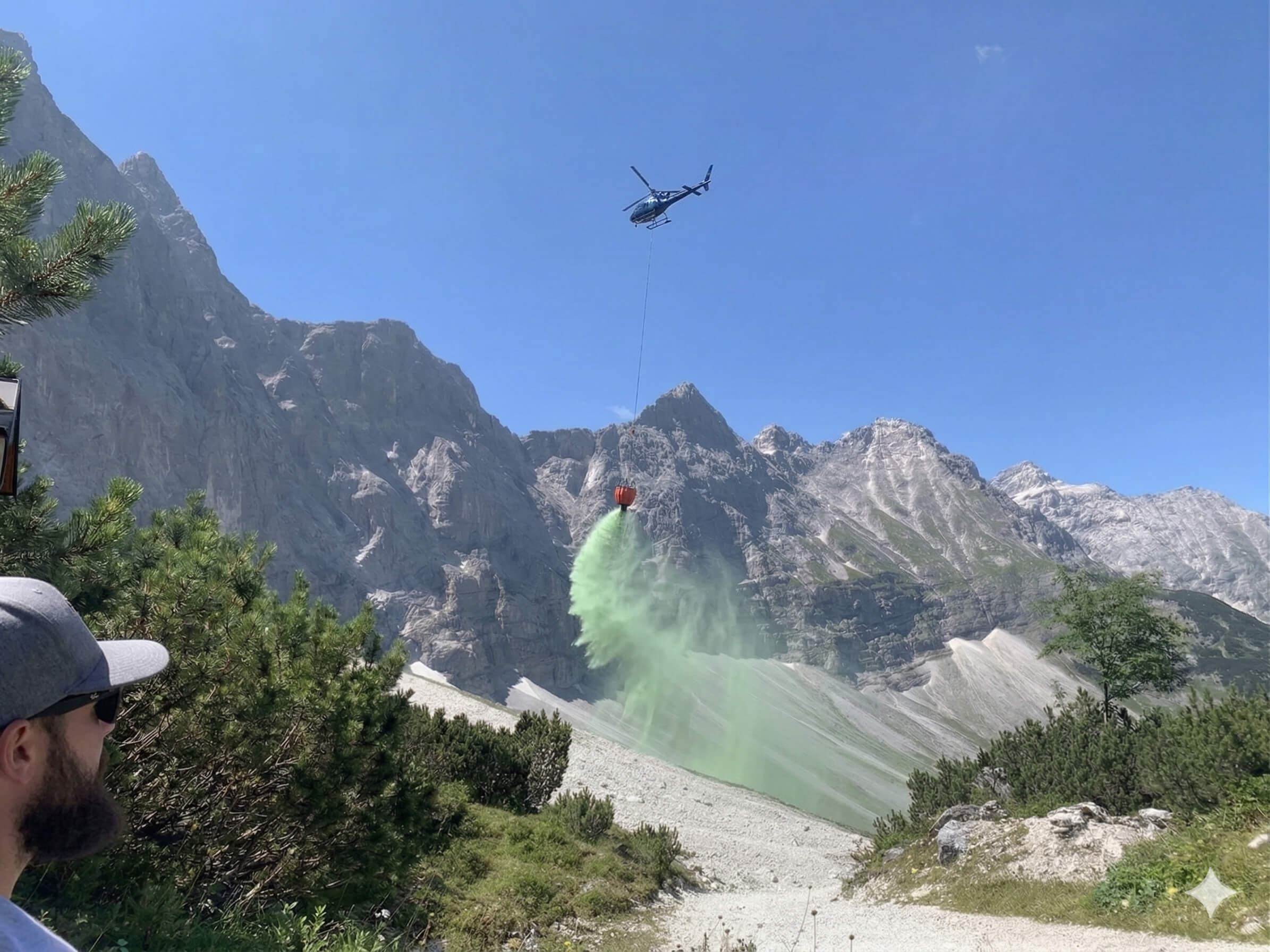
Alpine revegetation means establishing vegetation by technical means on high-altitude sites from roughly 1,400 m above sea level — on slopes, corridors, avalanche paths, protection structures and restoration areas that ground-based machinery cannot reach, or can only reach at disproportionate cost. Aerial seeding by helicopter is the most common way of doing it: it allows seed, binder, nutrients and erosion protection to be applied across an area in a single pass — regardless of slope gradient, site access or weather-dependent accessibility.
The method and the formulation, however, are the downstream problem. The knowledge that decides the outcome is ecological: which plant community will hold on this site, at this altitude, on this substrate and with this aspect? Anyone who cannot answer that question will fail with any method — even with the best helicopter pilot and the most expensive mixture.
The ecology of alpine sites
Alpine and subalpine sites follow rules of their own. Altitudinal zone, seed bank, frost dynamics and target community are not background botany: they determine the formulation, the seed selection, the application window and what counts as a realistic measure of success.
The boundary between the subalpine and alpine zones lies in the Northern Limestone Alps typically at 1,800–2,000 m above sea level (the natural treeline), and higher in the Central Alps. Below it, closed dwarf shrub communities and open woodland dominate; above it, grassland communities, cushion vegetation and increasingly bare rock and scree. That boundary has an immediate technical consequence: seed mixtures, establishment periods and realistic expectations differ fundamentally between the zones.
Seed bank and diaspore potential
Alpine raw soil sites — corridors, avalanche paths, scree slopes — generally hold a very limited seed bank in the soil. Natural diaspore density is low; wind dispersal selects strongly for light, wind-borne diaspore types, while heavier species barely arrive in sufficient density. Real natural succession on an undisturbed alpine raw soil site typically takes several decades without intervention.
Revegetation by aerial application does not replace that process — it accelerates the initial establishment phase and protects the area against erosion and wash-out during the critical period before the vegetation closes. The seed composition has to account for the limited natural resupply from the surroundings and rely on species that can build lasting stands even without an intensive diaspore source nearby.
Frost dynamics and cryoturbation
In the alpine zone, frost dynamics are the decisive stress factor for young seedlings. Night frost can occur into July; the frost-free period is often under 60 days. Cryoturbation — frost-driven soil movement through ice lens formation — can mechanically lift freshly germinated seedlings out of the substrate. The effect increases with altitude and with finer substrate.
Seed mixtures for the alpine zone therefore have to be built around species that are resistant to cryoturbation at the seedling stage, or that germinate and root quickly enough to get through the critical stage before winter sets in. The depth of the first frost and the soil texture at the project site determine which species are realistic.
Typical target communities
The target community is not taken from a catalogue but from reference areas near the project site. That requires a site walkover — aerial seeding without a prior vegetation survey regularly produces results that do not match the site.
| Altitudinal zone | Target community (selection) | Characteristic species | Substrates / aspect |
|---|---|---|---|
| Subalpine 1,400–1,800 m |
Seslerietum variae, subalpine dry grassland, Nardetum | Sesleria caerulea, Festuca pumila, Carex sempervirens, Nardus stricta | Limestone rock, rendzina; north to east aspect preferred |
| Alpine 1,800–2,400 m |
Seslerio-Semperviretum, Curvuletum, Elynetum | Carex curvula, Sesleria albicans, Agrostis alpina, Elyna myosuroides | Raw soil, scree cover; wind-exposed ridges |
| High alpine > 2,400 m |
Pioneer swards, scree communities, snowbed vegetation | Poa alpina, Linaria alpina, Silene acaulis, Saxifraga oppositifolia | Coarse scree, fine earth in hollows; south aspect |
On restoration areas and in protected sites, only site-typical species and provenances (regional provenance seed) are used — no cultivated varieties, no non-native species. The seed selection is set and documented individually for every site.