Equipment

Hydraulic Seeding Equipment

Practical equipment sizing for daily output, site access, pumping distance and hydraulic application requirements.

Equipment

Hydraulic seeding equipment

The central equipment question is not what represents the maximum available capacity, but what can be filled, transported and applied efficiently under normal working conditions.

Tank size affects more than the volume of one load. It determines filling time, mixing-cycle duration, vehicle requirements, site access and the number of applications that can realistically be completed per day. A large tank does not automatically increase output if water supply, material loading, travel distance or application time creates the actual bottleneck.

Payload must be calculated from the complete operating weight. Water alone weighs approximately one kilogram per liter, before fibers, seed, additives, fuel, equipment and the vehicle's own mass are included. A nominal 5,000-liter tank can therefore represent more than five metric tons of liquid payload.
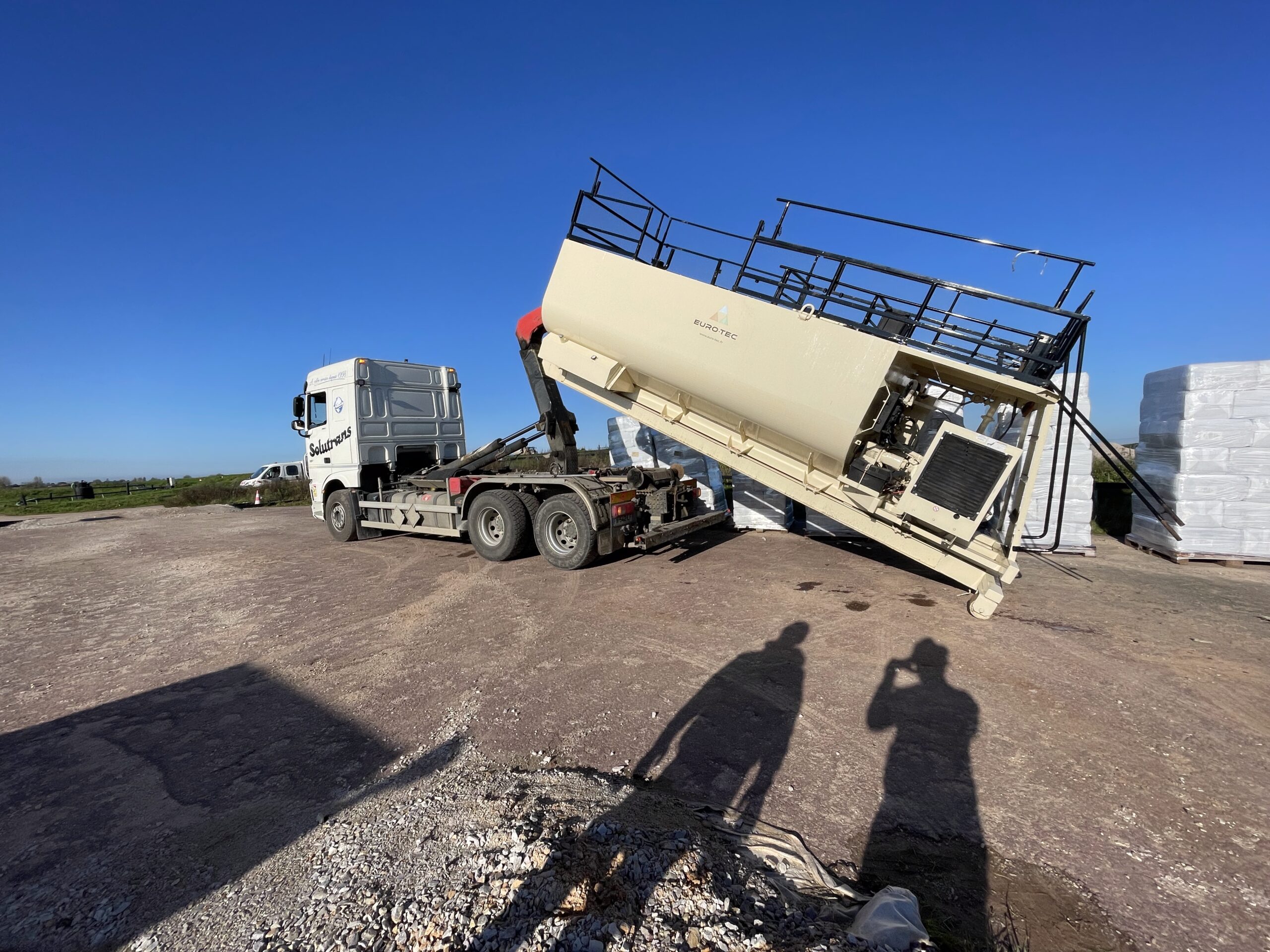
As capacity increases, three- or four-axle carrier vehicles may become necessary. The precise threshold depends on machine tare weight, slurry density, axle distribution and local road regulations—not tank volume alone. Larger carriers can introduce additional licensing, routing, permitting and access requirements.

Hydroseeder tank size must therefore be selected from the complete operating model: project size, refill logistics, carrier vehicle, terrain, pumping distance, elevation and required material systems.

Hook-lift truck tipping a bulk silo container of hydroseeding material on site

Gear pump vs. centrifugal pump

Pump selection determines which slurry viscosities can be conveyed, how the system responds to pressure and how effectively material can be applied over distance or elevation.

Gear-pump systems

A gear pump is a positive-displacement pump. It moves a defined volume with each rotation and can maintain comparatively consistent flow as system pressure increases, provided that the complete installation remains within its technical limits.

This makes gear-pump systems particularly relevant for viscous, fiber-rich slurries, long hose runs and applications involving substantial elevation differences. They can provide the pressure required to overcome static head and friction losses without relying on very high circulation flow.

Gear pumps require appropriate protection against excessive pressure and unsuitable foreign material. Pump size, drive power, relief system, hose diameter and the material's particle and fiber characteristics must be evaluated together.

Centrifugal-pump systems

A centrifugal pump produces flow by transferring rotational energy to the slurry. It can provide high circulation and discharge volumes where system resistance remains within the effective range of the pump curve.

Centrifugal systems can be well suited to rapid tank circulation, high-output application and broad distribution from a discharge cannon. As hose length, elevation, slurry viscosity or solids content increases, however, available flow and pressure may decline more strongly than with a positive-displacement system.

The actual capability depends on impeller design, pump size, engine power, piping geometry and the slurry the machine is designed to process.

Spray pattern and application quality

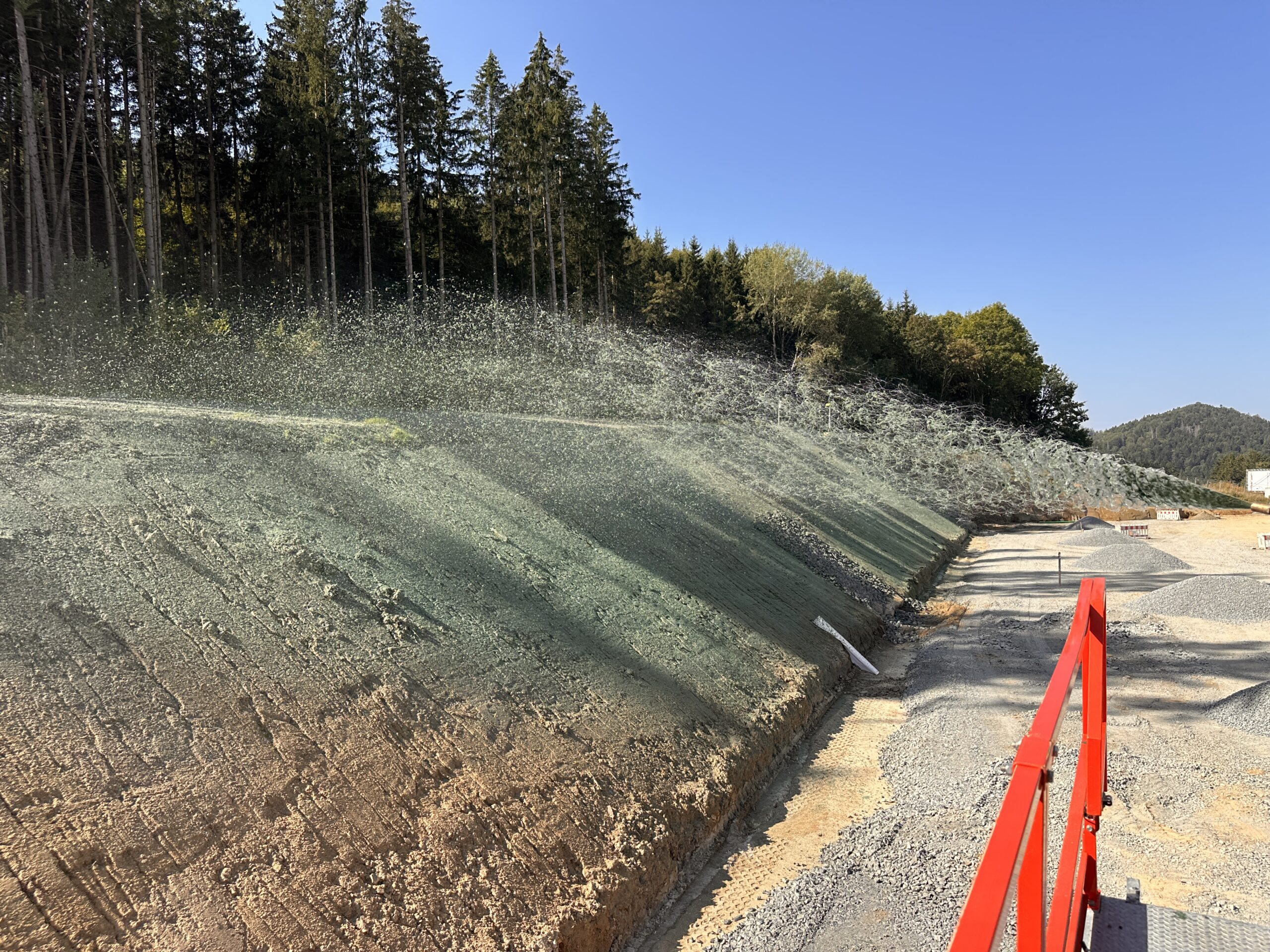
The pump alone does not determine the spray pattern. Nozzle geometry, pressure, flow rate, slurry viscosity, fiber content and discharge method together define droplet formation, throw distance and distribution across the surface.

A high-flow centrifugal system may create a broad, high-volume pattern from a cannon under suitable conditions. A gear-pump system can provide controlled pressure for hose and nozzle application of more viscous media. In both cases, the objective is consistent material distribution—not maximum throw distance alone.

Long distances and high elevations

Pumping performance must be calculated against both horizontal friction loss and vertical static head. As a practical reference, lifting water by ten vertical meters requires approximately one bar of pressure before hose friction, fittings, nozzle resistance and slurry viscosity are considered.

Alpine revegetation can involve hundreds of meters of hose and substantial elevation differences. Under these conditions, tank size becomes secondary to pump pressure, hose diameter, slurry rheology, system safety and the ability to maintain a stable material mix throughout the pumping route.

Published maximum pumping distances should never be treated as universal values. They depend on elevation, hose configuration and the actual slurry.

Fields of application

Application context

Mid-size units (2,000–5,000 L)

Mid-size units often provide greater day-to-day flexibility than maximum-capacity machines. They place lower demands on carrier vehicles, turning space and access while retaining sufficient capacity for many commercial applications.

Large-capacity units

Large units become economical when substantial treatment areas recur reliably and refill logistics support continuous production. Otherwise, carrier-vehicle costs and reduced deployment flexibility may outweigh the benefit of fewer filling cycles.

Mixed fleets

A mixed fleet combines tank sizes, pump systems and carrier vehicles for different operating conditions. This provides greater flexibility than requiring one machine to process every material and serve every site.

Biopolymer-ready configurations

Some emerging biopolymer systems introduce different hydration, viscosity, mixing and pumping requirements from conventional vegetation slurries. Equipment suitability must include agitation, shear behavior, circulation, pressure and cleanout requirements.

Qualification path—not a checkout

Hydraulic seeding equipment can support work beyond conventional vegetation establishment and erosion control. With an appropriate machine configuration and application knowledge, contractors may develop capabilities in dust control, temporary surface protection, industrial surface management and other engineered treatments.

Traditional training has often remained centered on seed, fertilizer and mulch application. New material systems require a broader understanding of substrate analysis, slurry behavior, pump performance and field quality control.

The SRBT qualification pathway connects equipment decisions with this wider operating capability. It considers fleet structure, pump and tank selection, hydraulic calculations, material handling, crew training and intended applications.

Where required, equipment access and technical resources can be coordinated through an international partner and equipment-fleet network. The objective is a qualified application platform—not an isolated machine transaction.

Explore the contractor qualification pathway
Any questions?

A project, a partnership or a research collaboration — get in touch by phone or email.