Technology & Methods

Biopolymer Systems

Raw material classes

Three material classes — the basis of every formulation.

"Bio" describes where the raw material comes from — not whether it is harmless. Anyone using biopolymers in revegetation and stabilization has to know the polymer class, the operating principle, the degradation behaviour and the application context. The wrong system on a hydrologically or ecologically sensitive site causes damage — regardless of whether the material is of biological origin.

Biopolymers

Film-forming, structure-giving and rheologically active macromolecules of natural origin. The primary binding component — responsible for adhesion, film integrity, degradation behaviour and interaction with the substrate. The operating principle varies widely by polymer class: swelling, gel formation, electrostatic adsorption, covalent cross-linking.

Mineral components

Mineral structural components with a defined layer charge, swelling capacity and reactivity. They control mechanical skeleton formation, barrier properties, ion exchange and the water regime within the applied layer. They raise shear strength and crust stability considerably compared with pure polymer formulations.

Fibers & additives

Mechanical skeleton and process control. Fibers increase crack tolerance, tensile strength across the direction of loading and the erosion resistance of the cured layer. Additives control rheology, application stability, degradation rate and weathering resistance.

Biopolymer fiber bonding in cross-section

Axle load untreated: dust escapes ~15 mm Path surfacing Fiber matrix (~15 mm) Load distribution · surface dust control Biopolymer binder Fines fixed to the grain Fines fixed in place no dust escape · biodegradable Base course (crushed stone) Load transfer Subgrade (formation level) Fiber matrix — laid on top, 10–15 mm; spreads axle loads and binds surface dust mechanically Biopolymer binder — cross-links sand and silt to the grain; electrostatic adsorption; fully biodegradable

Biopolymer classes in detail

Which binder for which context — a differentiated assessment.

Biopolymers are not a homogeneous group. Degradation behaviour, ecotoxicity, water solubility and interaction with soil organisms differ considerably by polymer class. The table below shows what actually matters when selecting a system.

Polymer classOperating principleDegradation behaviourTypical use & limitations
Polysaccharides
Xanthan, guar, CMC, chitosan
Swelling and gel formation; electrostatic adsorption onto clay minerals; reversible on contact with waterCompleteErosion control, hydroseeding, dust control — a broad spectrum. Service life depends on water solubility; can be stabilized by adding mineral components.
Lignin derivatives
Lignosulfonate, kraft lignin
Film formation; weaker binding action than polysaccharides; high variability depending on the processing routeLargelyTrack stabilization and dust control under light loading. Quality depends heavily on manufacture — not all lignin products are equivalent.
Humic acids & biocharNot a classical binder — they control soil structure, cation exchange capacity, water availability and germination stimulusCompleteThermocontrol (albedo management), soil improvement, germination support. Not suitable as a primary binder — always in combination with class 01.
Cellulose ethers
HEC, CMC, HPMC
Film formation and thickening; good adhesion on mineral substrates; temperature-dependent viscosityCompleteHydroseeding (fixing seed in place), erosion control. Combines well with mineral components for durable crust layers.
Anionic linear polymers
(class not further specified)
Electrostatic attachment to positively charged soil particles; flocculation of fine sedimentSlowProven in certain applications. Persistence in soil is possible — suitable for Natura 2000 areas and leachate pathways only after careful assessment. SRBT uses fully biodegradable formulations exclusively.
Cationic polymers
(class not further specified)
Strong attachment to negatively charged clay minerals; high flocculation performanceVariableNot suitable for water-adjacent areas. Highly toxic to aquatic organisms if used improperly. SRBT does not use this class.

Technical background:

degradation mechanisms, soil-polymer interaction, IPEC formation

Degradation mechanisms: biopolymers break down in soil through enzymatic hydrolysis (polysaccharides), oxidative degradation (lignins) or a combination of processes. The rate depends heavily on temperature, moisture and the microbiome. In anaerobic substrates (landfills, waterlogged soils) degradation can be considerably slower — for those sites the service life and residual concentration have to be assessed per project.

Soil-polymer interaction: polysaccharides adsorb preferentially onto positively charged surfaces (iron oxides, aluminium oxides) through electrostatic interaction and hydrogen bonding. In acidic soils (pH < 5.5) the surface charge shifts — adsorption strength, and with it service life, falls. Formulations for acidic substrates require pH correction or a different binder class.

IPEC formation (interpolyelectrolyte complexes): where anionic and cationic polymer components are used together, insoluble complexes can form spontaneously, disrupting application or triggering unwanted precipitation reactions in the soil. SRBT accounts for this during formulation development — mixing sequence, pH and ionic strength of the mixing water are application parameters, not side conditions.

Mineral reinforcement: clay minerals such as bentonite or metakaolin form charged complexes with biopolymers (biocomposites) whose mechanical properties clearly exceed those of the individual components. Bentonite swells on contact with water and closes microcracks in the binder matrix — a self-healing effect that pure polymer films do not have.
Sand fixation through biopolymer bonding

Untreated sand Particles can be mobilized Biopolymer treatment Particles fixed · nothing escapes Cross-linking — close up electrostatic bridging Loose sand particles — mobilized by wind Wind direction Biopolymer network — particles fixed in place, fully biodegradable biodegradable fully biodegradable

Formulation & layer logic

Every formulation is developed for a defined performance window.

Layer thickness, porosity, adhesion, degradation rate and substrate interaction are not incidental properties — they are deliberate development parameters. Complex systems follow a layer logic in which each layer takes on a specific function.

SRBT develops formulations in a feedback loop with field practice: substrate knowledge from real projects, application experience with specific machine types and field data from different climate zones and soil types feed directly into recipe development. Laboratory results alone are not a sufficient basis for recommendations.

Top layer
Weather protection & service life

Protects the functional layer against UV degradation, mechanical erosion and hydrological loading. Controls the degradation rate of the whole system through deliberate porosity and degree of hydrophobing.

UV stabilizationHydrophobingPorosity control
Functional layer
Primary effect

Carries the physical target behaviour: thermal control, erosion protection, moisture conservation, particle stabilization or crust stability — delivered through a specific combination of raw materials.

Application-specificDefined layer thicknessControlled performance window
Base layer
Adhesion & substrate bond

The mechanical and chemical bond between substrate and functional layer. Formulated for the substrate — raw soil, organic material and gravel subgrade each need a different adhesion mechanism.

Substrate-specificPenetration depthBond strength

Ecological assessment & behaviour in water

Why context-specific assessment is not optional — it is a duty.

Behaviour in water

Ecotoxicological assessment

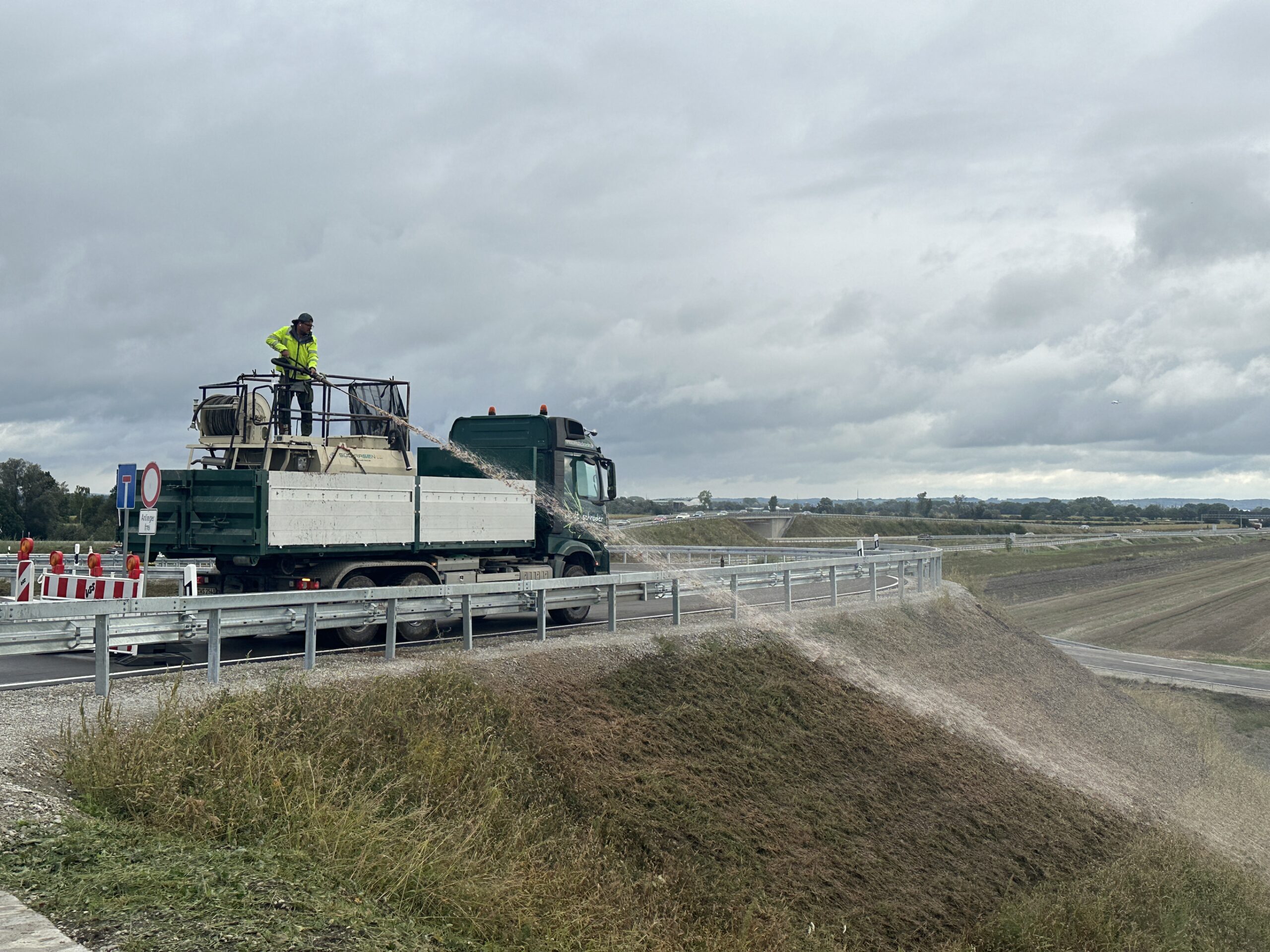
Binders differ widely in how they behave once they reach a water body: some are broken down completely, others persist and accumulate. On areas with a direct connection to a watercourse, on stormwater basins and on dam slopes, only materials that leave no persistent residue are appropriate.

SRBT uses fully biodegradable formulations exclusively — non-negotiable for water-adjacent and ecologically sensitive sites. The behaviour of every component is documented and forms part of the project records.

Biological origin is no guarantee of ecological harmlessness. What counts are the degradation products, the degradation rate in the actual substrate, ecotoxicity towards soil organisms and interaction with the local microbiome. Chitosan, for example — a polysaccharide-based binder — has antifungal and antibacterial properties that can be unwanted in ecologically sensitive soils.

SRBT assesses formulations per project. Application context, site ecology and degradation behaviour in the particular substrate are the decisive parameters — not blanket product classifications.

Background:

environmental behaviour and documentation

Proximity to water: on areas connected to a watercourse, every component used must be documented in terms of its environmental behaviour — not just the end product but every individual substance in the formulation.

Degradation products: a polymer may be harmless while its monomers or degradation products are not — acrylamide as a degradation product of certain polymer classes is the textbook case. SRBT assesses the degradation products of every formulation used, not only the finished product.

Documentation: on projects with official approval, evidence of the materials used and their assessment forms part of the execution records. SRBT supplies this documentation as standard — safety data sheets, material data and application parameters.

Our approach

Formulation expertise as a precondition for execution.

SRBT does not work with off-the-shelf products — every formulation is configured for the project. Material knowledge is not an add-on service but the basis of execution quality.

01
Site & substrate analysis

Soil type, pH, moisture regime and ecological sensitivity determine which polymer classes and mineral components are suitable. The environmental behaviour of every component feeds into the choice of system.

02
Formulation configuration

Biopolymer class, mineral component, fiber content, additives and layer logic are configured for the project — from field test data and laboratory characterization. Mixing sequence, pH of the mixing water and application parameters are part of the recipe.

03
Documentation & evidence

Safety data sheets, material data, application parameters and quality control records are supplied as standard — suitable as evidence for authorities, clients and environmental assessors.

Ask us about formulation.

Tell us the site, the substrate and the project objective — we will configure a suitable formulation.