Locations

Hydroseeding in Qatar

Engineered permanent greening and dust control for extreme heat, saline substrates and water-limited urban sites.

SRBT delivery capability in Qatar

SRBT can mobilize project-specific hydroseeding, surface-stabilization and dust-control systems for projects in Qatar. Delivery begins with an assessment of substrate chemistry, salinity, biological activity, irrigation water, drainage, heat exposure and the required long-term function of the surface.

Equipment, application capacity and technical support can be coordinated through an international partner and equipment-fleet network. The delivery model depends on technical feasibility, project scale, import requirements, access, water logistics and regulatory approval.

This describes international project capability, not a permanent local presence. Each inquiry is evaluated before a material system, application method or mobilization route is proposed.

Where surface problems arise in Qatar

Climate

Qatar has an extremely arid climate characterized by intense summer heat, high evaporation and limited, irregular rainfall. Wind and solar exposure place additional stress on unprotected soil and newly established vegetation. Short rainfall events can still generate runoff where urban grading, compaction or surface crusting restricts infiltration. Permanent greening therefore requires a designed root zone, reliable irrigation and plant material selected for the actual microclimate.

Dominant soils

Natural substrates are commonly shallow, calcareous, sandy or gypsiferous, with limited organic matter and biological activity. Coastal and low-lying areas may also be strongly saline. Urban projects add imported soils, construction fills and compacted mineral surfaces of varying quality. These materials must be assessed for pH, electrical conductivity, sodium-related structural risks, water retention, infiltration and available rooting depth before a vegetation system is specified.

Vegetation zones

Natural vegetation is sparse and adapted to severe water limitation. Distinct habitats include desert grass and shrub communities, vegetated depressions known as rawdas, saline coastal environments and mangrove areas. Urban parks, streetscapes and development landscapes form a separate, irrigated vegetation category. Natural habitats and engineered green spaces require different plant-selection and management principles and should not be treated as interchangeable.

Water availability

Permanent vegetation depends mainly on managed water supply rather than rainfall. Treated wastewater can provide an important irrigation source, but its salinity, sodium content, nutrient load and suitability for the intended vegetation must be verified. Irrigation volume, distribution uniformity, drainage and seasonal demand are part of the engineering concept. Moisture-retaining materials can improve the establishment environment but cannot replace a reliable long-term water budget.

Regulation

The Ministry of Environment and Climate Change launched the National Strategy to Combat Desertification 2025–2030 as a framework for restoring degraded land, protecting natural habitats and improving resource management. It supports Qatar National Vision 2030 and the Third National Development Strategy. Project-specific requirements may additionally involve municipal planning, water reuse, environmental assessment, biodiversity protection and construction approvals.

Lead industries and development sectors

Relevant contexts include large urban developments, public green spaces, tourism projects, sports and leisure facilities, infrastructure corridors and industrial sites. These projects increasingly combine surface cooling, vegetation, dust reduction and visual integration. SRBT does not position itself as a general landscaping or maintenance provider. Its role concerns large or technically demanding establishment projects where substrate engineering, hydraulic application and long-term performance must be coordinated.

Topography and terrain

Qatar is predominantly low-lying, but local depressions, limestone surfaces, coastal sabkhas, dunes and extensively graded urban land create different drainage and establishment conditions. Even limited elevation differences can concentrate runoff or irrigation water. Large development sites may also involve long pumping distances, restricted equipment positioning and surfaces at different construction stages, requiring coordinated access and application planning.

Structural risks

Wind erosion, sand movement and dust deposition can affect exposed land, construction areas and urban edges. The planned greenbelt around Metropolitan Doha has been associated with reducing dust-laden winds and sand encroachment as well as containing urban expansion. Other risks include salinity accumulation, surface sealing, irrigation-related waterlogging and vegetation failure where the root zone or maintenance regime is inadequate. A green surface cannot remain permanent if these underlying functions are unresolved.

Hydroseeding in Qatar

Hydroseeding in Qatar must be designed as part of a complete establishment system rather than as seed application alone. Site assessment should establish substrate chemistry, salinity, sodium-related dispersion risk, compaction, infiltration, rooting depth, heat exposure and irrigation-water quality.

Reduced microbial activity in arid or biologically inactive substrates can significantly limit the breakdown of conventional wood-fiber mulches. Adding fiber alone does not create a functioning soil. A project-specific system may therefore combine an engineered growth medium, moisture- and nutrient-management functions, a biologically based binder and vegetation selected for the site's water regime.

On exposed fine-particle surfaces, controlled surface binding can reduce wind erosion and sand pickup. Where permanent vegetation is required, the matrix must retain moisture without sealing the surface or obstructing root-zone aeration and drainage. Dust-control systems for non-vegetated operational areas require a separate specification.

Hydroseeding cannot compensate for saline irrigation water, an unsuitable root zone or inadequate long-term irrigation. These conditions must be corrected within the landscape, drainage and water-management design. Proprietary formulations remain project-specific.

Relevant applications

Climate Adaptation

Developing permanent surface and vegetation systems for extreme heat, water scarcity and saline substrates.

Application
Read more →
Dust Control

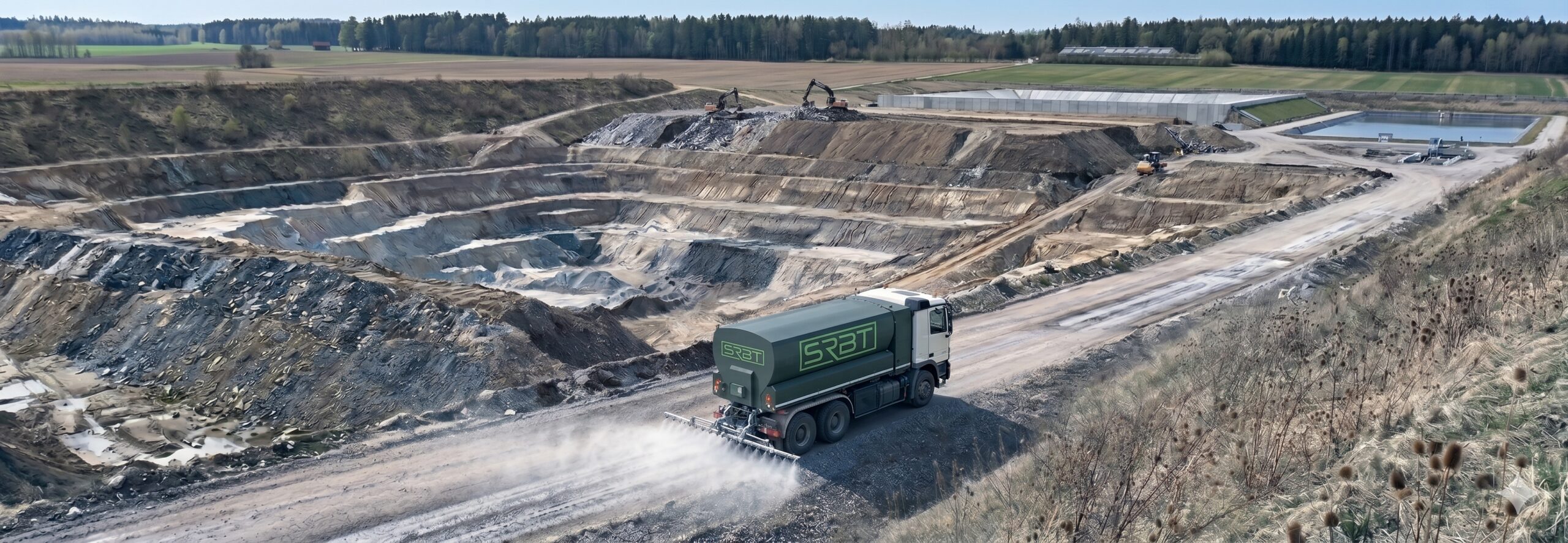
Reducing wind-driven dust and sand pickup through project-specific surface binding and application planning.

Application
Read more →
Water retention in hydraulic growth media

How substrate properties, fibers and moisture-management functions influence vegetation establishment under water-limited conditions.

Engineering Insight
Read more →
Any questions?

A project, a partnership or a research collaboration — get in touch by phone or email.