Locations

Hydroseeding in Slovenia

Engineered revegetation for karst substrates, alpine slopes and infrastructure surfaces where conventional establishment methods reach their limits.

SRBT delivery capability in Slovenia

SRBT can mobilize project-specific surface engineering systems for applications in Slovenia. Delivery begins with an assessment of substrate continuity, rooting depth, slope geometry, drainage, elevation, climatic exposure and intended vegetation. These parameters determine whether hydraulic application is technically appropriate and which material functions are required.

Projects may be implemented through qualified regional resources and SRBT's international partner and equipment-fleet network. This represents a delivery capability, not a claim of permanent local presence. Mobilization remains subject to technical feasibility, regulatory requirements, project scale and the availability of suitable access, water and application infrastructure.

Where surface problems arise in Slovenia

Climate

Slovenia combines Alpine conditions in the north and northwest, continental influences across much of the interior and Mediterranean conditions toward the coast. Rainfall, temperature and establishment periods vary over relatively short distances. Higher elevations add snow cover, freeze–thaw cycles and shortened vegetation windows, while karst areas may experience seasonal surface dryness despite substantial regional precipitation.

Dominant soils

Karst landscapes commonly have thin, discontinuous soils over fractured limestone, with exposed rock between isolated pockets of rooting material. Alpine terrain adds shallow, stony soils and weathered rock. Road construction, quarrying and earthworks create further substrates including compacted fills, cut rock faces and mineral materials with limited organic content or water-retention capacity.

Vegetation zones

Vegetation ranges from sub-Mediterranean grassland and woodland to extensive temperate forests, mountain meadows and Alpine communities. Species selection must reflect elevation, exposure, substrate depth and the surrounding ecological context. Standard lowland seed mixtures are not automatically suitable for karst grasslands, forest margins or short high-altitude establishment periods.

Water availability

Slovenia has substantial water resources, but karst hydrology creates specific design constraints. Rainfall can infiltrate rapidly through fractures and sink features, leaving limited moisture near the surface. Underground flow routes may extend beyond visible surface catchments and can be difficult to predict without investigation. Material loss or contamination pathways must therefore be considered before application.

Regulation

Projects may be subject to construction, water-management, environmental, nature-conservation and infrastructure requirements. Karst features, caves, protected habitats and groundwater resources may require particular attention. Work on roads or other public infrastructure also follows the relevant technical and safety requirements. Hydroseeding does not replace permits, environmental assessment or geotechnical design.

Lead industries

Road construction and infrastructure rehabilitation create significant applications on cut slopes, embankments, tunnel approaches and disturbed construction surfaces. Quarrying, energy infrastructure and utility corridors add further difficult substrates. In each case, vegetation establishment must be coordinated with drainage, rockfall protection, structural slope measures and the site's future inspection and maintenance requirements.

Topography and terrain

The Julian Alps, Kamnik–Savinja Alps, Karavanks, Dinaric karst and other steep landscapes create rapidly changing elevation and access conditions. Application may require long hose distances, substantial pumping heights or equipment positioning away from the treated slope. Terrain therefore influences both the material system and the feasible method of delivery.

Structural risks

Rockfall, landslides and debris movement are documented risks in parts of Slovenia's mountainous and hilly terrain. Karst sinkholes and subsurface cavities add a different form of ground uncertainty. Hydroseeding can limit surface erosion and support vegetation on an adequately engineered slope, but it cannot secure unstable rock, arrest a deep-seated landslide or bridge an unsupported karst void.

Hydroseeding in Slovenia

Hydroseeding in Slovenia should begin by determining whether the surface provides sufficient stable rooting material. On discontinuous karst soils, exposed limestone and isolated soil pockets cannot be treated as one uniform substrate. Hydraulic application can distribute seed and functional materials across accessible areas, but it cannot create a stable soil profile where no suitable rooting layer exists.

Where adequate substrate is present, the engineered system may combine selected fibers, a biologically based binder, growth-medium components, moisture-management functions and vegetation adapted to the site. The system must resist early rainfall and surface wash while retaining enough moisture for establishment. On sensitive karst terrain, material selection must also consider rapid infiltration and possible connections to groundwater.

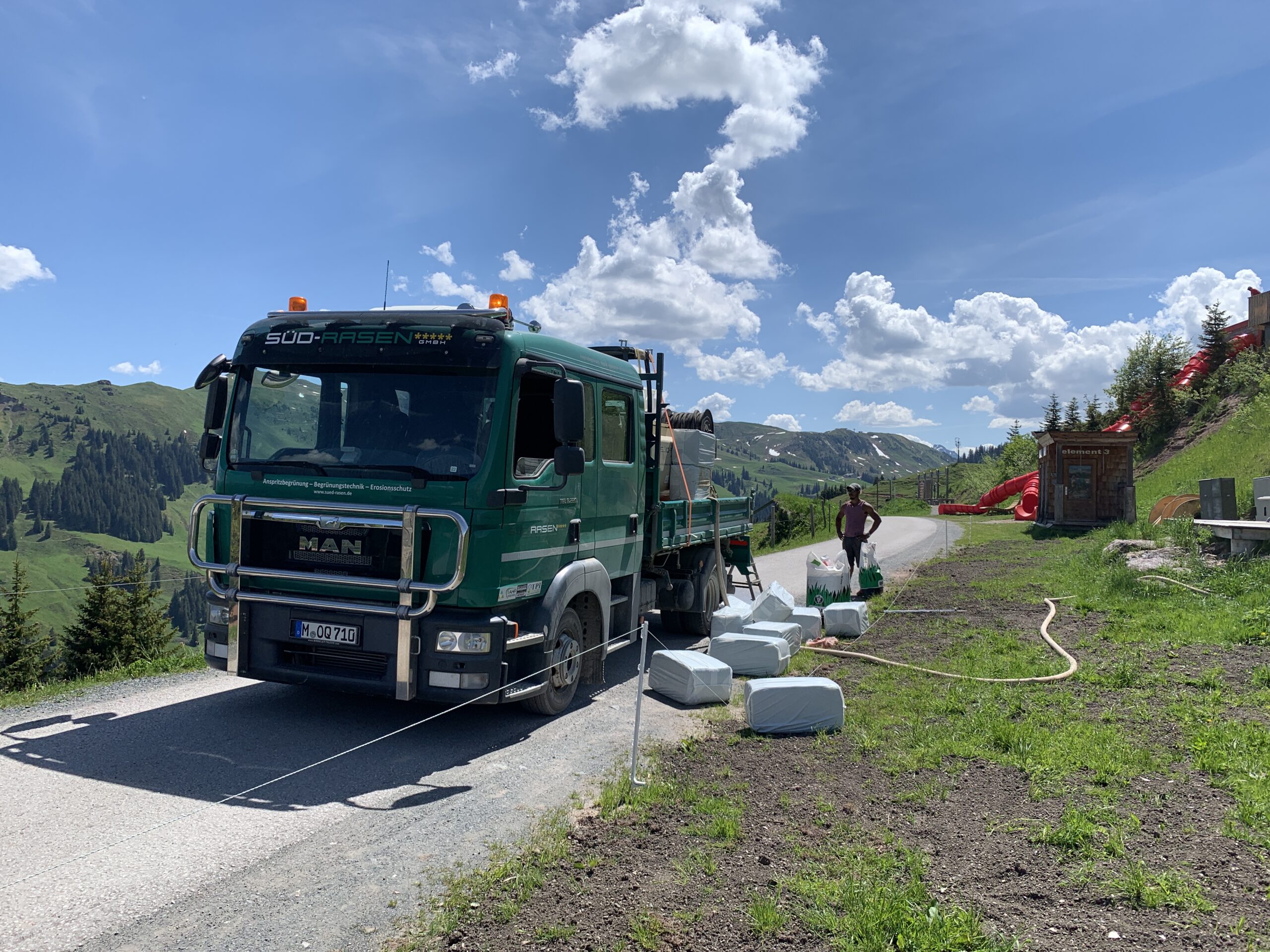
Alpine and steep-slope projects require additional attention to elevation, aspect, freeze–thaw exposure and the available establishment window. Pump selection, hose length and achievable pumping height form part of the application design, particularly where equipment cannot approach the treated surface.

Rockfall barriers, anchors, drainage, retaining structures and landslide remediation remain separate engineering measures. Hydroseeding follows these interventions where biological cover or surface erosion control is required. Applicable Slovenian and EU environmental requirements must be assessed for each site, and proprietary formulations remain project-specific.
Terminology in Slovenia

No specific Slovenian equivalent of "hydroseeding" is treated here as an established commercial term. Slovenian technical documentation may instead describe the intended function through terms such as zaščita pred erozijo for erosion protection and sanacija plazov for landslide remediation. These functions should not be treated as interchangeable.

Relevant applications

Difficult Revegetation

Vegetation establishment on thin, rocky, discontinuous or otherwise unfavorable substrates.

Application
Read more →
Climate Adaptation

Surface systems designed for variable rainfall, drought stress, freeze–thaw exposure and short Alpine establishment windows.

Application
Read more →
Guide to Slope Stabilization

How surface erosion control, vegetation establishment and structural slope engineering perform different but coordinated functions.

Engineering Guide
Read more →
Any questions?

A project, a partnership or a research collaboration — get in touch by phone or email.