Locations

Hydroseeding in Portugal

Rapidly deployable post-fire surface protection for burned watersheds and difficult Atlantic-Mediterranean terrain.

SRBT delivery capability in Portugal

SRBT can mobilize project-specific post-fire erosion-control and revegetation systems for projects in Portugal. Proximity to Mediterranean equipment and contractor capacity can support an accelerated response when burned terrain must be evaluated before seasonal rainfall.

For time-critical inquiries, SRBT aims to activate the technical and logistics assessment within 48 hours after receiving sufficient initial site information. This is a response-planning target, not a guaranteed mobilization or on-site delivery time. Equipment availability, transport, regulatory approval, site access, fire-scene release and operating conditions must first be confirmed.

This describes international project capability, not a permanent local presence.

Where surface problems arise in Portugal

Climate

Portugal has a strong Atlantic influence combined with a Mediterranean rainfall pattern. The north and northwest are generally wetter, while the interior and south experience longer, hotter and drier summers. Extended summer drought increases vegetation stress and rural-fire susceptibility. After fire, autumn and winter rainfall can rapidly mobilize ash and exposed soil, particularly where steep catchments drain toward settlements, reservoirs or watercourses.

Dominant soils

Common substrates include shallow soils over granite and schist, acidic forest soils, sandy coastal material and more clay-rich or calcareous soils in selected regions. Many upland sites have limited rooting depth and low organic-matter reserves. Fire can remove surface litter, weaken soil structure and create localized water repellency. Burned slopes must therefore be assessed for severity, infiltration, erodibility and natural recovery potential before treatment is specified.

Vegetation zones

Vegetation ranges from Atlantic-influenced forests in the north to pine and eucalyptus stands, cork- and holm-oak landscapes, Mediterranean shrubland and dry grassland farther south. These systems differ in their natural regeneration capacity and response to fire. Active revegetation is not automatically appropriate everywhere. Seed introduction should follow ecological assessment, land-use objectives and the applicable restoration plan rather than displace viable natural regeneration.

Water availability

Water availability varies substantially between regions and seasons. Summer scarcity can restrict slurry production and biological establishment, while burned catchments may require additional protection of reservoirs and surface waters. Project planning must establish the permitted water source, quality, transport distance, storage and refill cycle. Where irrigation is unavailable, the system must be designed around realistic rainfall and the substrate's actual moisture-retention capacity.

Regulation

Portugal's Programas Regionais de Ordenamento Florestal (PROF) establish regional frameworks for forest functions, sensitive forest areas and management objectives. They do not, by themselves, authorize a specific post-fire treatment. Project requirements may also involve the Institute for Nature Conservation and Forests, the Portuguese Environment Agency, municipalities, landowners and protected-area authorities. Emergency stabilization must remain consistent with regional planning, ecological constraints and approved recovery measures.

Lead industries and land-management sectors

Relevant contexts include forestry, cork and wood-based value chains, wildfire-risk management, conservation, agriculture and the rehabilitation of burned or degraded rural land. SRBT does not position itself as a general Portuguese landscaping provider. The focus is on technically demanding post-fire projects and difficult terrain requiring rapid assessment, engineered surface protection, specialist hydraulic application or coordination across larger affected areas.

Topography and terrain

Mountainous northern and central regions, deeply incised valleys, interior plateaus and steep Atlantic catchments create varied deployment conditions. Machine access may be restricted by narrow forest roads, damaged tracks or unstable burned areas. Long hose distances, elevation changes, refill logistics and safe equipment positioning must be considered during mobilization planning. Hydraulic reach does not remove the need for safe access or geotechnical assessment.

Structural risks

After fire, exposed soils are vulnerable to sheet, rill and gully erosion. Ash, sediment and burned organic material can enter streams, reservoirs and drainage systems. Steep slopes may also be affected by rockfall, shallow instability or debris movement. Post-fire stabilization can therefore require several complementary disciplines: watershed protection, drainage clearance, structural sediment retention, slope treatment and biological recovery.

Hydroseeding in Portugal

Hydroseeding in Portugal should begin with a rapid but evidence-based assessment of burn severity, slope, soil depth, infiltration, drainage paths, downstream receptors and natural regeneration potential. Areas likely to recover without intervention should not be treated automatically.

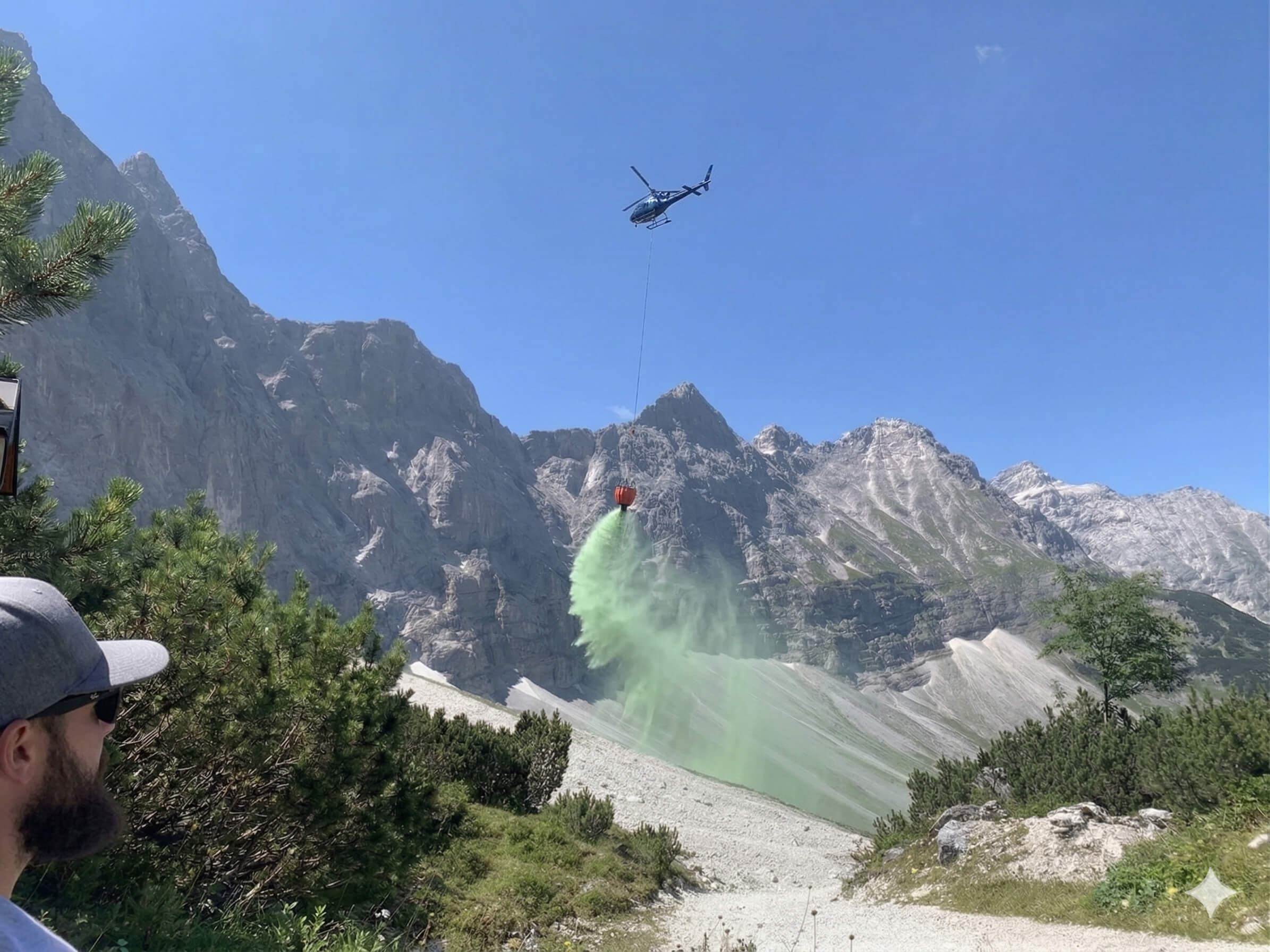
Where active surface protection is justified, a hydraulic system may combine fibers, biologically based binders, moisture-management functions, growth-supporting components and an ecologically appropriate seed mixture. The applied matrix can reduce immediate surface exposure and retain materials during the interval before vegetation develops effective cover. Material selection and application rates remain project-specific.

SRBT's role is not to replace established Portuguese vegetation or forestry contractors. It is to support technically difficult projects requiring specialist material systems, difficult-access application or accelerated post-fire delivery planning.

Hydroseeding cannot stabilize unsafe slopes, clear blocked watercourses or replace check dams and other structural sediment-control measures. It also cannot compensate for unsuitable species selection or absent aftercare. These functions must be coordinated within the approved recovery plan. Treatment timing should reflect forecast rainfall, soil moisture, site safety and the realistic biological establishment window.

Portuguese terminology

Hidrossementeira is the established Portuguese term for hydraulic seeding and is used for slope revegetation, erosion control and large-area vegetation establishment. Related expressions include controlo da erosão, estabilização pós-incêndio and recuperação de áreas ardidas. The term alone does not define the required material system or performance level.

Relevant applications

Wildfire Recovery

Protecting burned surfaces during the critical interval between vegetation loss and the first significant rainfall.

Application
Read more →
Post-fire erosion control: the first-rains window

Why burn assessment, approvals, logistics and surface protection must be coordinated before rainfall begins to mobilize ash and exposed soil.

Engineering Insight
Read more →
Any questions?

A project, a partnership or a research collaboration — get in touch by phone or email.