Locations

Hydroseeding in Jordan

Engineered revegetation and surface protection for water-limited, erosion-prone and dust-exposed terrain.

SRBT delivery capability in Jordan

SRBT can mobilize project-specific hydroseeding, erosion-control and dust-binding systems for projects in Jordan. Delivery begins with an assessment of substrate chemistry, salinity, biological activity, available water, erosion mechanism and the required long-term function of the surface.

Equipment, application capacity and technical support can be coordinated through an international partner and equipment-fleet network. The appropriate delivery model depends on project scale, technical feasibility, water logistics, site access, import requirements and regulatory approval.

This describes international project capability, not a permanent local presence. Each inquiry is evaluated before a material system, application method or mobilization route is proposed.

Where surface problems arise in Jordan

Climate

Jordan lies at the eastern margin of the Mediterranean climate zone, with hot, dry summers and rainfall concentrated in winter. More than 90% of the country receives less than 200 millimeters of annual precipitation. The eastern and southern desert regions receive considerably less, while higher elevations in the northwest are cooler and wetter. Rainfall scarcity is combined with short, sometimes intense events capable of generating rapid runoff across dry or crusted surfaces.

Dominant soils

Substrates range from calcareous highland soils and basaltic material to shallow desert soils, sandy or stony surfaces and saline irrigated soils. Organic matter and biological activity are commonly limited in arid and disturbed areas. Construction fills, quarry surfaces and compacted project sites introduce additional variability. Salinity, sodium-related dispersion, surface crusting and restricted rooting depth must be assessed before vegetation establishment is specified.

Vegetation zones

Jordan includes Mediterranean woodland and grassland in parts of the northwest, Irano-Turanian steppe, extensive Saharo-Arabian desert and localized wetland or riparian vegetation. The Badia supports sparse, drought-adapted rangeland rather than continuous green cover. Vegetation design must therefore reflect the ecological zone, land use and available water. A generic amenity mixture is unsuitable for most restoration sites.

Water availability

Water availability is the governing design constraint. Jordan's National Water Strategy 2023–2040 prioritizes groundwater protection, reduced over-abstraction and greater use of treated wastewater and other non-conventional sources. Irrigation water must be tested for salinity and suitability before use. Petra's Nabataean water-management heritage demonstrates the longstanding regional importance of capturing, routing and storing episodic runoff. Modern projects can follow the same functional principle through properly engineered catchments, retention and controlled infiltration—not by copying archaeological structures.

Regulation

Projects may involve the Ministry of Environment, the Ministry of Water and Irrigation, the Water Authority, the Ministry of Agriculture and local planning authorities. Requirements depend on water source, land classification, environmental sensitivity and intended use. Treated wastewater, groundwater abstraction, drainage and work near protected or archaeological areas require separate approval. Hydroseeding does not provide an exemption from water-allocation or environmental requirements.

Lead industries and development sectors

Relevant contexts include agriculture, tourism, urban development, renewable energy, quarrying, mining and the rehabilitation of construction or industrial surfaces. These sectors create different requirements: permanent vegetation, temporary erosion protection and operational dust control should not be specified as one interchangeable treatment. In water-limited projects, the intended surface function must be matched to a viable long-term maintenance and water plan.

Topography and terrain

Jordan extends from the Jordan Rift Valley and western highlands to dissected wadis, the eastern Badia and high desert plateaus. Steep gradients can concentrate runoff, while exposed plains are vulnerable to wind erosion. Remote sites may require long water-transport routes, extensive hose deployment and careful equipment positioning. Hydraulic reach improves access but cannot correct unstable slopes or uncontrolled drainage.

Structural risks

Water erosion can occur where intense rainfall encounters steep, bare or sealed surfaces. Wind erosion dominates other exposed, dry and weakly vegetated areas. Geospatial research in northwestern Jordan confirms that the two mechanisms follow different spatial controls: water erosion is closely associated with terrain and soil, while wind erosion depends strongly on exposed surface properties and wind. Salinity and groundwater decline can further reduce the capacity of vegetation to recover.

Hydroseeding in Jordan

Hydroseeding in Jordan must be designed around the water budget rather than the desired visual outcome alone. Site assessment should establish pH, electrical conductivity, sodium-related structural risk, compaction, infiltration, available rooting depth, exposure and the quality and quantity of establishment water.

Reduced microbial activity in arid or biologically inactive substrates can significantly limit the breakdown of conventional wood-fiber mulches. Fiber alone therefore does not create a functional growth medium. A project-specific system may combine suitable fibers, a biologically based binder, moisture- and nutrient-management functions and vegetation selected for the actual rainfall and irrigation regime.

Where terrain permits, hydraulic revegetation can be integrated with modern runoff capture, microcatchments or other water-harvesting measures. These functions require separate hydrological design; the sprayed matrix cannot compensate for inadequate water capture or storage.

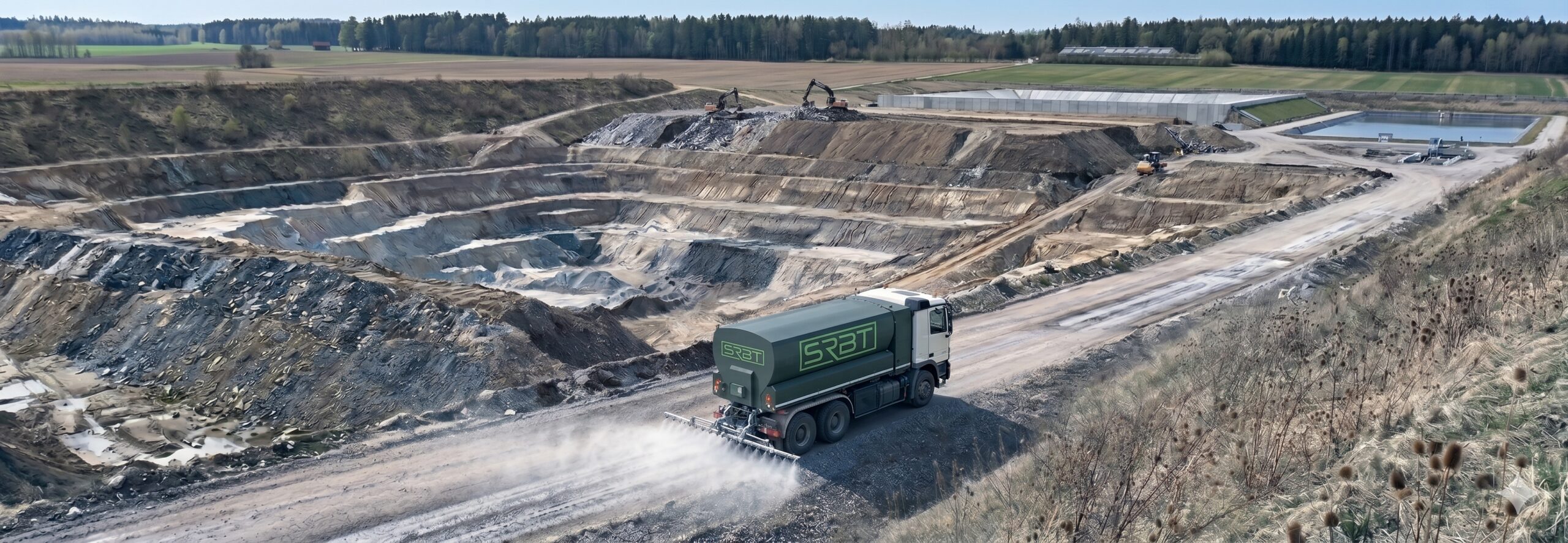
Dust control on non-vegetated surfaces requires a different specification focused on immediate cohesion and operational exposure. Hydroseeding cannot correct saline groundwater, unstable terrain or an unrealistic maintenance plan. Proprietary formulations remain project-specific.

Relevant applications

Climate Adaptation

Developing surface and vegetation systems for extreme water limitation, heat, irregular rainfall and saline substrates.

Application
Read more →
Dust Control

Reducing wind-driven and operational dust through project-specific surface binding and application planning.

Application
Read more →
Water retention in hydraulic growth media

How substrate properties, fibers and moisture-management functions influence the available establishment window under water-limited conditions.

Engineering Insight
Read more →
Any questions?

A project, a partnership or a research collaboration — get in touch by phone or email.