Equipment

Hydromulching Equipment

Machines for fiber-rich mulch matrices and erosion-control application.

Equipment

Hydromulching equipment

Hydroseeding and hydromulching are often used interchangeably, and in conventional revegetation work that remains understandable. Most modern hydroseeding applications already include cellulose mulch, wood fiber, or blended fiber products together with seed and other amendments. The distinction becomes more useful when fiber is no longer simply a carrier and establishment aid, but a significant functional component of the applied layer.

Hydromulching equipment must therefore be considered in relation to the material system it is expected to process. Increasing fiber concentration changes slurry rheology, mixing behavior, pump demand, discharge characteristics, and the amount of water required to place a given quantity of dry material. A machine that performs well with a conventional hydroseeding slurry may operate very differently when processing a highly loaded fiber matrix.

Higher application rates should not be confused automatically with higher performance. Beyond the effective range of a particular fiber system, additional material does not necessarily produce a proportional improvement in water retention or erosion resistance. It does, however, increase slurry volume, machine cycles, water demand, and the wet mass applied to the surface. On steep, smooth, or poorly structured slopes, excessive wet layer mass can itself become undesirable if the freshly applied matrix has insufficient resistance to downslope movement.

The appropriate hydromulching system is therefore determined by functional layer requirements rather than fiber quantity alone.
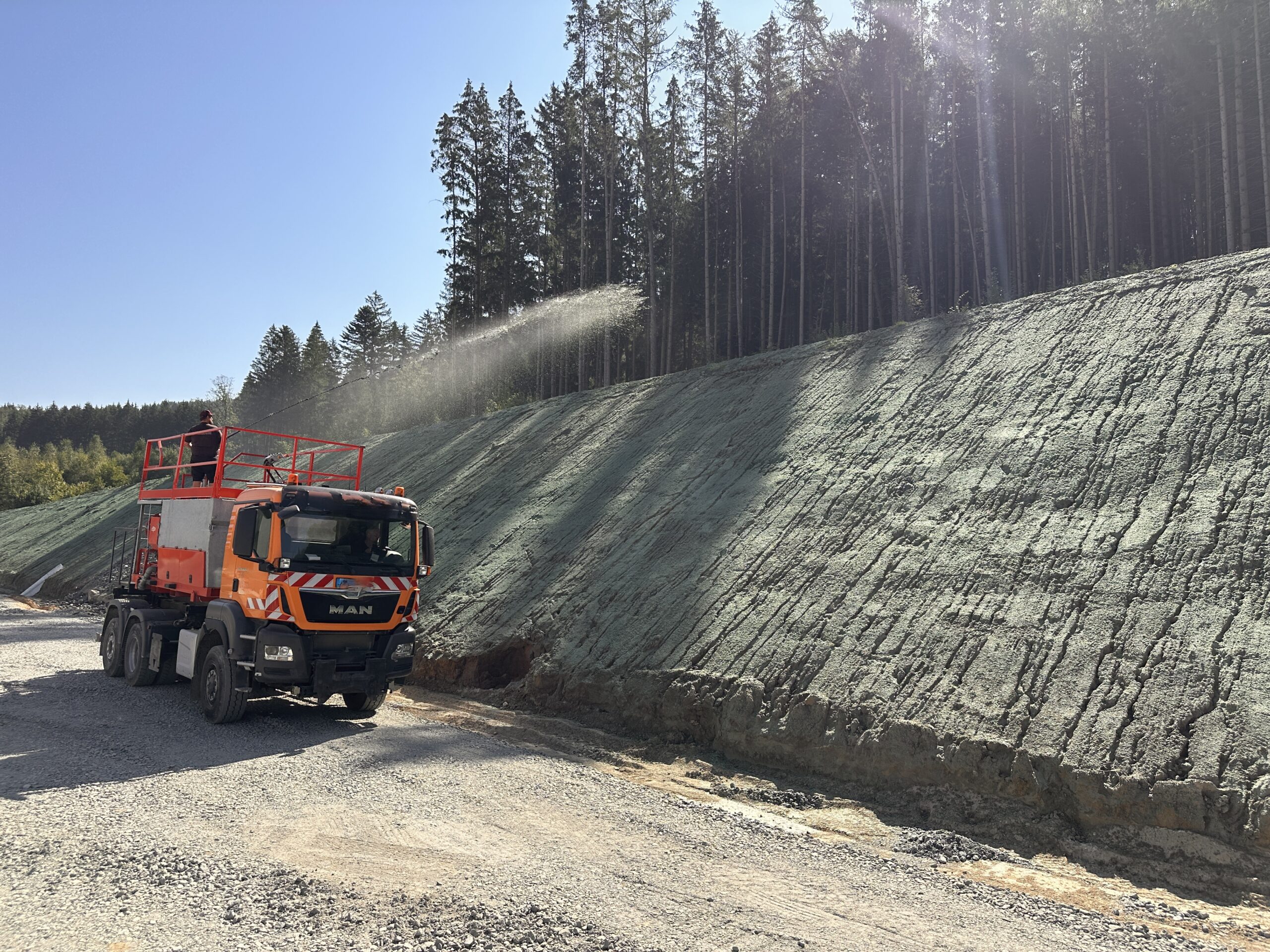
Slope revegetation by hydraulically applied seeding

Machine and process requirements

Fiber-rich slurries place different demands on equipment than conventional revegetation mixtures. Mixing systems must wet and disperse large quantities of fiber without creating persistent agglomerates, while maintaining sufficient circulation throughout loading and application. Mixing intensity is important, but so is mixing time: excessive mechanical processing can alter fiber structure and slurry behavior, while insufficient mixing produces inconsistent discharge and coverage.

Pump selection becomes increasingly important as viscosity and solids loading rise. Centrifugal systems can provide high flow rates and efficient production with suitable mixtures, but their operating envelope becomes more restrictive as slurry viscosity increases. Positive-displacement and gear-pump configurations can handle different rheological conditions and provide greater control with highly loaded or specialized matrices.

For this reason, some purpose-built systems combine more than one pumping principle. Such configurations expand the usable material envelope rather than simply increasing nominal output.

Discharge characteristics are equally important. Hydromulching is generally intended to create continuous surface coverage. Nozzle geometry, flow rate, pressure, fiber distribution, and operator technique must therefore work together to form a consistent layer rather than concentrating material at individual points.

Fields of application

Application context

Erosion control

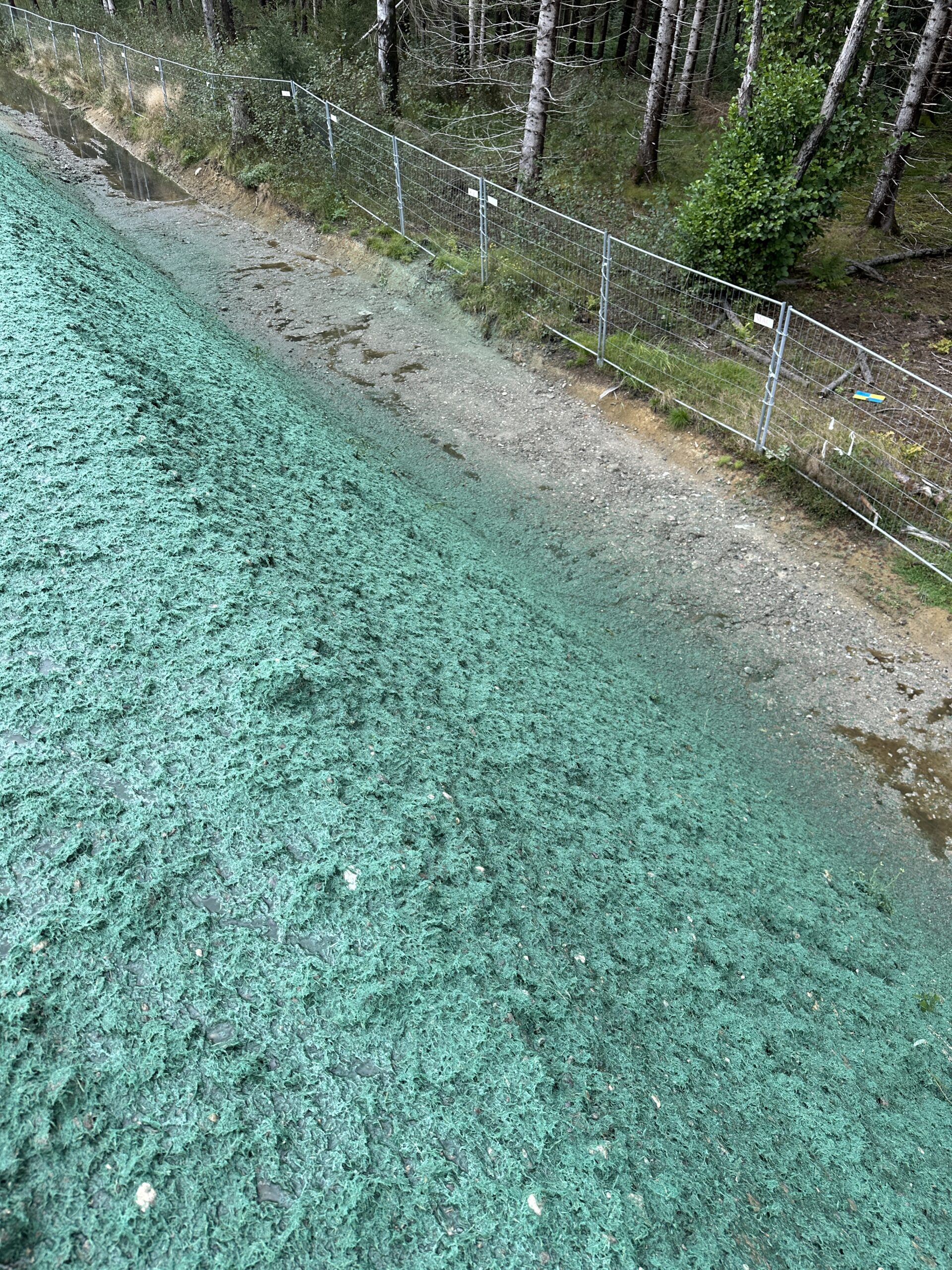
Erosion-control hydromulching uses the applied matrix as a temporary surface-protection layer while vegetation establishes. Equipment selection should be based on the required coverage, matrix behavior, slope geometry, and erosion mechanism rather than on maximum achievable fiber loading. A higher dry-matter application rate is only useful where it creates a measurable functional benefit. Efficient equipment should place the required matrix uniformly while minimizing unnecessary water, material, and machine cycles.

Steep slopes

Steep slopes require control of both application and the freshly placed material. High-output equipment can rapidly build a thick wet layer, but more material is not automatically more stable. On smooth or compacted slopes in particular, excessive wet mass can increase the tendency for an inadequately anchored matrix to move before drying. Equipment should therefore allow controlled layer formation, uniform coverage, and adjustment of slurry properties to the substrate and slope rather than simply maximizing application rate.

Fire recovery

Post-fire surfaces can combine loss of vegetation, altered infiltration, ash, exposed mineral soil, and high runoff susceptibility. Hydromulching can provide rapid surface coverage where immediate stabilization and subsequent revegetation must be addressed together. The equipment must accommodate the selected functional matrix while remaining productive over potentially large and difficult-to-access burned areas. Material selection, application rate, logistics, and machine configuration should therefore be considered as one system rather than independently.

Difficult substrates

Hydromulching becomes particularly relevant where the applied layer must perform functions beyond conventional seed establishment. Difficult mineral substrates, engineered surfaces, landfill applications, containment areas, and other technically demanding sites may require matrices designed for moisture management, temporary sealing, insulation, surface protection, or other defined functions. In these applications, slurry rheology can depart substantially from conventional hydroseeding mixtures. The ability to process different viscosities and solids concentrations becomes more important than nominal tank capacity alone.

Beyond revegetation: surface engineering

Hydraulic application equipment can also serve as a platform for surface engineering. Fiber-based or composite matrices may be designed for functions such as odor control, temporary containment, moisture management, insulation, dust and surface stabilization, or landfill cover applications.

These systems can require substantially different rheology from conventional seed-and-mulch slurries. Equipment capable of handling a wider viscosity range—including configurations using different pumping principles—therefore provides greater flexibility when hydraulic application moves from vegetation establishment toward engineered surface functions.

Equipment qualification

Hydromulching equipment should not be selected from tank capacity or advertised output alone. Qualification starts with the material system and its intended function.

Relevant parameters include fiber type and concentration, slurry viscosity, mixing behavior, required application rate, pumping distance, elevation change, nozzle configuration, desired layer characteristics, available water, site access, and expected daily production.

For conventional erosion-control work, a relatively straightforward machine configuration may be sufficient. For high-solids matrices or engineered surface applications, pump technology, agitation, material compatibility, and controllability become increasingly important.

The objective is not to maximize the amount of material a machine can process. It is to identify the configuration that can reliably mix, transport, and apply the required functional matrix under actual site conditions.

Explore the contractor qualification pathway
Any questions?

A project, a partnership or a research collaboration — get in touch by phone or email.