Locations

Hydroseeding in Montenegro

Engineered revegetation for steep, rocky slopes, karst terrain and selected coastal stabilization projects.

SRBT delivery capability in Montenegro

SRBT can mobilize project-specific surface engineering systems for applications in Montenegro. Delivery begins with an assessment of substrate continuity, slope geometry, karst features, drainage, water availability, climatic exposure and the intended surface function. These parameters determine whether hydraulic application is appropriate and which material functions are required.

Projects may be implemented through qualified regional resources and SRBT's international partner and equipment-fleet network. This represents a delivery capability, not a claim of permanent local presence. Mobilization remains subject to technical feasibility, regulatory requirements, project scale and the availability of suitable access, water and application infrastructure.

Where surface problems arise in Montenegro

Climate

Montenegro combines maritime conditions along the Adriatic coast with continental and mountain climates inland. Coastal areas typically have warm, dry summers and wetter winters, while high mountain regions experience lower temperatures, snow and shorter vegetation periods. Local climate can change rapidly with elevation and exposure, requiring project-specific establishment timing rather than one national specification.

Dominant soils

Much of Montenegro is characterized by limestone, dolomite and other karst-forming geology. Soils on this terrain may be shallow, stony and discontinuous, with exposed rock between isolated rooting zones. Flysch and marl areas present different erosion and stability behavior, while river valleys and coastal plains contain deeper alluvial, marine or deltaic sediments.

Vegetation zones

Vegetation ranges from Mediterranean scrub, coastal grassland and evergreen communities to deciduous forest, coniferous mountain forest and Alpine vegetation. Seed selection must reflect elevation, salt exposure, rooting depth and the surrounding ecological context. A mixture intended for a coastal infrastructure slope may be unsuitable for a northern mountain site.

Water availability

Montenegro has substantial water resources, but karst aquifers are seasonally variable and highly connected through fractures, caves and underground channels. Rainfall may infiltrate rapidly, leaving limited moisture near the surface. Visible topography does not necessarily define underground flow paths. Water sourcing and groundwater-protection requirements therefore form part of the assessment.

Regulation

Projects may be subject to environmental, water-management, mining, construction, coastal-management and nature-conservation requirements. Protected landscapes, groundwater resources and the coastal zone can require additional review. Hydroseeding does not replace environmental approval, geotechnical design, coastal-process assessment or the permits required for water use and infrastructure works.

Lead industries

Tourism-related infrastructure, road construction, utility corridors, mining and energy projects create relevant applications. Coastal development adds cut slopes, embankments and disturbed land in visually and environmentally sensitive settings. Mining and quarrying generate mineral substrates that may require technical preparation before biological establishment can begin.

Topography and terrain

Montenegro's Adriatic coast transitions rapidly into the Dinaric mountain system, while the interior includes deep valleys, plateaus and high terrain around Durmitor and other massifs. Official spatial-planning documents describe abrupt elevation changes and steep coastal mountain flanks. Equipment access, pumping height, hose distance and safe positioning are therefore central delivery parameters.

Structural risks

Landslides, rockfall and slope erosion are recognized risks on parts of the road and mountain network. Karst adds cavities, sink features and variable ground conditions. Coastal sites may also be affected by wave action and sediment movement. Hydroseeding can control surface erosion on a stable substrate, but it cannot stabilize rock masses, arrest deep movement or correct a coastal sediment deficit.

Hydroseeding in Montenegro

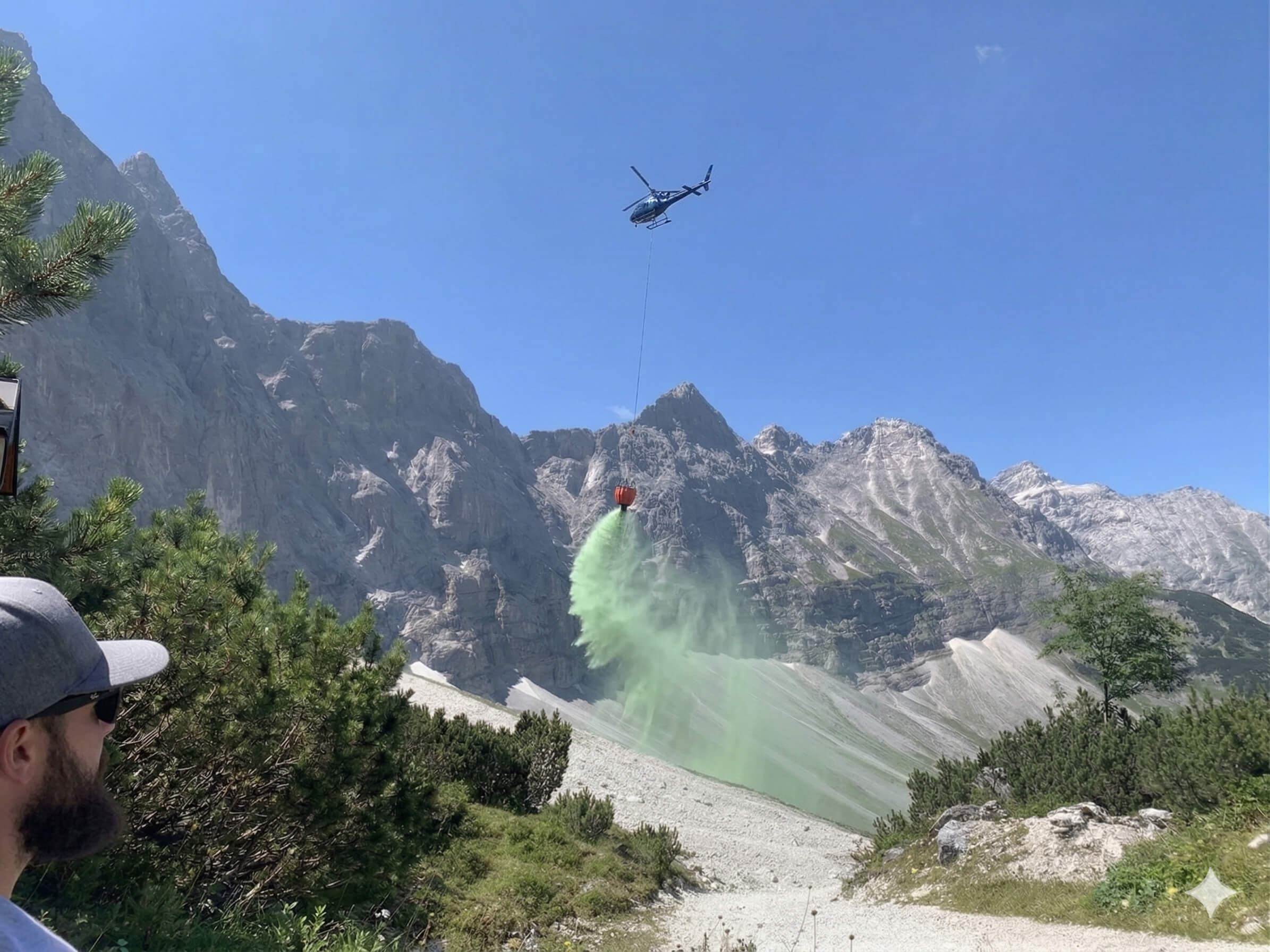
Hydroseeding in Montenegro requires separate design logic for steep inland slopes and coastal surfaces. On rocky or karst terrain, the first question is whether sufficient stable rooting material exists. Hydraulic application can distribute seed and functional materials across prepared soil pockets and mineral surfaces, but it cannot create a viable soil profile on unsupported bare rock.

Where adequate substrate is present, the engineered system may combine selected fibers, a biologically based binder, growth-medium components, moisture-management functions and vegetation adapted to elevation and exposure. Steep-slope planning must also consider drainage, rockfall measures, pumping height, hose routing and safe equipment positioning.

Coastal stabilization requires a different assessment. Dune-oriented systems may be appropriate on unconsolidated sand where wind mobility and low cohesion dominate. They are not a substitute for coastal engineering where wave action, currents, storm surge or disrupted sediment supply control the erosion process. Salt exposure and ecological restrictions must also be considered.

Karst groundwater connections require particular care when selecting and applying materials. Geotechnical stabilization, drainage and coastal-engineering measures remain separate disciplines. Applicable Montenegrin requirements must be assessed for each site, and proprietary formulations remain project-specific.

Terminology in Montenegro

No Montenegro-specific commercial term for hydroseeding is presented as established. Hydroseeding remains the clearest procedural term. The regional phrase zaštita od erozije may be used to describe erosion protection, but it defines the required function rather than a specific application method.

Relevant applications

Difficult Revegetation

Vegetation establishment on thin, rocky, discontinuous or otherwise unfavorable substrates.

Application
Read more →
Dune Stabilization

Surface stabilization where wind-driven movement and low cohesion affect unconsolidated coastal sand.

Application
Read more →
Guide to Slope Stabilization

How structural slope engineering, surface erosion control and vegetation establishment perform different but coordinated functions.

Engineering Guide
Read more →
Any questions?

A project, a partnership or a research collaboration — get in touch by phone or email.