Technology & Methods

Hydroseeding & Hydraulic Seeding

Hydroseeding Hydraulic seeding Hydromulching Spray-applied revegetation Erosion control

The method

Application equipment and formulation are two different things.

Hydroseeding is the umbrella term for spray-applied, hydraulically pumped revegetation and erosion-control systems. The term itself does not define the mixture's composition — that is determined by the formulation. Hydromulching is a supplementary term sometimes used alongside hydroseeding; it does not describe an independently defined process of its own.

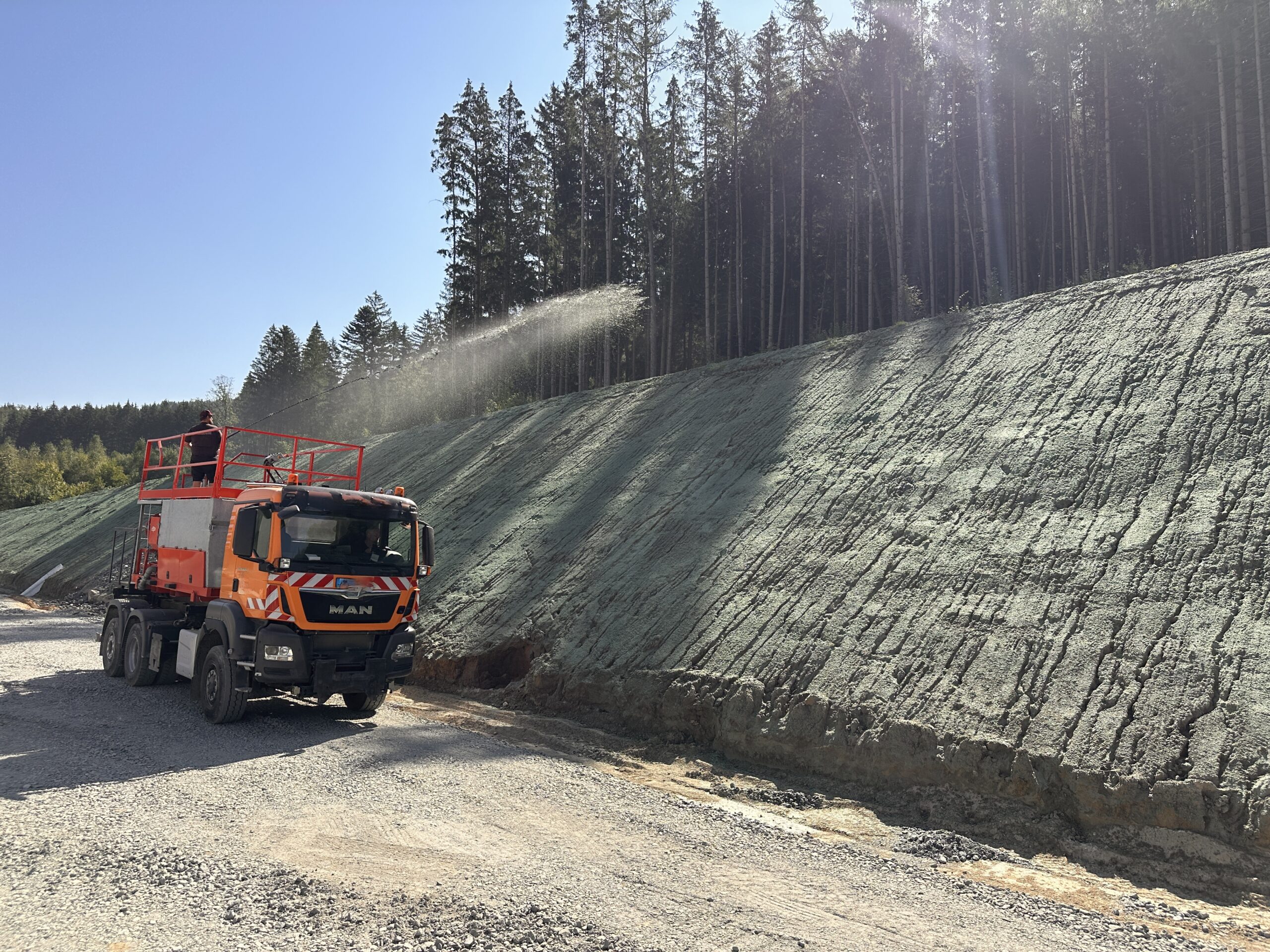
In hydraulic application a pumpable mixture is sprayed onto the target area under pressure. Tank size, pump capacity and hose configuration determine reach and area output — at SRBT up to several hundred metres of throw.

The equipment is only the tool. What decides the outcome — erosion protection, vegetation establishment, long-term stability — depends entirely on what is in the mixture: mulch material, biopolymer class, carrier medium, seed spectrum and additives are configured for each site individually.

SRBT uses in-house simulation tools to calculate germination forecasts, soil temperature curves and water savings against dry seeding from a handful of core inputs — postcode, application window and site class. The result is a sound basis for decisions before work begins.
Fields of application

Where hydraulic application is used.

The method is universal — the formulation is not. Substrate, objective and accessibility determine the composition.

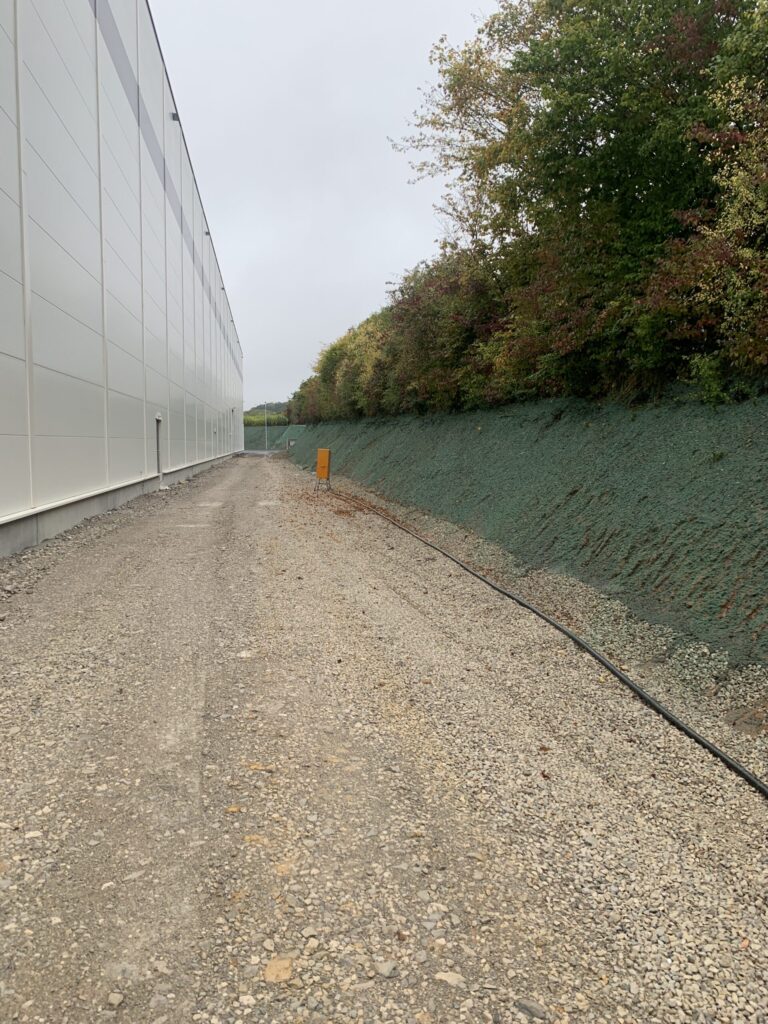
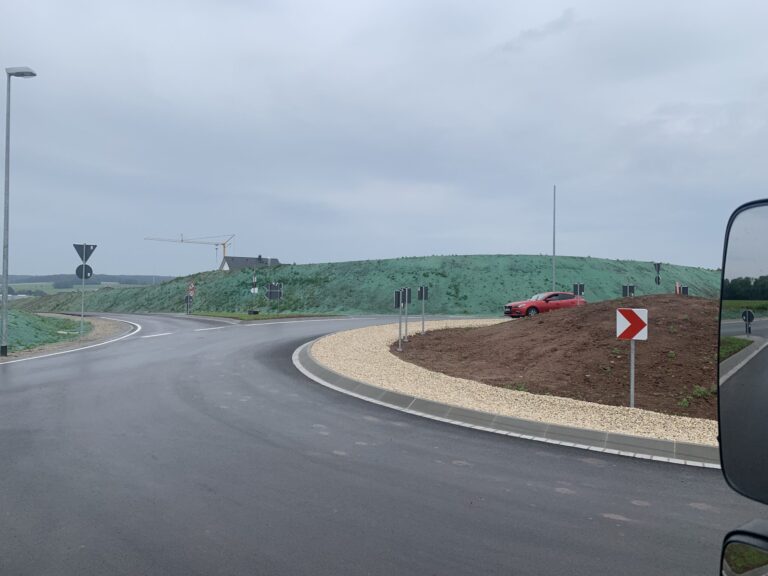
Hydroseeded embankments with green mulch at a newly built roundabout
Slope revegetation & infrastructure

Road and motorway slopes, railway embankments, noise barriers — fiber-reinforced formulations with biopolymer binders for lasting erosion stability under traffic and mowing loads.

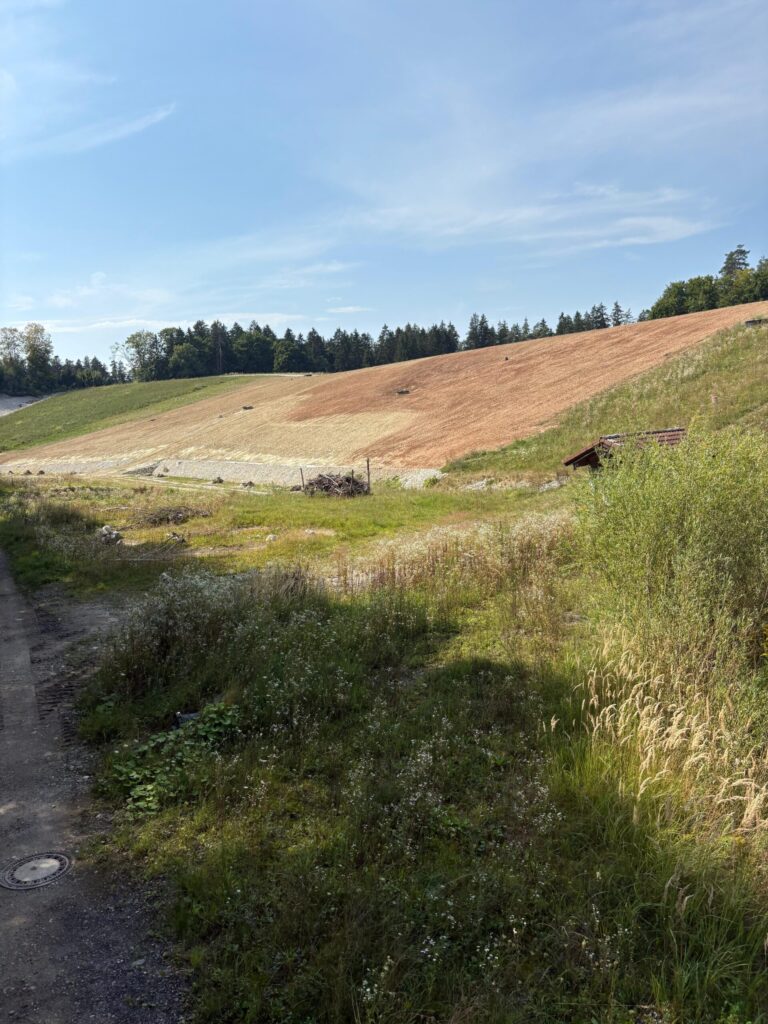
Reclaimed slope covered with hydromulch and emerging vegetation
Reclamation & restoration

Post-mining land, landfills, bogs, floodplains — pedogenesis methods and site-adapted seed mixtures build biologically active soil structures on extreme sites with no natural topsoil.

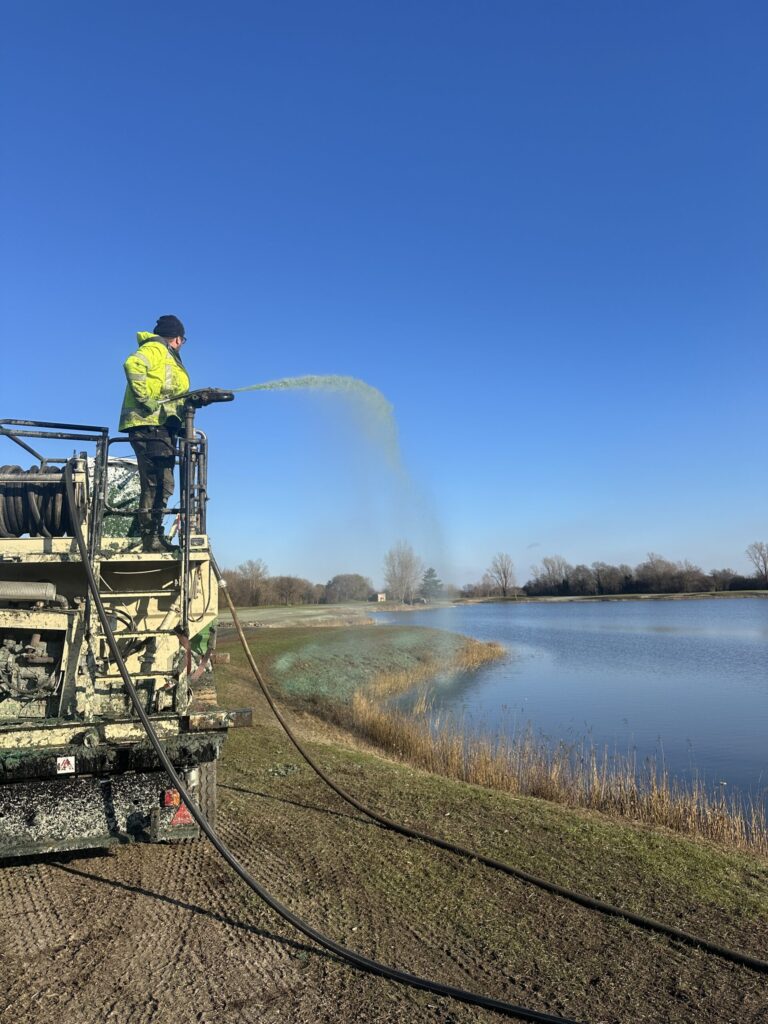
Operator spraying hydroseeding slurry onto a lakeside bank from a truck-mounted hydroseeder
Water-adjacent areas

Stormwater basins, dam slopes, riparian buffer strips — exclusively fully biodegradable formulations. No polybutadiene-based binders, and seed mixtures selected for alternating wet conditions.

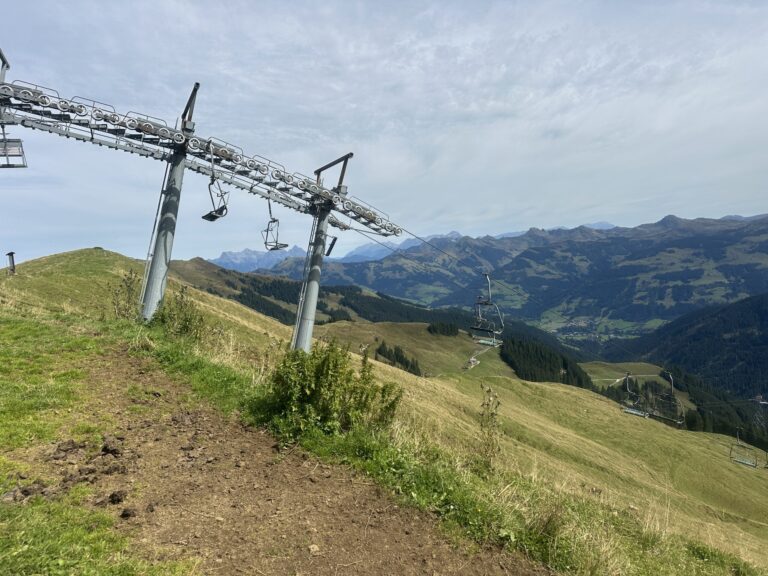
Chairlift on an alpine ridge with revegetated slopes
Alpine & inaccessible terrain

High altitudes, steep faces, lift corridors, avalanche defense structures — short vegetation periods call for Thermocontrol formulations. Applied from the ground or by aerial seeding.

Slope protection on a mining and landfill site
Mining, landfill & industry

Stabilization carried out alongside operations — every formulation fully biodegradable. Dust control and staged revegetation without interrupting production.

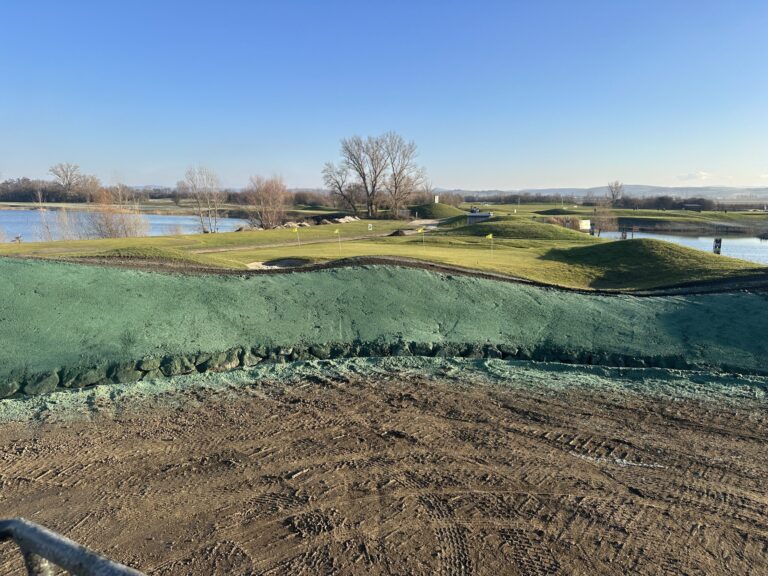
Hydromulch as a low-cost method for establishing turf
Golf & sports turf

New construction, renovation and repair to USGA standards. Formulations that leave no residues in the rootzone, with seed mixtures selected for high-performance turf.

Our approach

From site analysis to field application.

SRBT supports hydroseeding projects from the first technical specification through to acceptance — planning and execution from a single source.

01
Site analysis & simulation

Substrate, aspect, gradient, climate zone and the constraints of the site are recorded. In-house simulation tools model the soil temperature curve and germination forecast — before the work, not after it.

02
Formulation development

Mulch material, biopolymer class, seed mixture and additives are configured for the project. C/N ratio and the constraints recorded for the site feed directly into the recipe.

03
Execution & monitoring

Our own hydroseeder fleet, trained crews and laboratory-backed quality control. Documentation and establishment monitoring are part of every contract.

Formulation depth

Mulch material and thermal management — the underrated parameters.

C/N ratio as the key parameter

Thermocontrol — thermal management in the germination layer

Mulch material is the most frequently underrated parameter in hydraulic application. Chopped straw is still widely used — cheap, but with an unfavourable C/N ratio that microbially immobilizes nitrogen in the soil. On demanding sites that regularly leads to inhibited germination and slow vegetation build-up.

SRBT works with wood fiber mulches and project-specific carrier media whose C/N ratio is matched to the substrate, the fertilization plan and the seed spectrum.

SRBT uses its own Thermocontrol additives based on biochar and humic acid. In winter they lower surface albedo and raise the temperature in the germination layer by 2–4 °C — measurably bringing forward the usable germination window for spring and autumn seeding.

In summer the effect reverses: higher albedo, less heat absorption, a cooler soil surface — which matters on extreme sites under heat stress. Biochar is biodegradable and free of microplastics.

0 25 50 75 100 C/N ratio 80 Short-chopped straw 100+ Wheat straw 30 Wood fiber mulch Optimum Straw (C/N > 60): nitrogen immobilized by microorganisms → germination inhibited Wood fiber mulch (C/N ~30): balanced nitrogen budget → no inhibition
Winter ↓ Albedo high absorption Biochar · humic acid Germination layer: +2–4 °C Temperature ↑ Germination supported Summer ↑ Albedo high reflection High-albedo formulation Germination layer: cooling Temperature ↓ Heat stress reduced Dark formulation: low albedo → more absorption → warmth in the germination layer Light formulation: high albedo → more reflection → cooling of the soil surface

Technical background:

C/N ratio, water sensitivity, albedo

C/N ratio: straw-based mulches have an unfavourable C/N ratio (>80:1) that microbially immobilizes nitrogen in the soil and inhibits germination. Wood fiber mulches with a C/N ratio between 30:1 and 50:1 perform considerably better on demanding sites. SRBT matches the C/N ratio of the whole formulation to the substrate and the fertilization plan.

Proximity to water: polybutadiene-based binders persist in the water body and are unsuitable for stormwater basins, riparian buffer strips or any area with a direct connection to a watercourse. For water-adjacent areas SRBT formulates exclusively with fully biodegradable binders.

Thermal management (albedo): biochar-based additives (Thermocontrol) lower surface albedo in winter — the surface absorbs more solar radiation and warms the germination layer by 2–4 °C. In summer the effect reverses: higher albedo, less absorption, a cooler soil surface. Reduced fungal pressure is a useful side effect; the material is biodegradable and free of microplastics.

The shift in the germination window achieved with Thermocontrol is calculated with our in-house ThermoBoost simulation tool for sites across Germany and Austria, based on postcode and application window.

Planning support

Simulation-based decision-making.

SRBT uses in-house planning tools that model system behaviour from a handful of core inputs — as the basis for formulation decisions and execution planning.

TES simulation: enter a postcode → climate data → simulation of the daily soil temperature curve, the reduction in germination time and the water saved against dry seeding. Four TES product variants (TES-14/21/21-HP/30), with worldwide postcode coverage.

ThermoBoost simulation: for spring and autumn seeding across Germany and Austria — frost risk assessment, the shift in the germination window achieved with Thermocontrol, and a site-specific temperature forecast for the germination layer based on postcode and application window.

Costing tool V1.5: recipe, quantity requirement and unit price in a single pass — from site class, area, gradient and seed specification. The C/N ratio of the whole formulation and the fertilization correction are built in.

In development: sediment loss models to ASTM, particle formation composition based on soil samples, and rainfall-to-loss correlation — towards fully simulation-based planning from the soil profile to the application recipe.

SRBT Hydroseeding Platform · Motorway embankment, north face · road authority Simulation current PROJECT AREA 12,400 m² SITE / REGION Southern Germany APPLICATION WINDOW April – May SYSTEM CLASS C – critical slope 1:2 and steeper Raw soil RECIPE FIBER MATERIAL Wood fiber EC-N Wood fiber 100% · EU 2018/848 certified Fiber 150.0 g/m² Soil tackifier (guar) 8.0 g/m² org./mineral fertilizer 47.0 g/m² SEED Slope, regional 30/70 Regional provenance seed SEASON RECOMMENDATION Spring seeding ✓ Optimal window. Rising soil temperatures, sufficient Quotation costing Mixture information Vegetation forecast SOIL TEMP. 9 °C RAINFALL 68 mm FROST RISK low DROUGHT STRESS none GERM. DELAY none CLIMATE ZONE Cfb Oceanic VEGETATION FORECAST · GROUND COVER · SYSTEM CLASS C Southern Germany · April · climate-corrected 100% 75% 50% 25% 0% 85–96 % T14 T28 T42 T70 T100 T14: 2–6 % T28: 10–22 % T42: 35–58 % T70: 70–88 % Min/max band Median line Acceptance guide value ≥ 80 % C/N BALANCE OF THE MIX Fiber carbon content (analytical) 48.0 % Fiber nitrogen content 0.50 % C/N before fertilization 96 : 1 Fertilizer requirement 470 kg/ha C/N after: 22.4 : 1 Target range 17–35 : 1 Optimal – no risk of nitrogen immobilization Analytical declared values · no equivalence factor TECHNICAL MIXTURE PARAMETERS Fiber material Wood fiber EC-N Fiber application rate 150 g/m² · 1,860 kg Soil tackifier (guar) 8.0 g/m² org./mineral fertilizer 47 g/m² · 583 kg m² per tank load 1,500 m² Total tank loads 9 tanks · 1 AT Machine Finn T120 · 225 kg/T STANDARDS & APPROVALS Establishment maintenance Slope stabilization EU 2018/848 · organic compliant No persistent residue Tender documentation
SRBT sediment loss model · Alpine slope protection · location 7b · forestry authority ASTM D6459 ASTM D7101 Model validated Model validated SITE PARAMETERS SLOPE GRADIENT 1 : 1.2 · 40° extremely critical SOIL TYPE Alpine skeletal soil · Kf 8.5 × 10⁻⁴ m/s SLOPE LENGTH 68 m HEAVY RAINFALL (ASTM D6459) Stage I–III · 51 / 102 / 152 mm/h 3 × 20 min sequential EROSION CONTROL FORMULATION STAGE 1 — IMMEDIATE PROTECTION SR-FGM fiber · 300 g/m² Biopolymer tackifier 12 g/m² · applied wet immediately after regrading STAGE 2 — SEALING SR-FGM fiber · 180 g/m² Thickening polymer 6 g/m² · sealing layer after 48–72 h drying No revegetation · surface protection only TOTAL FIBER APPLIED 480 g/m² · two-stage TEST CONDITIONS Test standard ASTM D6459-19 Test plot gradient 3H : 1V Plot size 2.4 × 10.1 m Substrate Alpine skeletal soil Heavy rainfall I / II / III 51 / 102 / 152 mm/h Repetitions n = 9 · KI 95 % Site characteristics Sediment loss model Parameter matrix Comparison scenarios SEDIMENT RAW SOIL 1,340 kg per 60 min event SEDIMENT STAGE 1 87 kg SR-FGM · 300 g/m² SEDIMENT STAGE 1+2 18 kg after sealing TOTAL REDUCTION −98.7 % vs. raw soil RUNOFF ↓ −74 % Runoff reduction CONF. LEVEL 95 % n = 9 test runs SEDIMENT LOSS BY RAINFALL INTENSITY · ASTM D6459 kg / test plot 500 375 250 125 0 51 mm/h 178 12 3 102 mm/h 398 32 8 152 mm/h 764 43 7 Raw soil SR-FGM stage 1 (300 g/m²) Stage 1 + 2 sealed RUNOFF HYDROGRAPH mm/h 120 90 60 30 0 0 10 20 40 60 Time (min) Raw soil Stage 1 Stage 1+2 RUSLE EROSION MODEL · PARAMETER OVERVIEW PARAMETER SYM VALUE UNIT SOURCE Rainfall erosivity factor R 118 MJ·mm/(ha·h·a) ZAMG climate normal Erodibility factor skeletal soil K 0.052 t·ha / (MJ·mm) BFW laboratory Slope length and steepness factor LS 9.41 dimensionless GIS-based Cover factor raw soil C₀ 1.000 — ASTM D6459 control Cover factor SR-FGM stage 1 C₁ 0.065 — ASTM D6459-19 Cover factor stage 1+2 sealed C₂ 0.013 — ASTM D6459-19 A = R × K × LS × C₂ × P 7.9 t/(ha·a) RUSLE result Raw soil reference (C₀ = 1.0) 608 t/(ha·a) → −98.7 % EFFECT BY APPLICATION STAGE Raw soil 100 % SR-FGM · 150 g/m² 60 % SR-FGM · 200 g/m² 40 % SR-FGM · 300 g/m² (stage 1) 6.5 % Stage 1 + 2 sealed 1.3 % ✓ 0 % 100 % (raw soil) Relative sediment loss · SR-FGM fiber without revegetation · application stages compared No revegetation Purely mechanical surface protection
Request a hydroseeding concept.

Site analysis, advice on formulation or a quotation — get in touch by phone or email.