Engineering Guide

A Guide to Dust Control

How substrate, traffic, climate and environmental constraints determine the right surface-control system

Dust control is not simply a choice between water, salt and a binder. Effective treatment begins with the mechanism that releases particles from the surface.

On haul roads, traffic abrasion continuously generates and redistributes fines. On stockpiles and exposed industrial areas, wind shear is often the dominant force. Moisture loss, poor particle-size distribution, surface drainage and fines migration can intensify both processes. A treatment that performs well on a cohesive quarry road may therefore be ineffective on loose sand, coarse gravel or a highly trafficked working surface.

The objective must also be defined correctly. Temporary dust suppression, longer-term surface binding and geotechnical stabilization are different tasks. Selecting a product before clarifying the required function often produces either short treatment intervals or unnecessary environmental and operational risk.
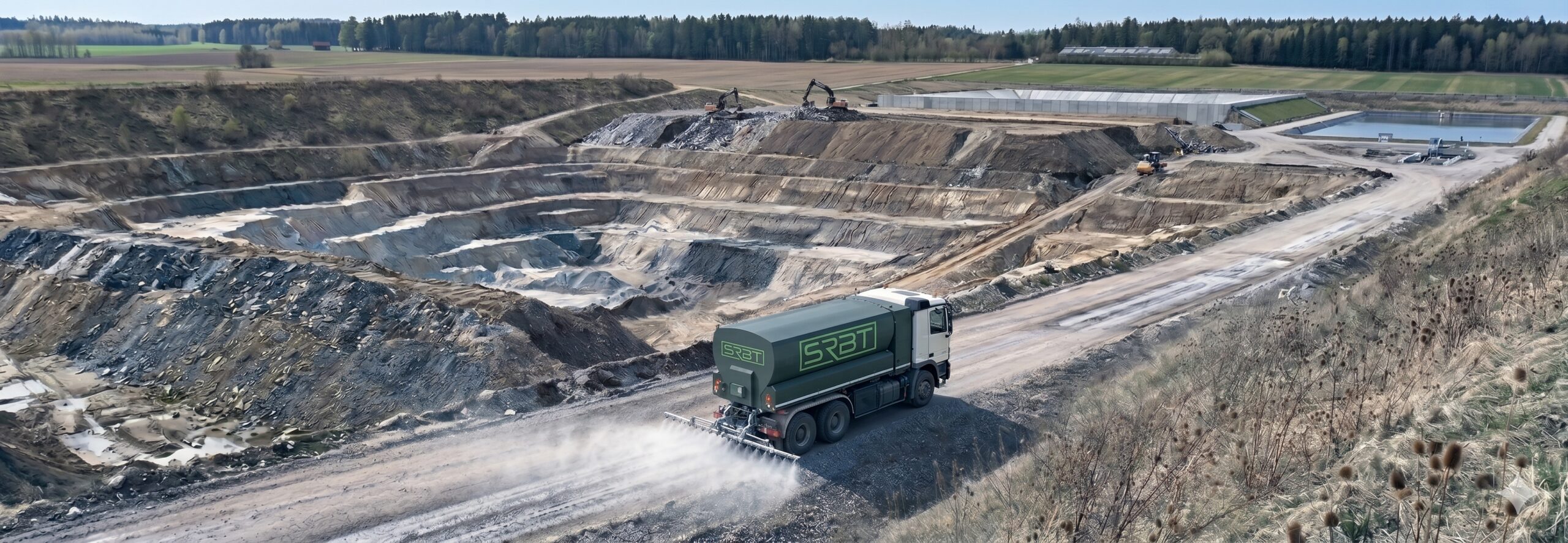
SRBT tanker spraying dust suppressant along a quarry haul road

Technical guide

Start with the surface, not the product

A technical dust-control assessment should establish:

These factors determine whether the system should retain moisture, bind particles chemically, reinforce the surface mechanically or combine several functions.

Chlorides: effective moisture retention with external costs

Calcium chloride and magnesium chloride are established dust suppressants for unpaved roads and working surfaces. Both are hygroscopic: they attract and retain moisture, helping to keep fine particles within the road surface instead of allowing them to become airborne.

Their advantages are clear. Chlorides are widely available, comparatively inexpensive and familiar to many operators. They can provide effective suppression where the surface contains sufficient fines, the climate supports moisture retention and drainage is controlled.

Their limitations are equally important. Chlorides remain mobile in water and can migrate through runoff, spray, leaching or material transfer. Repeated application can increase chloride loading in adjacent soils and drainage systems. Sensitive vegetation and freshwater environments require particular attention.

Chlorides can also accelerate corrosion of vehicles, electrical components, processing equipment and steel infrastructure. Calcium and magnesium chloride should not be treated as technically interchangeable: corrosion behavior depends on concentration, impurities, ambient moisture, exposed materials and operating conditions. Individual tests have found magnesium-chloride products to be substantially more aggressive than calcium-chloride alternatives, but a universal corrosion multiplier would be misleading without comparable test conditions.

Chlorides are therefore not unsuitable by definition. They can remain a rational option on contained sites where drainage, application rates, asset compatibility and regulatory approval are properly managed. Their low purchase price should, however, be evaluated against repeat applications, equipment corrosion, washout and water-management requirements.

Vinyl-acetate-based and other synthetic polymer binders

Synthetic polymer dispersions suppress dust by creating bonds between surface particles. After application and water evaporation, the polymer forms a film or matrix that reduces particle movement under wind and, depending on the system, moderate traffic.

Polyvinyl-acetate and related vinyl-acetate-based binders can provide rapid crust formation and comparatively durable initial performance. This can make them commercially attractive for stockpiles, temporary working areas and surfaces where frequent watering is impractical.

Performance still depends on the substrate. A brittle surface film may crack under heavy traffic, grading or differential movement. Poor penetration can leave a treated crust above loose material, while excessive application may restrict infiltration or complicate later reworking. Ultraviolet exposure, rainfall and mechanical abrasion also affect service life.

The REACH distinction matters

REACH Annex XVII Entry 78 is sometimes described too broadly as a restriction on "vinyl acetate." That is not technically correct. The entry concerns synthetic polymer microparticles meeting defined physical, dimensional, concentration and persistence criteria. Whether a particular polymer dispersion falls within the entry therefore depends on the actual formulation, particle form, concentration, solubility, degradability, intended use and any applicable derogation.

A vinyl-acetate-based product cannot be classified as compliant or non-compliant from its commercial description alone. Before specification in the European market, the supplier should provide sufficient documentation to assess:

Entry 78 does not create a blanket prohibition on every synthetic dust binder. It does make formulation-specific compliance assessment and supplier documentation increasingly important.

Organic and biological binders

Organic and biologically derived binders provide an alternative where long-term synthetic-polymer persistence or chloride mobility is undesirable. Depending on the material system, they can aggregate fines, form a flexible surface matrix and reduce wind pickup without relying solely on moisture retention.

However, "biological" does not automatically mean impact-free or universally suitable. Feedstock, processing, ecotoxicological properties and behavior in water must still be assessed. Biodegradability also creates an operational trade-off: a system designed to break down naturally will generally not provide the indefinite persistence of an inert synthetic material.

Expected service intervals must therefore be realistic. Under strong ultraviolet exposure, rainfall, traffic or microbial activity, a biodegradable treatment may require earlier renewal than a persistent polymer system. This shorter duration is not necessarily a failure. It may be the intended consequence of selecting a material that should not remain permanently in the environment.

The relevant comparison is total project performance, not price per liter. Application frequency, surface preparation, maintenance, corrosion, environmental monitoring and end-of-use requirements all influence the actual cost.

Fiber interlocking: adding mechanical reinforcement

SRBT uses fiber-based surface systems where the substrate allows fibers to interact mechanically with the soil structure. The fibers bridge fine aggregates, distribute localized stress and form a reinforcing matrix across the treated surface. A compatible binder component can add cohesion while the fiber network reduces dependence on a thin chemical film alone.

This mechanism is particularly effective on cohesive or partially cohesive substrates containing clay, silt or a stable fine fraction. Surface texture and small aggregates give the fibers points of engagement, allowing the matrix to interlock with the upper soil layer.

The limitation must be stated clearly: fibers alone cannot create reliable cohesion in clean, loose sand or coarse gravel. On highly granular substrates, they may remain on the surface without sufficient anchorage. These conditions generally require an additional binder mechanism, a suitable growth or carrier matrix, improved grading, or another form of surface stabilization.

Fiber interlocking is also not a substitute for geotechnical design. It controls particle release and shallow surface behavior; it does not correct inadequate bearing capacity, slope instability or structural failure within the underlying layer.

Increasing regulatory attention without predicting a universal ban

Dust suppressants are receiving greater regulatory attention in several jurisdictions, but the development is not governed by one global rule.

For chlorides, the focus is primarily on freshwater quality, runoff pathways, soil accumulation and infrastructure corrosion. Requirements can vary between countries, states, water authorities and individual project permits. Applications near water bodies may require explicit assessment or approval even where the same product is routinely used elsewhere.

In the European Union, REACH Entry 78 has introduced a more detailed framework for synthetic polymer microparticles, including restrictions, derogations and information or reporting duties. This does not justify predicting an immediate prohibition of all synthetic binders. It does mean that product selection can no longer rely solely on historical practice or a generic safety data sheet.

The observable direction is toward stronger documentation, clearer control of environmental release and more site-specific justification.

Comparing the main system types

System comparison

SystemPrimary mechanismBest suited toMain advantagesMain constraints
Calcium or magnesium chlorideMoisture attraction and retentionFine-bearing roads with controlled drainageEstablished, accessible, comparatively low initial costCorrosion, runoff, chloride accumulation and repeat application
Synthetic polymer binderFilm formation and particle bondingStockpiles and surfaces requiring a defined crustRapid binding and potentially longer initial service lifeFormulation-specific REACH assessment, cracking, persistence and reworking
Organic or biological binderAggregation and biodegradable bindingEnvironmentally sensitive or temporary applicationsReduced reliance on persistent polymersWeathering, biodegradation and potentially shorter treatment intervals
Fiber-reinforced biological systemMechanical interlocking plus bindingCohesive clay-, silt- or fines-containing substratesCombines mechanical reinforcement with surface bindingLimited anchorage on clean sand or coarse gravel without additional measures

A practical selection process

A technically defensible specification should answer five questions:

  1. 1. What releases the dust?

    Wind, traffic abrasion, moisture loss and fines migration require different responses.

  2. 2. What does the substrate provide?

    A binder cannot compensate indefinitely for unsuitable grading, and fibers need material with which they can interlock.

  3. 3. Where can the treatment migrate?

    Drainage, runoff, groundwater, nearby vegetation and receiving waters must be part of the design.

  4. 4. How long must the system perform?

    A temporary shutdown, an active haul road and a long-term stockpile require different durability and maintenance strategies.

  5. 5. What happens after use?

    Regrading, excavation, reuse and final rehabilitation can make persistent treatment undesirable even when it initially performs well.

Where uncertainty remains, a controlled field trial is more reliable than selecting a system from generic product data. Application quality, weather during curing, traffic control and monitoring are as important as the material itself.

Revegetation of company premises and logistics areas

Dust control as an engineered surface system

SRBT develops dust-control systems from site conditions rather than from a fixed product catalog. The process combines substrate assessment, material selection, application engineering and operational planning. Proprietary formulations remain project-specific.

The objective is not to eliminate established methods such as chlorides or synthetic binders from every project. It is to use them only where their mechanism, service life and external effects fit the site — and to provide fiber-reinforced biological alternatives where a different balance is required.

Related application

SRBT tanker spraying dust suppressant along a quarry haul road
Dust Control

Application
Read more →
SRBT tanker spraying dust suppressant along a quarry haul road
Haul-road dust binding at an active quarry

Case Study
Read more →
Any questions?

A project, a partnership or a research collaboration — get in touch by phone or email.