Engineering Guide

A Guide to Slope Stabilization

Why structural stability, drainage, surface preparation and vegetation must be designed as coordinated but separate functions

The term "slope stabilization" is often used for very different engineering tasks. A retaining structure, a drainage channel, an erosion-control matrix and a vegetation system may all contribute to the performance of a slope, but they do not perform the same function.

Structural slope engineering determines whether the soil or rock mass is stable. Drainage engineering controls surface water and subsurface pressure. Surface erosion control protects the exposed soil against raindrop impact and runoff. Vegetation supports the longer-term development of the upper soil layer.

A successful system coordinates all four disciplines without expecting one to compensate for failure in another.
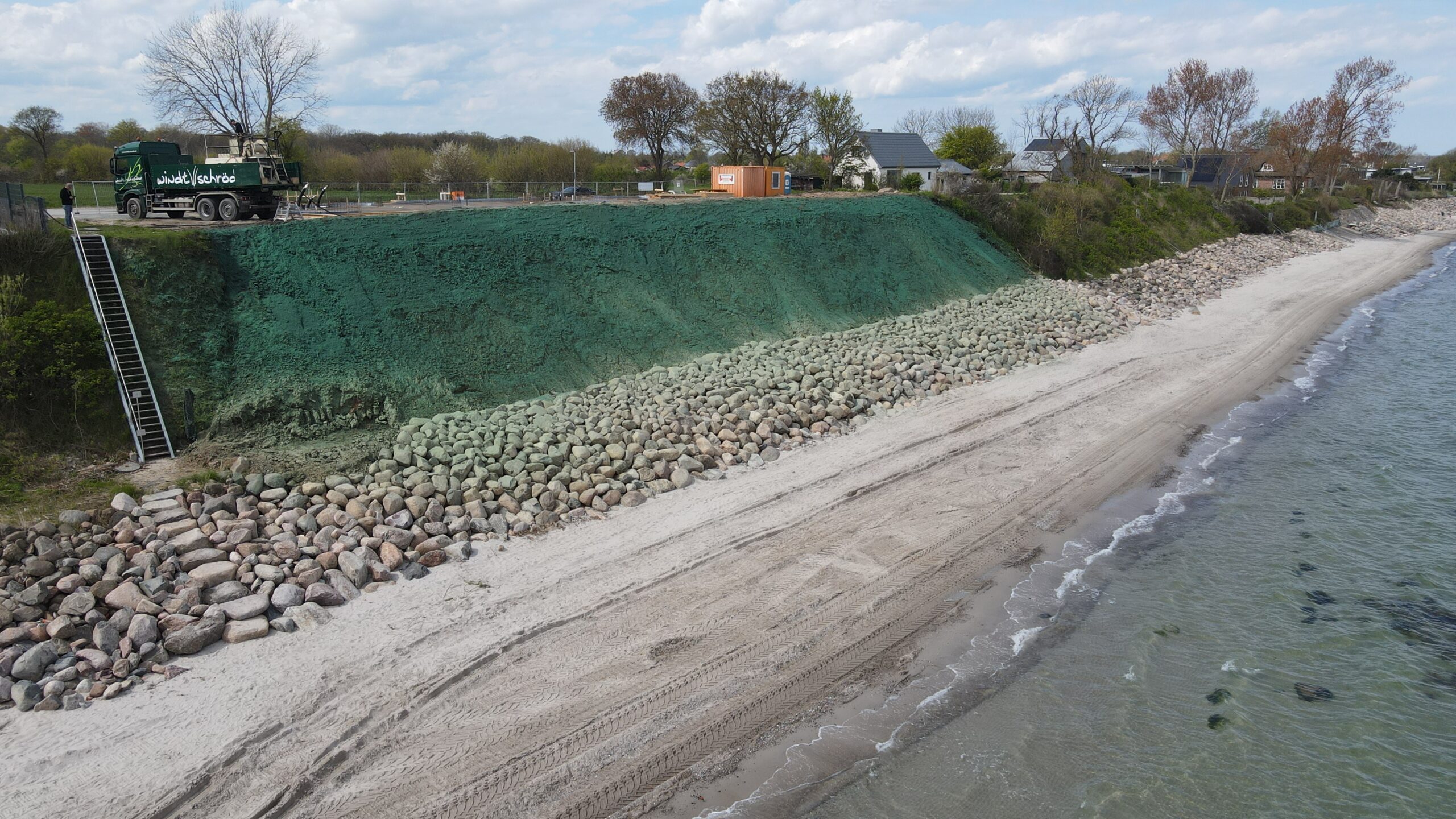
Coastal protection and revegetation of dike systems

Technical guide

Structural stability comes first

Before surface treatment is specified, the slope must be assessed for potential structural failure.

Relevant factors can include:

Where the slope is structurally unstable, stabilization may require regrading, retaining structures, soil nails, anchors, reinforced-earth systems, rockfall protection or other geotechnical measures.

Hydroseeding, erosion-control fibers and vegetation cannot provide a geotechnical factor of safety. Their role is limited to the surface and shallow rooting zone after the landform has been assessed and, where necessary, structurally secured.

Drainage is part of the slope system

Water is one of the main links between structural instability and surface erosion.

Surface runoff can detach and transport soil particles. Concentrated flow can create rills and gullies, undermine the slope toe or erode around structures. Water entering the slope can increase pore pressure, reduce effective stress and contribute to deeper movement.

Drainage design may therefore include:

These measures require hydraulic and, where relevant, geotechnical design. Applying vegetation to a slope with uncontrolled concentrated flow usually delays visible failure rather than resolving its cause.

Why smooth slopes can erode quickly

A visually clean, finely graded slope is not necessarily an erosion-resistant slope.

A smooth surface provides little microtopography to slow runoff, store small quantities of water or intercept moving sediment. Rainfall that cannot infiltrate begins as sheet flow across the surface. As runoff accumulates downslope or follows small imperfections, it can concentrate into rills. Once these preferential flow paths develop, erosion can accelerate rapidly.

Fine grading may also compact the upper soil layer. This can reduce infiltration and make root penetration more difficult, increasing both runoff and the risk of poor vegetation establishment.

The problem is not that every smooth surface will fail. It is that smoothness removes small-scale resistance and storage features that might otherwise slow the transition from rainfall impact to concentrated erosion.

Surface roughening as a functional treatment

Surface roughening introduces grooves, depressions, steps or track impressions into the prepared slope. Properly designed, these features:

Common methods include scarification, contour furrowing, stair-step grading, serrated grading and track walking. The correct method depends on slope gradient, substrate, accessibility, equipment safety, future maintenance and the intended surface treatment.

Roughening should not produce excessive compaction. Repeated heavy-equipment passes can create dense layers that reduce infiltration and impair root growth. Sandy, rocky or very steep surfaces may also require different preparation methods because conventional grooves cannot be formed or maintained reliably.

Surface roughening is a preparation measure, not a complete stabilization system. It normally works in combination with hydraulic application, mulch, erosion-control matrices, blankets, vegetation or other protective measures.

Orientation determines whether grooves help or harm

Grooves and track impressions must interrupt the downslope flow path. They should therefore run approximately along the contour—across the fall line rather than directly downhill.

Correctly aligned transverse features spread and slow runoff. They shorten the uninterrupted flow path and provide small storage and deposition zones.

Continuous grooves running down the fall line can have the opposite effect. Instead of slowing runoff, they collect and channel water. Flow depth and velocity increase within the groove, making rill formation more likely.

This is an important construction-quality issue. A specification that simply requires the slope to be "roughened" is incomplete unless it also defines the intended orientation, equipment method and inspection criteria.

Four coordinated functions

System comparison

FunctionPrimary purposeTypical measuresWhat it does not replace
Structural slope engineeringPrevent mass movement or structural failureRegrading, reinforcement, retaining systems, anchors, soil nailsDrainage, erosion control or vegetation design
Drainage engineeringControl surface flow and subsurface waterDiversions, channels, slope drains, toe drains, energy dissipationGeotechnical stabilization
Surface erosion controlReduce detachment and shallow soil lossRoughening, fiber matrices, binders, blankets, temporary coversStructural stability or contamination remediation
Vegetation establishmentDevelop long-term protective cover and root-zone functionSeed, growth media, moisture management and site-adapted vegetationImmediate protection during the establishment window

The functions interact, but they are not interchangeable. Vegetation may reinforce the shallow root zone, yet it cannot restrain a deep slip surface. A blanket may resist raindrop impact, yet it cannot safely convey concentrated runoff unless its anchoring and hydraulic limits have been designed for that purpose.

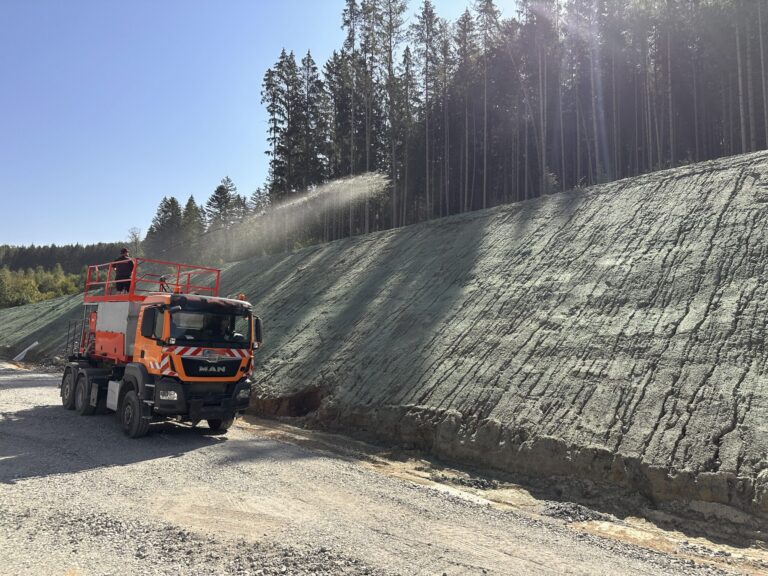
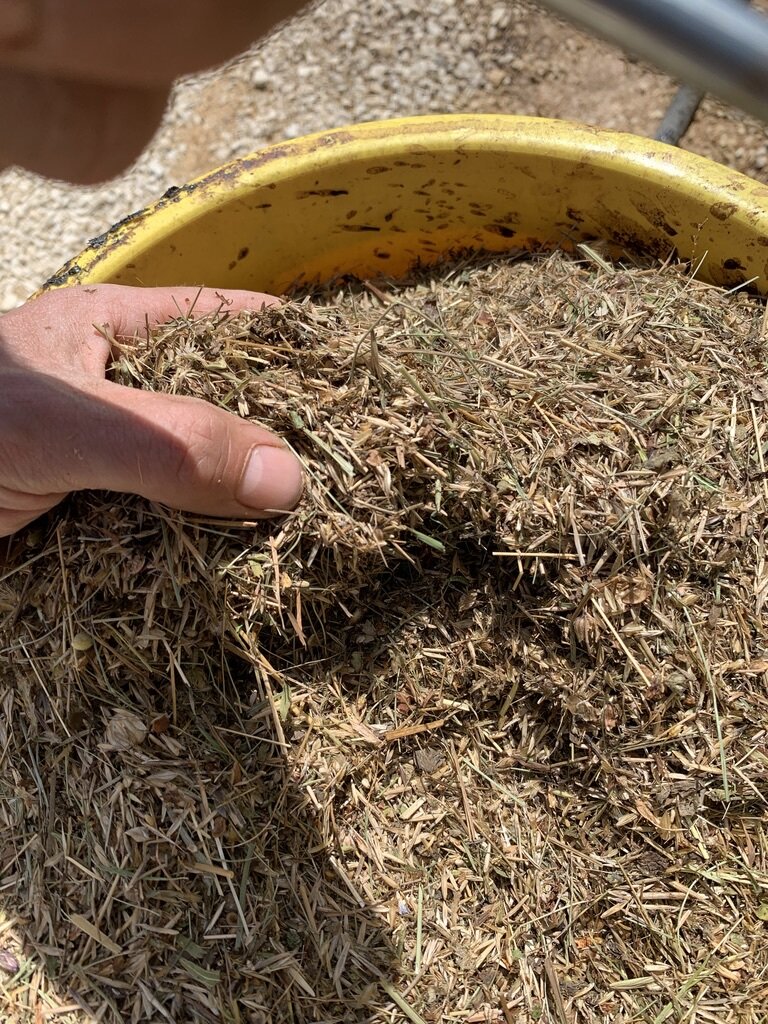
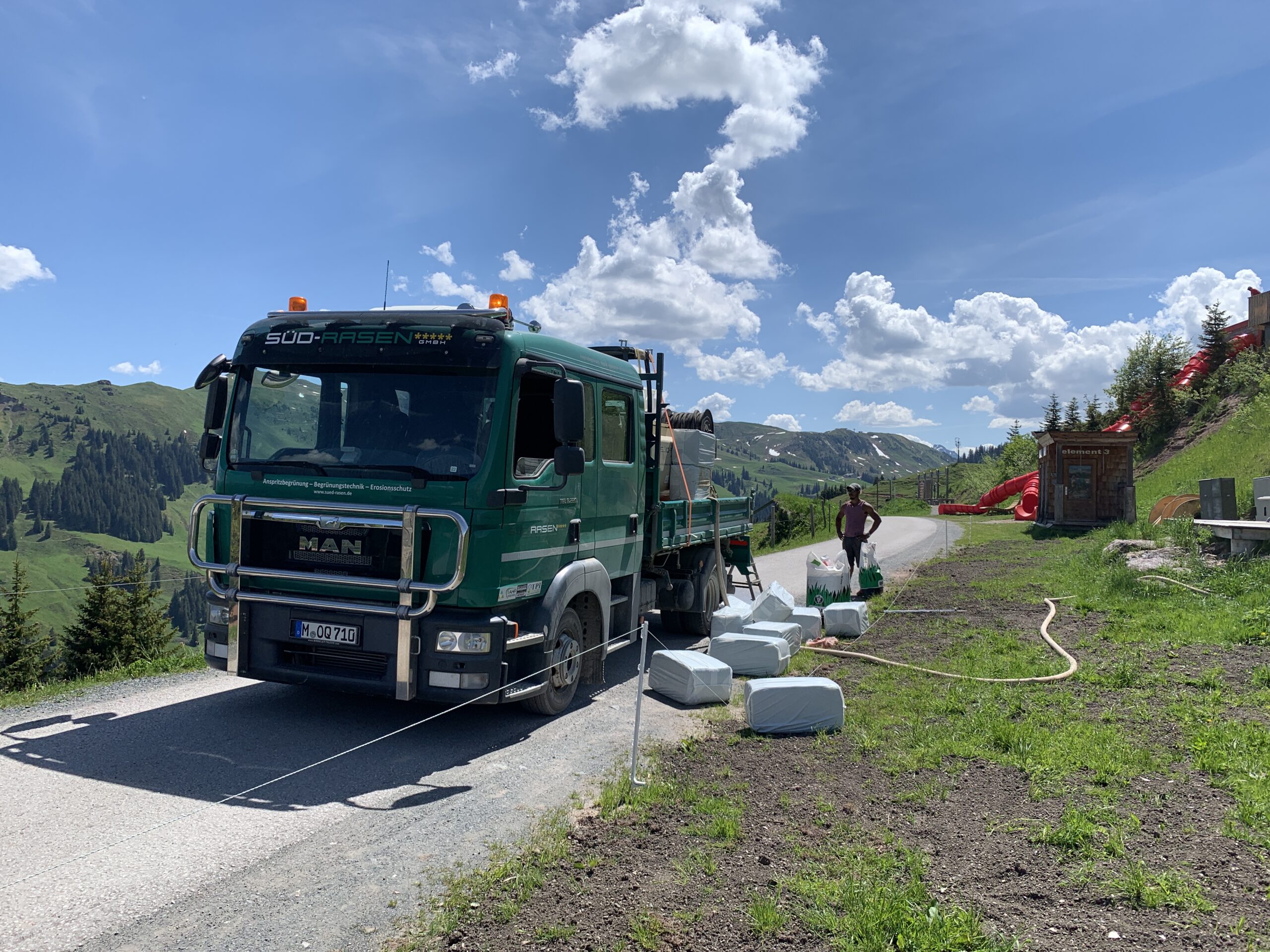
Service vehicle and mulch bales at a high-altitude revegetation site

The erosion window before vegetation establishes

A newly seeded slope remains vulnerable until sufficient cover has developed. This interval may last weeks or months depending on climate, season, substrate and species.

During the establishment window, the system must protect against:

Hydraulic erosion-control systems can combine fibers, growth media, moisture management and compatible binders to create immediate surface protection while vegetation develops. Material selection must reflect the erosion exposure, substrate chemistry, slope geometry and required service period.

Proprietary formulations remain project-specific.

Matching the system to the substrate

Cohesive soils

Clay- and silt-bearing substrates may offer good mechanical engagement for a fiber matrix, but they can also seal, compact and generate substantial runoff. Surface preparation must create roughness without producing a dense, polished layer.

Granular soils

Loose sand and gravel provide limited cohesion. Fibers alone may not anchor sufficiently, particularly under concentrated runoff. These surfaces can require a compatible binder, an engineered growth layer, confinement or another structural surface measure.

Rock and thin soils

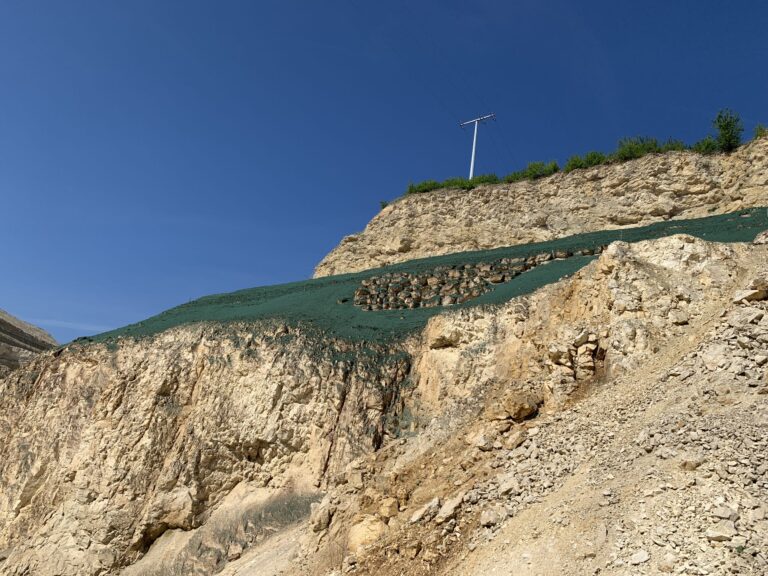
Rock cuts and shallow mineral substrates may lack sufficient rooting volume. Vegetation establishment depends on whether suitable material can be retained on the face. Rockfall and block stability remain separate geotechnical questions.

Reconstructed and mine substrates

Waste rock, overburden and engineered cover layers can vary widely in compaction, drainage, salinity, pH and available fines. Surface treatment should begin only after the technical landform and any containment system have been approved.

Where modeling supports decisions

SRBT uses proprietary erosion and sediment-modeling software to compare surface-treatment scenarios before application.

Depending on the available project data, scenario inputs can include:

The purpose is comparative: to estimate how changing slope geometry, surface preparation, cover system or establishment strategy may alter erosion and sediment loss relative to another scenario.

Modeling can help identify sensitive parameters, compare alternatives and prioritize field trials. It is not an exact prediction of the quantity of soil that will leave a particular slope during a future storm.

Results depend on input quality, model boundaries and the extent to which field conditions correspond to the assumptions. Localized failures, blocked drains, construction defects, extreme events and concentrated flow paths may not be represented adequately by a surface-erosion model.

The software does not calculate geotechnical slope stability and does not replace hydraulic design, statutory engineering verification or site monitoring. No software name, algorithm details or proprietary calculation methods are disclosed.

From model comparison to field validation

Where the project risk or uncertainty is material, modeling should be followed by controlled validation.

A field trial can test:

The trial should represent the actual slope orientation, gradient and substrate as closely as practical. A demonstration performed on level, prepared soil provides limited evidence for performance on a steep production slope.

Field observations can then be used to refine assumptions before full-scale implementation.

A practical slope-treatment sequence

  1. 1. Establish the structural condition

    Confirm that the slope geometry and material are stable or define the necessary geotechnical intervention.

  2. 2. Design the water pathway

    Identify where water originates, how it crosses or enters the slope, and where it can be discharged without causing erosion elsewhere.

  3. 3. Characterize the surface

    Assess particle size, cohesion, compaction, infiltration, chemistry, rooting depth and existing erosion features.

  4. 4. Prepare the surface correctly

    Select the appropriate roughening method and ensure that grooves or impressions interrupt the fall line rather than channeling water downhill.

  5. 5. Compare treatment scenarios

    Use erosion and sediment estimates to evaluate surface cover, roughness, vegetation timing and temporary protection options.

  6. 6. Validate critical assumptions

    Use a representative field trial where substrate behavior, weather exposure or application performance remains uncertain.

  7. 7. Install and inspect

    Verify preparation, coverage, anchoring, drainage connections and vulnerable transition areas during construction.

  8. 8. Monitor through establishment

    Inspect after significant rainfall and during vegetation development. Repair rills, blocked drainage, exposed edges or local failures before they expand.

Inspection must consider transitions

Slope failures often begin at interfaces rather than across the center of a uniformly treated area.

Critical locations include:

Monitoring should record surface erosion, sediment deposition, drainage performance, vegetation cover and changes in the slope itself. Cracks, bulging, persistent seepage or movement require geotechnical assessment, not another surface application.

What a successful system achieves

A successful slope system does more than produce vegetation.

It should:

The correct measure is therefore not the amount of material applied or the speed at which the slope turns green. It is the coordinated performance of the landform, drainage, surface protection and vegetation over the required service period.

The SRBT approach

SRBT develops surface-protection and revegetation systems after structural and drainage requirements have been defined.

The process combines site analysis, comparative erosion modeling, surface-preparation planning, project-specific material selection and hydraulic application engineering. Field trials and post-application monitoring are used where the available data do not justify relying on model estimates alone.

Structural slope engineering, surface erosion control and vegetation establishment perform different but coordinated functions. Treating them as one interchangeable service creates avoidable technical risk.

Related application

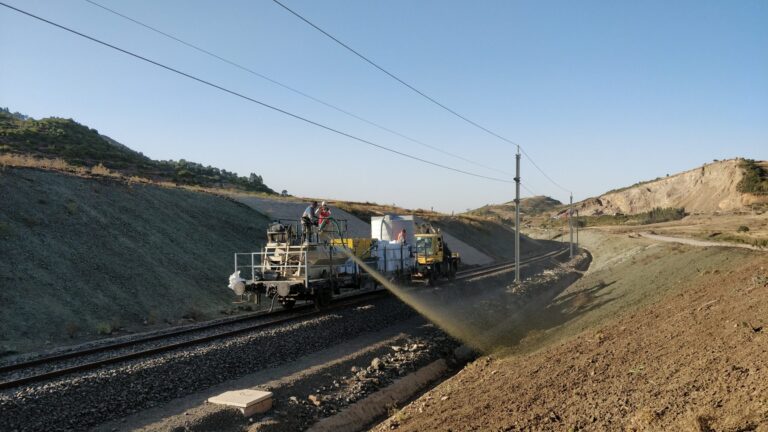
Railway track revegetation by hydroseeding
Difficult Revegetation

Application
Read more →
Revegetation and dust control on unpaved parking areas
Mine Rehabilitation

Application
Read more →
Slope revegetation by hydraulically applied seeding
Temporary Surface Protection

Application
Read more →
Biodiversity areas established on a golf course
Climate Adaptation

Application
Read more →
Any questions?

A project, a partnership or a research collaboration — get in touch by phone or email.