Engineering Insight

Managing Dust, Erosion and Cover on One Site

Why three related surface problems can require different—and sometimes opposing—technical solutions

Project inquiries frequently arrive as a single, underspecified request: "we have a dust problem" or "we need erosion control." These statements describe a symptom, not an engineering brief.

Dust on a stockpile and dust on a haul road are not the same problem. One is driven primarily by wind shear across an exposed, largely undisturbed surface; the other by mechanical abrasion and disturbance from repeated vehicle traffic. The appropriate material system, application method and reapplication logic can differ substantially between the two, even though both are described using the same word.

Before any system can be designed, the actual location, mechanism and regulatory context of the problem must be established.
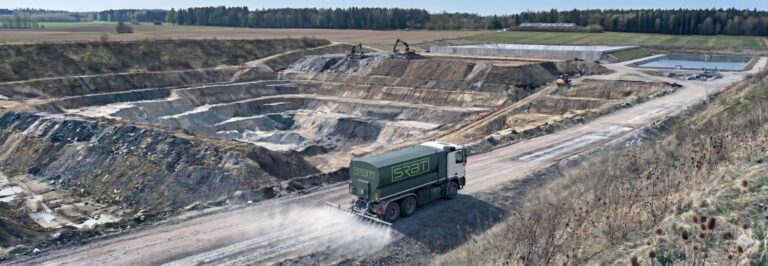
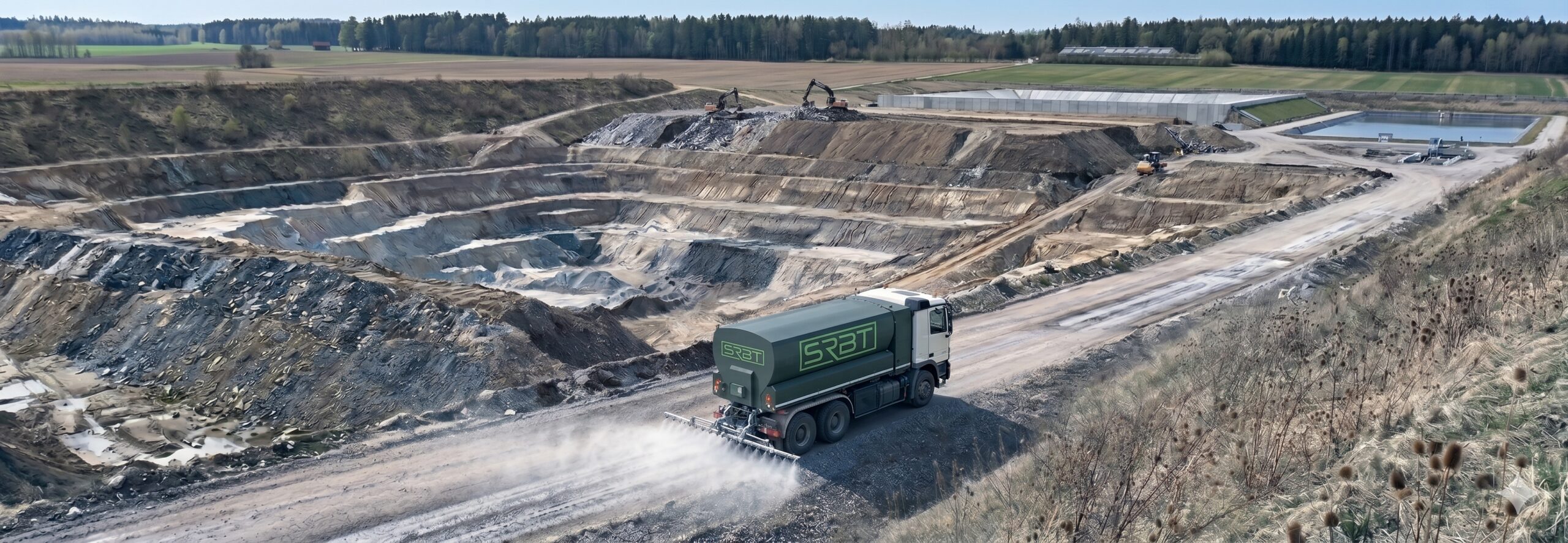
SRBT tanker spraying dust suppressant along a quarry haul road

Technical guide

The first question: where, exactly, is the problem?

A single site can generate several distinct dust, erosion or cover requirements simultaneously, and each location typically demands a different answer.

Identifying which of these locations—and which underlying mechanism—is actually generating the reported problem is the necessary first step. A system specified for wind-driven stockpile dust will not necessarily perform on a haul road subject to constant wheel loading, and vice versa.

The second question: is there a water-protection requirement?

Independent of the specific location, one question is relevant on nearly every industrial or infrastructure site: does a water-protection or groundwater-related regulatory requirement apply to this area?

This question can change the entire technical approach, not merely the choice of material. Water-protection status determines whether the treated surface should promote infiltration, restrict it, or manage it through controlled drainage—and this decision must be made before a system is selected, not adjusted afterward.

Relevant considerations include proximity to surface water or groundwater, the presence of regulated or potentially contaminated material beneath the treated surface, applicable permits or environmental conditions attached to the site, and whether runoff from the treated area is required to be captured, treated or otherwise managed separately.

Dust: three available mechanisms

Dust control can draw on several distinct mechanisms, and the appropriate combination depends on the specific exposure and objective.

Particle fixation

A binder or tackifier creates adhesion between fine particles, reducing their tendency to become airborne under wind or disturbance. This mechanism is most relevant where the primary objective is preventing individual particles from separating from the surface.

Moisture retention

Retaining moisture within the surface layer reduces dust generation by keeping fine material cohesive rather than dry and mobile. This mechanism is time-limited by definition: its effectiveness depends on ongoing moisture availability, evaporation rate and climate.

Thin protective matrix application

A sprayed matrix can form a thin, continuous protective layer across the exposed surface, physically limiting particle release independent of moisture content. This mechanism is generally more persistent than moisture retention alone but depends on maintaining surface continuity.

These mechanisms are not mutually exclusive. A project-specific dust-control system frequently combines fixation, moisture management and matrix formation in proportions determined by the site's exposure, substrate and required service life.

Erosion: fiber interlocking as the near-universal starting point

Erosion control on exposed slopes and disturbed surfaces relies, in almost every case, on a combination of wood fibers at different lengths engineered to create three-dimensional interlocking within the applied matrix.

Longer fibers form a more open structural framework capable of bridging larger surface irregularities and resisting displacement. Shorter fibers fill the resulting gaps, increase overall matrix density and improve surface coverage. Combined, the fiber blend absorbs raindrop energy, resists shallow sheet and rill erosion, and retains seed and fine material during the vulnerable establishment period.

Application rates are not a fixed specification. They are determined by three site-specific factors:

Proprietary formulations and application rates remain project-specific.

Cover: defining what must be prevented

"Cover" is not one function. It answers a specific question: what is the treated layer actually meant to stop?

Two common objectives lead to substantially different, sometimes opposing, technical requirements.

Cover for groundwater and containment protection

Where the objective is protecting groundwater—typically because the covered material includes contaminated, regulated or potentially leachable content—the treated layer must be designed for low permeability.

Its function is to direct precipitation off the surface through controlled drainage rather than allowing it to infiltrate through the stored material and mobilize contaminants. This is fundamentally a containment and barrier function, closer to engineered cap design than to conventional erosion control. A permeable, infiltration-friendly erosion-control system would be the wrong choice here—potentially the opposite of what the site requires.

This function must be coordinated with the site's approved containment design, drainage engineering and any regulatory monitoring requirements. Surface treatment supports this objective; it does not substitute for an engineered containment system where one is required.

Cover for wind-driven dispersal protection

Where the objective is preventing material from being dispersed by wind—whether driven by regulatory requirement, worker health and safety, or protection of nearby equipment and vehicles—the relevant mechanisms are much closer to conventional dust control: particle fixation, surface cohesion and, where appropriate, moisture management.

This function does not generally require low permeability and can often be integrated with erosion-control or vegetation objectives on the same surface.

Confusing these two cover objectives can lead to a system that performs the wrong function—for example, a permeable dust-suppression treatment applied where an impermeable containment layer was actually required, or an unnecessarily impermeable barrier applied where straightforward wind protection would have sufficed.

Comparing the four functions

System comparison

FunctionTypical objectivePreferred permeabilityPrimary mechanisms
Dust controlReduce particle release from an exposed surfaceUsually permeable or moderately permeableParticle fixation, moisture retention, thin protective matrix
Erosion controlReduce detachment and transport of soil or mineral materialUsually permeable, supports infiltration and vegetationFiber interlocking, tackifier/binder cohesion
Cover for containmentPrevent infiltration into contaminated or regulated materialDeliberately low permeabilityEngineered barrier layer, controlled surface drainage
Cover for wind protectionPrevent wind-driven dispersal of material or dustPermeable, focused on surface cohesionParticle fixation, surface binding, similar to dust control

Why one site often needs several different systems

An active industrial or infrastructure site frequently contains all of these functions simultaneously, in different locations.

A haul road may need traffic-resistant dust binding. An adjacent stockpile may need wind-driven dust control through moisture management and fixation. A regulated storage area may need a low-permeability containment cover unrelated to either. A graded slope elsewhere on the same site may need fiber-based erosion control designed to support vegetation.

Treating these as one undifferentiated "surface treatment" problem—applying a single specification across the entire site—risks under-protecting some areas while unnecessarily over-engineering others, and in the case of containment versus conventional erosion control, risks specifying a system with the wrong permeability characteristics entirely.

Revegetation of company premises and logistics areas

A practical intake framework

Before a system can be designed, the following should be established for each distinct area of the site:

  1. 1. Location and mechanism

    Is the problem occurring on a stockpile, road, slope, storage area or temporarily exposed surface? Is it wind-driven, traffic-driven, rainfall-driven or infiltration-related?

  2. 2. Regulatory and water-protection context

    Does a water-protection or groundwater requirement apply to this specific area? Is the underlying material regulated, contaminated or otherwise subject to containment requirements?

  3. 3. The actual objective

    Is the goal reducing airborne particles, reducing soil or material transport, preventing infiltration, or some combination? Is vegetation establishment part of the objective, or is the treatment intended to remain vegetation-free?

  4. 4. Site conditions

    What is the substrate, slope, traffic exposure, climate and available water? What service life is required, and what happens to the surface afterward?

  5. 5. Coordination across the site

    Where multiple functions are required in different locations, how do the treatment boundaries align, and are there transition zones requiring particular attention?

This assessment sequence applies before material selection, not after. A specification developed without first answering these questions is unlikely to match the actual requirement, however well-engineered the material system itself may be.

The SRBT approach

SRBT begins every industrial surface-management engagement by disaggregating the reported problem into its actual location, mechanism, regulatory context and objective, rather than responding to an underspecified request with a single default treatment.

The process combines site-wide functional mapping, water-protection and regulatory review, mechanism-specific material selection for dust, erosion and cover requirements, and coordinated application planning across zones with different—sometimes opposing—technical needs.

The objective is not to apply one surface treatment across an entire site. It is to identify which of several distinct problems is actually present in each location, and to design the corresponding system accordingly.

Proprietary formulations remain project-specific.

Related application

Revegetation of company premises and logistics areas
Industrial Surface Management

Application
Read more →
SRBT tanker spraying dust suppressant along a quarry haul road
Guide to Dust Control

Engineering Guide
Read more →
Alpine revegetation carried out by helicopter
Guide to Slope Stabilization

Engineering Guide
Read more →
Any questions?

A project, a partnership or a research collaboration — get in touch by phone or email.