Case Study

Haul-Road Dust Binding at an Active Quarry

An inspection-led approach to replacing vinyl-acetate-based dust binders under variable traffic and weather exposure

Fields of application

Application

Dust Control

Operating environment

Active quarry

Surface

Unpaved mineral haul roads

Primary loading

Repeated heavy-vehicle traffic

Design objective

Transition away from vinyl-acetate-based binders while maintaining practical dust control

Reapplication principle

Condition- and axle-load-based rather than calendar-based

Case study

The challenge

Dust control on an active quarry haul road is not simply a matter of applying a binder at regular intervals. The treated surface is exposed simultaneously to wheel abrasion, braking and turning forces, fines migration, drying, rainfall and repeated loading by heavy vehicles.

The operator wanted to move away from vinyl-acetate-based binder systems. This was treated as a project-specific material decision rather than a claim that all vinyl-acetate formulations are prohibited.

REACH Entry 78 regulates synthetic polymer microparticles according to defined material and formulation criteria. Its relevance must therefore be assessed for the individual product; the presence of a vinyl-acetate-based polymer alone does not determine regulatory status. The operator's objective was nevertheless clear: identify alternative systems with a more suitable material profile without ignoring the shorter functional life that can accompany non-inert or biodegradable components.

The replacement system also needed to perform under uneven traffic loading. Straight haul-road sections, turning areas, loading zones and gradients do not deteriorate at the same rate. A single calendar-based treatment interval would therefore have resulted in either premature reapplication or insufficient protection.
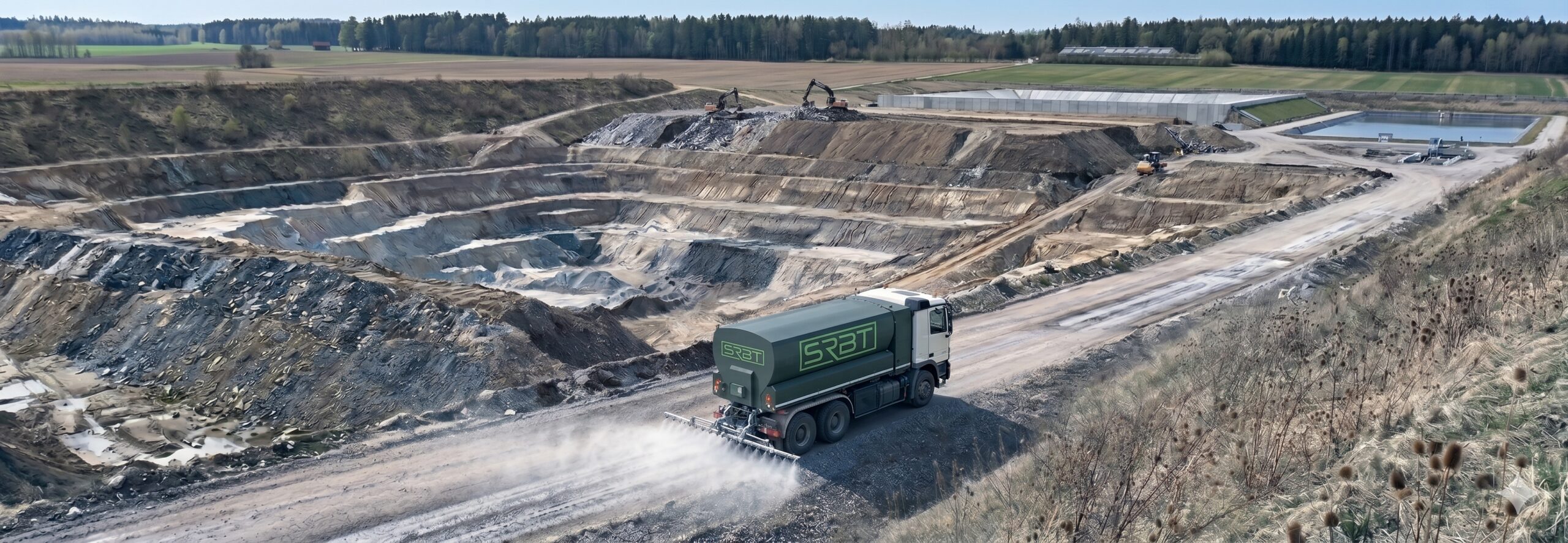
SRBT tanker spraying dust suppressant along a quarry haul road

Why standard reapplication schedules were unsuitable

Many dust-control programs specify treatment weekly, monthly or at another fixed interval. This simplifies planning but does not describe the actual mechanical demand on the surface.

Surface deterioration is influenced by:

A road section carrying frequent loaded outbound traffic may lose its protective function much faster than a lightly used access section. Turning zones can experience high near-surface shear even where total vehicle numbers are lower.

The methodology therefore linked inspection and reapplication to actual traffic exposure and cumulative axle loading—not solely to elapsed days.

Site and substrate assessment

The first step was to divide the road network into functional sections rather than treating the quarry as one uniform surface.

The assessment considered:

This distinction was essential because the available binding mechanism changes with the substrate.

A lignosulfonate-based binder can interact effectively with fines and cohesive particles, but performance may be reduced on coarse, clean aggregate with little fine material. A fiber matrix can improve mechanical interlocking and retain loose particles near the surface, but it does not replace a structurally adequate road base.

Two material-system variants

Two alternative system principles were assigned according to the behavior of each road section.

Lignosulfonate-based system with a fiber fraction

The first variant combined a lignosulfonate-based binding function with a selected fiber fraction.

Lignosulfonate can provide particle adhesion and surface cohesion. The fibers add a mechanical component by forming a network within the upper surface layer. This network can:

The fibers were not treated as an inactive filler. Their geometry and interaction with the mineral surface formed part of the binding mechanism.

This variant was most relevant where sufficient fines and substrate contact allowed the lignosulfonate and fiber components to operate together.

Load-responsive fiber matrix

The second variant used a more strongly fiber-dominated matrix on sections exposed to concentrated wheel loading and near-surface shear.

Its purpose was to distribute stresses within the treated surface layer, retain fines around wheel-contact areas and reduce localized displacement. This should not be interpreted as structural axle-load distribution in the pavement-engineering sense.

The matrix does not increase the bearing capacity of an inadequate road base, correct deep rutting or replace geotechnical road design. Its function is limited to the upper surface zone, where fibers can improve mechanical interlocking and reduce the rapid separation of loose particles under traffic.

The distinction is important: dust-control treatment manages the surface; it does not rebuild the haul road.

Application methodology

Before treatment, the surface condition was assessed to determine whether grading, localized repair or moisture adjustment was required.

Applying a binder to an unstable, deeply rutted or poorly drained surface would have protected the wrong condition. Structural maintenance therefore remained separate from the dust-control application.

The application sequence followed four principles:

Proprietary formulations and application rates remain project-specific.

Reapplication based on loading and condition

Reapplication was planned within a variable range of approximately 10 to 45 days. This range was not a guaranteed service interval.

The shorter end could apply during:

Longer intervals could be achievable where:

Reapplication was triggered by the combined evidence of traffic loading, weather exposure and physical inspection. The number of days was an operational result, not the primary design criterion.

Relevant inspection indicators included:

Outcome and transferable lessons

The methodology demonstrated that replacing a conventional synthetic binder is not a one-for-one product substitution. Material choice, fiber function, substrate behavior and maintenance planning must be redesigned as one operating system.

Alternative systems may require shorter intervals

Materials selected for improved environmental behavior may be less persistent than inert synthetic systems. This limitation should be reflected honestly in maintenance planning and lifecycle costing.

Fiber provides a separate mechanical function

A fiber fraction can supplement chemical binding by retaining fines and reinforcing the near-surface matrix. Its benefit depends on fiber geometry, mineral contact and the behavior of the treated substrate.

Traffic loading is more informative than the calendar

A fixed monthly schedule cannot distinguish a heavily loaded turning area from a lightly trafficked straight section. Cumulative vehicle and axle loading provide a more defensible basis for inspection planning.

The route should be divided into functional sections

Different parts of the same haul road may require different material systems, application intensities or inspection frequencies.

Surface treatment does not replace road engineering

Dust binding cannot correct insufficient bearing capacity, defective drainage, severe rutting or unsuitable aggregate grading. These conditions must be addressed separately.

Degradability changes the maintenance model

A naturally degradable system can reduce concerns associated with persistent materials, but degradation also limits functional duration. Environmental profile, service life and reapplication effort must be evaluated together.

The SRBT approach

SRBT develops quarry dust-control systems from the actual surface condition, traffic loading, substrate composition, climate and operational constraints.

The process combines route segmentation, substrate and fines assessment, traffic and axle-load evaluation, material-system selection, fiber and binder coordination, application planning, installed-coverage inspection, condition-based reapplication and review after weather and maintenance events.

The objective is not to replace one binder with another and preserve the previous maintenance schedule. It is to establish a technically and operationally defensible surface-management system for the individual site.

Proprietary formulations remain project-specific.

Methodological disclaimer

This anonymized case study illustrates transferable engineering principles. It does not identify or claim execution at a specific quarry, guarantee a particular treatment interval or establish universal performance for lignosulfonate- or fiber-based systems.

Actual results depend on substrate, fines content, vehicle loading, road design, weather, water quality, application rate, installation quality and maintenance practices.

Related application

SRBT tanker spraying dust suppressant along a quarry haul road
Dust Control

Application
Read more →
SRBT tanker spraying dust suppressant along a quarry haul road
Guide to Dust Control

Engineering Guide
Read more →
Any questions?

A project, a partnership or a research collaboration — get in touch by phone or email.