Case Study

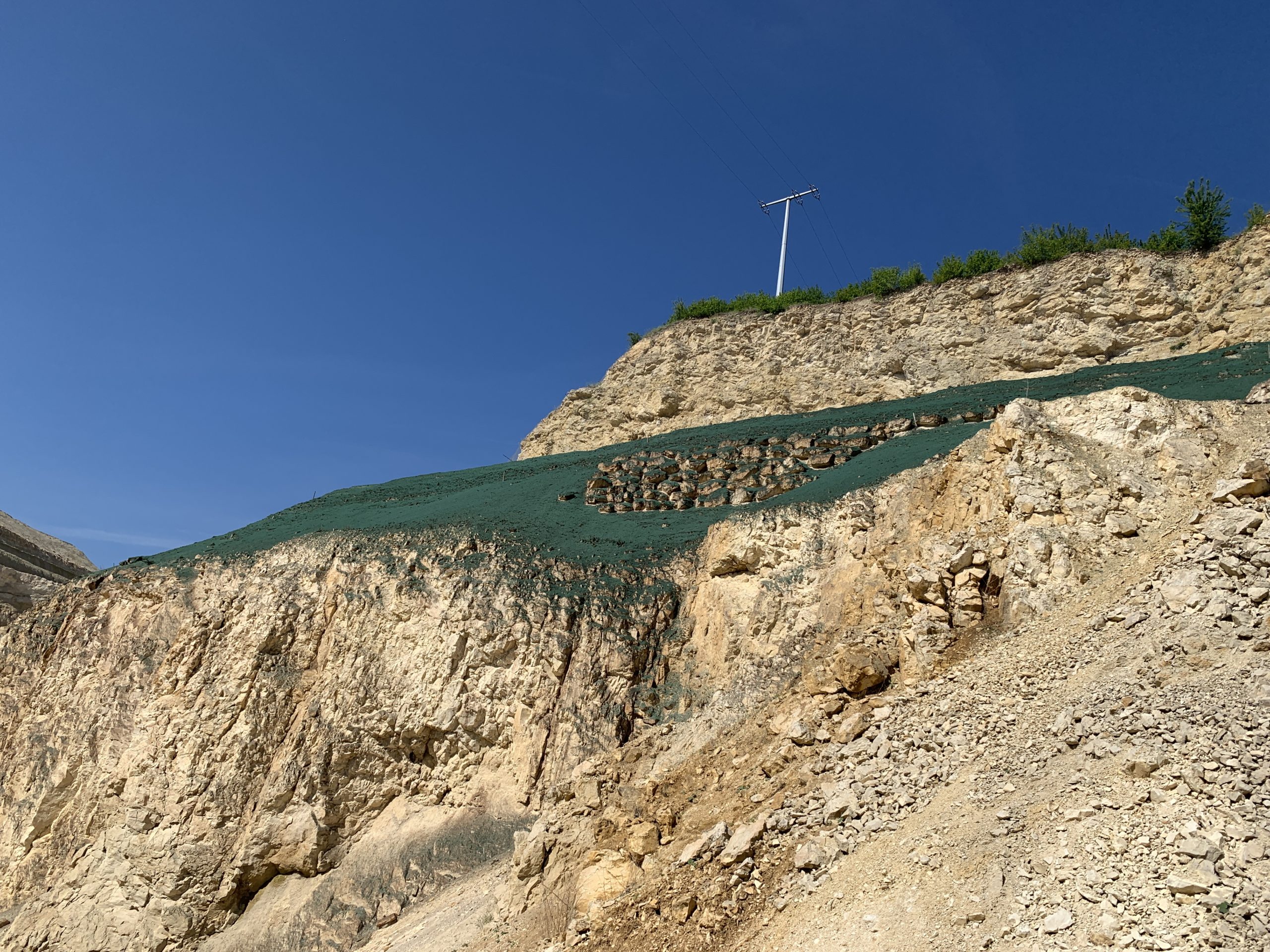
Revegetating a Steep Waste-Rock Slope

A two-stage system combining peat-free biotic soil media with project-specific surface erosion protection

Fields of application

Application

Mine Rehabilitation

Surface

Steep waste-rock (barren rock / mine-waste) slope

Substrate condition

Mineral, nutrient-poor and biologically inactive

Primary challenge

Establishing vegetation while protecting the exposed surface

Method

Two-stage hydraulic application

Stage 1

Peat-free biotic soil medium

Stage 2

Proprietary full-surface erosion-control matrix

Case study

The challenge

Waste-rock slopes present a fundamentally different establishment environment from natural topsoil. This barren, largely mineral material is generated when uneconomic rock is moved to reach valuable ore, and it commonly remains biologically inactive until deliberately treated.

The material may contain little organic matter, limited microbial activity and few plant-available nutrients. Coarse particles drain rapidly, while fine fractions can compact or seal. Depending on the source material, pH, salinity or elevated metal concentrations may further restrict root development.

Slope angle adds a separate physical problem. Before vegetation develops, rainfall can detach fine particles and carry seed, nutrients and biological amendments downslope. Wind may remove lighter components, while runoff can create preferential flow paths and rills.

The project therefore required two coordinated but distinct functions:

A conventional seed-and-fertilizer slurry would not have addressed the lack of biological function. A surface erosion matrix alone would have protected the mineral surface without necessarily creating suitable conditions for sustained plant establishment.
Revegetation and dust control on unpaved parking areas

The geotechnical boundary

Hydraulic revegetation does not stabilize an unsafe waste-rock slope.

Before biological treatment, the slope must be assessed for:

Grading, drainage, containment and geotechnical stabilization belong to the technical rehabilitation phase. The hydraulic system begins only after the slope is considered suitable for biological rehabilitation.

It also does not remediate contamination. Where potentially phytotoxic or environmentally significant constituents are present, their concentration, mobility and regulatory status require separate assessment.

Why a two-stage system was selected

The biological medium and the erosion-control layer were applied as separate stages because they perform different functions.

The first application was designed to create the biological and physicochemical conditions required for vegetation. It needed direct contact with the waste-rock substrate.

The second application formed a continuous protective matrix over the treated surface. Its purpose was to retain the first-stage components, reduce particle detachment and protect the establishment zone during the period before roots provided meaningful reinforcement.

Combining every component into one undifferentiated slurry could have compromised their distribution. Biological amendments might have remained concentrated in the upper protective layer instead of reaching the substrate interface, while the erosion-control matrix might not have developed the required surface structure.

Stage 1: Peat-free biotic soil medium

A project-specific biotic soil medium, or BSM, was developed around three principal functional components:

The system deliberately avoided peat-based ingredients.

The BSM was not intended to reproduce mature topsoil instantly. Its purpose was to introduce selected functions that the waste-rock substrate lacked and create a more favorable interface for seed germination, root development and microbial establishment.

Proprietary formulations and application rates remain project-specific.

Mycorrhiza: extending access to water and nutrients

Mycorrhizal fungi form associations with compatible plant roots. Their hyphal networks can extend beyond the immediate root zone and improve access to water and poorly mobile nutrients.

This function is potentially valuable on barren waste rock, where nutrients may be present in low concentrations, unevenly distributed or chemically unavailable.

Mycorrhiza should not be treated as a universal additive. Establishment depends on:

The inoculum must survive mixing and hydraulic application and subsequently encounter suitable roots. A product declaration alone does not establish successful colonization.

Humic substances: supporting the substrate interface

Humic and fulvic fractions can contribute to nutrient retention, aggregation and chemical buffering within the developing root zone. Their functional relevance is greatest where the mineral substrate has little native organic matter and limited capacity to retain nutrients.

Humic substances are not a replacement for a complete nutrient strategy. Their effect depends on source, composition, molecular characteristics, dosage and interaction with the waste rock.

Within the BSM, they were used to support the substrate interface and improve the retention and availability of selected nutrients rather than as a standalone fertilizer claim.

Research on mine tailings has evaluated combinations of biochar, humic substances and mycorrhizal fungi for improving fertility, hydraulic properties and plant establishment, while also confirming that responses depend on the specific tailings and amendment system.

Biochar: physical structure and chemical function

Biochar was incorporated as a functional component rather than as a generic organic filler.

Depending on its feedstock and production conditions, suitable biochar may contribute to:

These functions can be relevant on biologically inactive mineral substrates, but biochar performance is highly material-specific.

Biochar can differ substantially in pH, electrical conductivity, ash content, particle size, porosity, surface chemistry, nutrient content, contaminant profile and water-holding behavior.

An alkaline biochar may be unsuitable for an already alkaline waste rock. A highly sorptive material may immobilize undesirable constituents but may also temporarily retain nutrients needed by plants. Fine biochar can improve distribution but may create dust or alter slurry behavior.

Biochar therefore requires characterization against the actual substrate. It should not be described as a universal amendment or a guaranteed method of contaminant immobilization.

Recent field research in reclaimed coal-mine soils supports the potential for a complementary relationship between biochar and arbuscular mycorrhizal fungi, while also emphasizing that the response is specific to the soil, biochar and biological system.

Why peat was excluded

Peat has long been used in growing media because it provides low bulk density, water retention and a workable organic structure. Its technical usefulness does not remove the environmental consequences associated with peat extraction and the disturbance of peatland carbon and habitat functions.

The project therefore used a peat-free BSM.

This decision did not assume that biochar is a direct one-for-one substitute for peat. Research on peat alternatives consistently shows that biochar performance depends on feedstock, production conditions, proportion, companion materials and plant requirements. High substitution levels do not automatically produce better results.

The design objective was not to recreate a peat-based growing medium with another single material. It was to combine selected biological, physical and chemical functions in a substrate-specific system.

Applying the biotic soil medium

The first-stage application was designed to establish continuous contact between the BSM and the waste-rock surface.

Application planning considered:

The waste-rock surface needed sufficient texture to receive and retain the applied medium. A smooth, compacted or sealed slope would have provided poor anchorage and encouraged runoff beneath or across the biological layer.

The BSM was not intended to fill deep voids or correct structural defects. Its function was limited to the establishment zone at the exposed surface.

Stage 2: Project-specific erosion-control matrix

Following the BSM application, a proprietary erosion-control matrix was applied across the complete treatment area.

The second layer was designed to protect the BSM against raindrop impact, retain seed and biological amendments, reduce wind displacement, limit shallow sheet erosion, interrupt early flow paths, maintain surface contact, moderate moisture loss and protect the establishment zone while roots developed.

The matrix was engineered as a separate system rather than selected as a standard catalog product. Fiber structure, tackifier and binder functions were coordinated with slope exposure, expected rainfall and required service life.

No recipe or generic application rate can be transferred safely between waste-rock slopes. The required matrix depends on surface geometry, material texture, climate, runoff behavior and the time required for vegetation establishment.

Tackifier, binder and fiber functions

The erosion-control matrix combined mechanical and cohesive functions.

Fiber formed the physical framework. It absorbed raindrop energy, covered the mineral surface and created mechanical interlocking.

Tackifier provided early attachment immediately after application and during the initial curing period.

Binder supported longer-lasting cohesion over the required establishment window.

These functions were balanced carefully. Excessive sealing could have limited infiltration, gas exchange or seedling emergence. Insufficient binding would have left the BSM vulnerable to the first significant rainfall.

The objective was a permeable, erosion-resistant matrix—not an impermeable crust.

Application quality on a steep slope

On steep surfaces, the amount of material leaving the machine is not the same as the amount retained on the target area.

Quality control therefore focused on installed coverage, including:

High pumping elevations and long hose distances can also alter flow, viscosity and spray pattern. Application equipment and material rheology must therefore be matched to the slope rather than evaluated independently.

Performance assessment

The two stages required separate performance criteria.

Biotic soil medium

Erosion-control matrix

Vegetation response alone would not prove that the initial erosion-control function had performed correctly. Conversely, an intact matrix would not demonstrate the successful development of biological soil function.

Outcome and transferable lessons

No quantified performance result is published in this anonymized case study. It illustrates the methodology and design logic rather than claiming a universal establishment rate or erosion-reduction percentage.

Biological function must be designed explicitly

Seed and fertilizer alone cannot be expected to transform biologically inactive waste rock into a functioning root environment.

The substrate controls the amendment strategy

Biochar, humic substances and mycorrhiza can provide useful functions, but each must be selected against the actual pH, salinity, mineralogy, contaminant profile and vegetation objective.

Peat-free design requires functional replacement

Removing peat is not achieved by replacing it with one alternative ingredient. Water retention, biological habitat, nutrient behavior and physical structure must be rebuilt deliberately.

Biochar is not one standardized material

Feedstock and production conditions determine whether a particular biochar is suitable. Characterization is essential, especially where mining substrates already have extreme chemistry.

Biological establishment and erosion protection are different tasks

The BSM created the establishment interface. The erosion-control matrix protected that interface. Keeping these functions distinct allowed each stage to be designed and assessed separately.

Full-surface protection is critical on steep waste rock

Isolated treatment points leave untreated flow paths between them. Continuous coverage reduces the exposed area during the vulnerable establishment period.

Hydraulic treatment has defined limits

Neither layer replaces geotechnical stabilization, drainage engineering, containment or contamination remediation.

The SRBT approach

SRBT develops mine-rehabilitation systems from the waste-rock properties, slope condition, climate, water availability and approved post-mining land-use objective.

The process combines geotechnical and environmental boundary review, waste-rock and water characterization, vegetation-objective definition, peat-free BSM development, mycorrhiza, humic-substance and biochar selection, hydraulic application engineering, project-specific erosion-control design, installed-coverage inspection and post-rain and vegetation monitoring.

The objective is not to cover waste rock with a generic green layer. It is to establish the biological functions required for vegetation and protect them during the period in which the surface remains most vulnerable.

Proprietary formulations remain project-specific.

Methodological disclaimer

This anonymized case study illustrates transferable engineering principles. It does not identify or claim execution at a specific mine, guarantee vegetation establishment or establish universal performance for biochar, mycorrhizal inocula, humic substances or hydraulic erosion-control matrices.

Actual results depend on waste-rock chemistry and structure, slope stability, climate, water quality, species selection, amendment compatibility, application rate, installed coverage and subsequent site management.

Related application

Revegetation and dust control on unpaved parking areas
Mine Rehabilitation

Application
Read more →
Revegetation and dust control on unpaved parking areas
Guide to Mine Rehabilitation

Engineering Guide
Read more →
Any questions?

A project, a partnership or a research collaboration — get in touch by phone or email.