Case Study

Progressive Revegetation of a Closed Construction-Waste Mound

How dormant winter seeding and extended pumping distance avoided the need to drive across a sensitive closed surface

Fields of application

Application

Difficult Revegetation

Surface

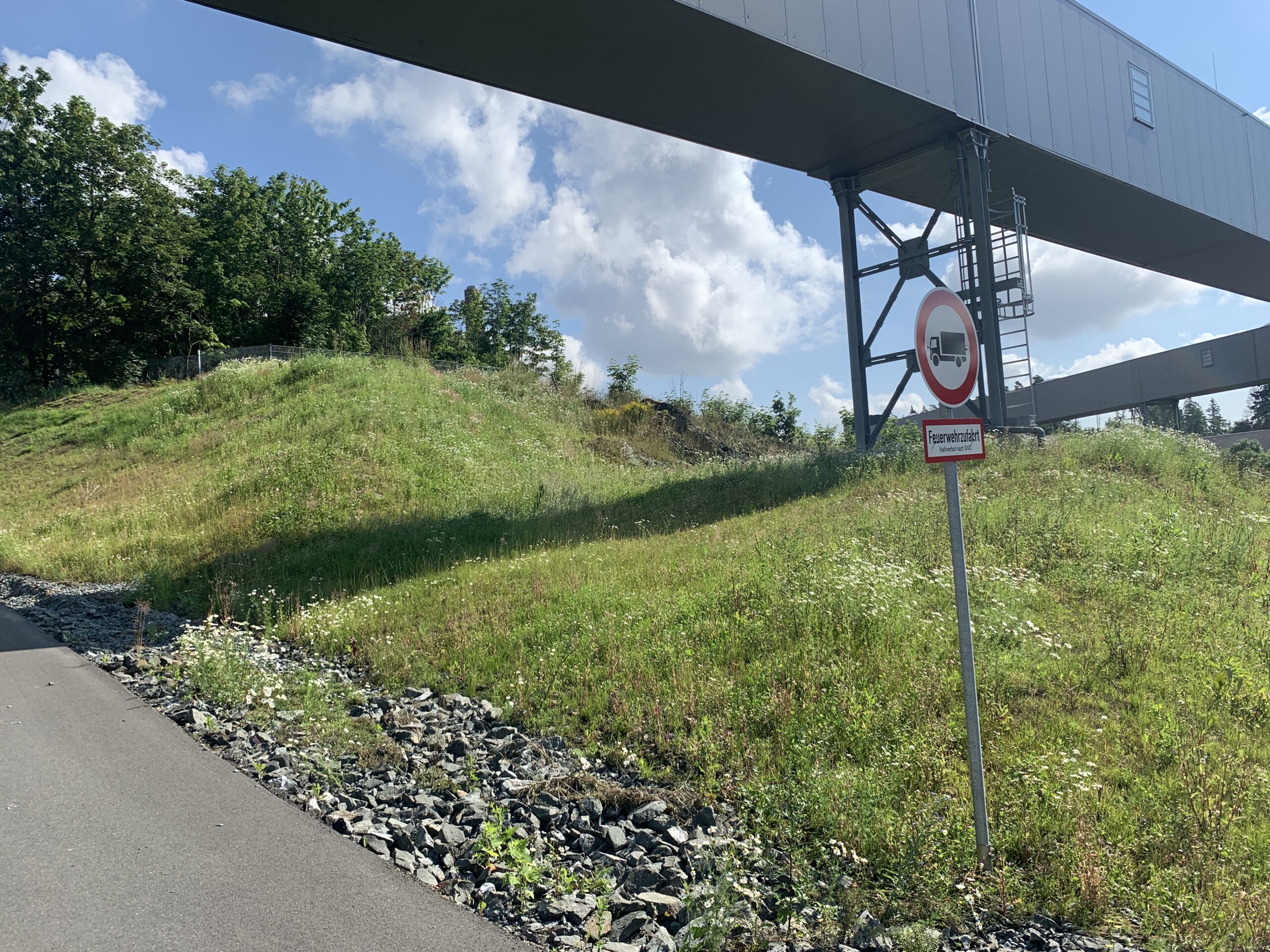
Closed mound of processed construction and demolition debris

Material

Processed (recycled) construction rubble—not raw or unprocessed debris, and not a municipal waste landfill

Vegetation objective

Native species revegetation

Application timing

Dormant seeding during winter months

Access constraint

No vehicle traffic across the treatment area during the winter application period

Application method

Long-range hydraulic application from four sides, supported by auxiliary booster pumps

Case study

The challenge

Processed construction and demolition debris differs substantially from natural topsoil or waste rock. Depending on the source material and processing method, it typically contains crushed concrete, brick and mineral fragments with variable particle size, often elevated pH from residual cement content, and limited organic matter or biological activity.

Native-species revegetation on this kind of substrate requires species selection and establishment planning matched to its specific chemistry and structure—a different profile from either agricultural topsoil or naturally weathered mineral substrate.

The defining constraint on this project, however, was not the substrate chemistry. It was access.

The closed mound could not be driven on during the winter application period. Vehicle traffic across a wintering, potentially soft or partially frozen surface risked compaction, rutting and damage to the mound's surface profile at exactly the time the area needed to be treated. This ruled out any application method requiring machinery to traverse the treatment area directly.
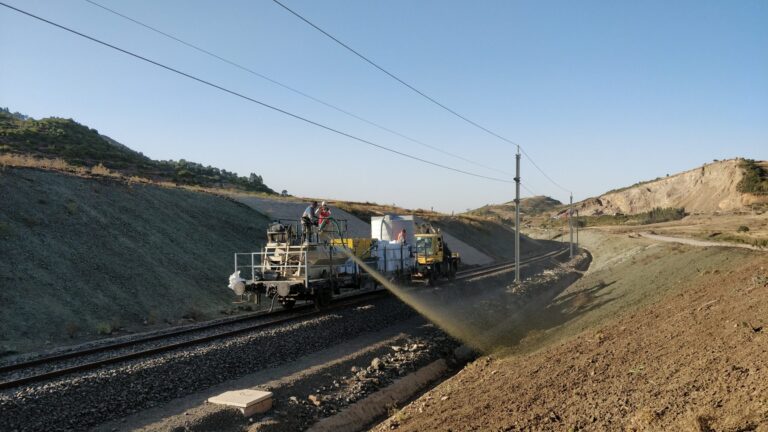
Revegetation of company premises and logistics areas

Dormant seeding as the timing strategy

Dormant seeding—applying seed during the winter months before active growth resumes—was selected as the establishment approach for the native-species mixture.

This timing allows seed to be positioned on or near the surface through the winter, with germination beginning as temperatures rise in spring, often supported by natural stratification processes that some native species require. It also aligned with the access constraint: since the area could not be driven on until conditions allowed, application needed to occur during a window compatible with both the access restriction and the seed's dormancy requirements.

Solving access through equipment, not compromise

Rather than relaxing the no-vehicle-access constraint or accepting incomplete coverage, the project addressed the problem through application equipment and technique.

Working from positions outside the treatment area on multiple sides, and supported by auxiliary booster pumps, the application achieved pumping distances of approximately 190 meters. This allowed the full mound to be covered by working from four sides around its perimeter, without any equipment entering the treatment area itself.

Achieving this throw distance required more than a single machine's standard pump capacity. Auxiliary booster pumps were used to maintain adequate pressure and flow over the extended distance, compensating for friction losses and any elevation change between the perimeter access points and the mound surface.

The broader lesson: technique over formulation

This project illustrates a principle that recurs across difficult-access sites: the limiting factor is frequently not the material system, but whether that system can actually be delivered to the surface that needs it.

A well-designed seed mixture and growth medium provide no benefit if they cannot reach the treatment area without violating an access constraint. In this case, the applicable formulation itself was comparatively conventional for native-species dormant seeding; the project's technical demand was concentrated entirely in pump selection, booster configuration and application planning capable of reaching 190 meters from four separate perimeter positions.

Proprietary formulations and application rates remain project-specific.

Application planning for extended throw distance

Achieving reliable coverage at this distance required coordinated planning across several factors:

Outcome and transferable lessons

No quantified performance result is published in this anonymized case study. It illustrates the methodology and design logic rather than claiming a universal establishment outcome.

Access constraints should shape the technical solution, not be treated as an obstacle to work around informally

Designing the application method explicitly around the no-vehicle-access requirement avoided compromising either the constraint or the treatment quality.

Pumping distance is an equipment and planning problem, not primarily a material one

Reaching 190 meters required booster pump configuration and access-point planning; the seed and growth-medium formulation did not need to be unusual to succeed once delivery was solved.

Working from multiple sides can replace direct access

Covering a sensitive surface from four perimeter positions avoided the need to enter the treatment area at all, at the cost of more complex logistics and equipment coordination.

Dormant seeding timing can align naturally with access restrictions

Where winter access is constrained, dormant seeding's own seasonal timing requirement can work with the constraint rather than against it.

Processed construction debris is not equivalent to natural topsoil or to municipal waste

Its chemistry and structure require substrate-specific species selection, distinct from either agricultural soils or the very different profile of a municipal landfill.

The SRBT approach

SRBT evaluates access constraints as a core design input alongside substrate chemistry and vegetation objectives, not as a secondary logistics issue addressed after material selection.

The process combines substrate characterization for processed or recycled mineral material, native-species selection matched to that substrate, seasonal timing aligned with both species requirements and access restrictions, and application engineering—including pump and booster selection—capable of reaching the required distance without compromising site constraints.

The objective is not simply to specify an appropriate seed mixture. It is to ensure that mixture can actually be delivered to every part of the treatment area under the real constraints of the site.

Methodological disclaimer

This anonymized case study illustrates transferable engineering principles. It does not identify or claim execution at a specific site, guarantee a particular establishment outcome or establish universal performance for dormant seeding or long-range hydraulic application on processed construction debris.

Actual results depend on substrate composition, species selection, winter and spring weather conditions, application distance and equipment configuration, and subsequent site management.

Related application

Railway track revegetation by hydroseeding
Difficult Revegetation

Application
Read more →
Alpine revegetation carried out by helicopter
Guide to Slope Stabilization

Engineering Guide
Read more →
Any questions?

A project, a partnership or a research collaboration — get in touch by phone or email.