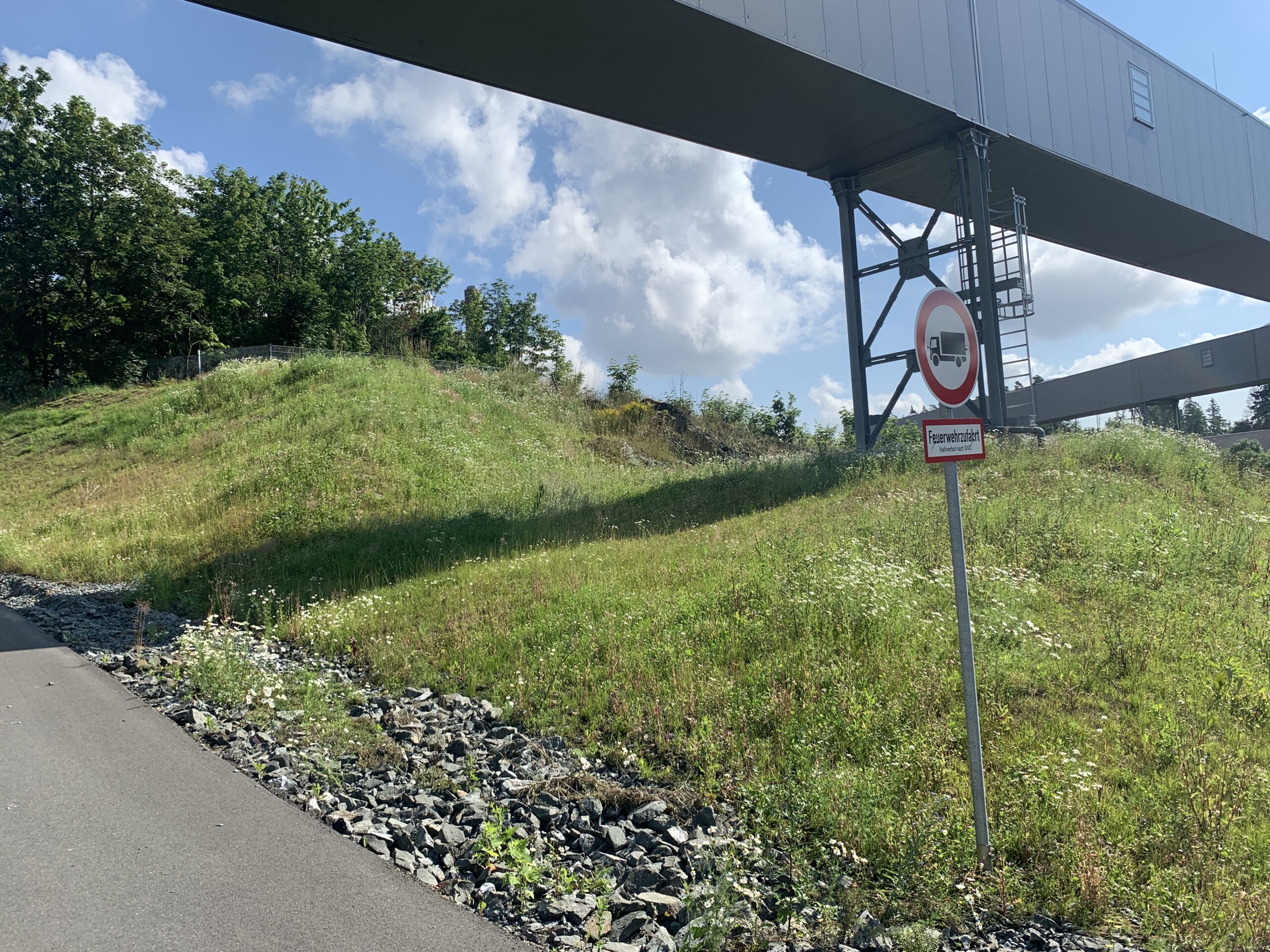
Case Study

Establishing Cover on a Compacted Infrastructure Fill

Resolving the conflict between required bearing capacity and root development on an engineered embankment

Fields of application

Application

Difficult Revegetation / Temporary Surface Protection

Surface

Compacted infrastructure fill (embankment-type engineered fill)

Substrate condition

Mechanically compacted to a specified bearing capacity

Primary challenge

Establishing vegetation cover without compromising the engineered compaction

Method

Shallow-rooting-oriented hydraulic establishment system

Case study

The challenge

Engineered fills used for roads, rail embankments, platforms and similar infrastructure are compacted deliberately. The required density provides the bearing capacity, settlement control and long-term stability the structure depends on.

This creates a direct conflict with vegetation establishment. High compaction reduces pore space, restricts infiltration, limits gas exchange and physically resists root penetration. Surfaces that are dense enough to carry the intended structural load are frequently too dense to support conventional topsoil-based planting.

Unlike a biologically inactive waste-rock slope, the material itself may be geotechnically appropriate and even chemically unremarkable. The obstacle is structural rather than chemical: the fill was engineered to resist exactly the kind of loosening that vegetation typically requires.

The project brief therefore excluded any measure that would reduce compaction, since this would have conflicted with the fill's design function. The objective was to establish functional vegetation cover while preserving the specified engineering performance of the fill.
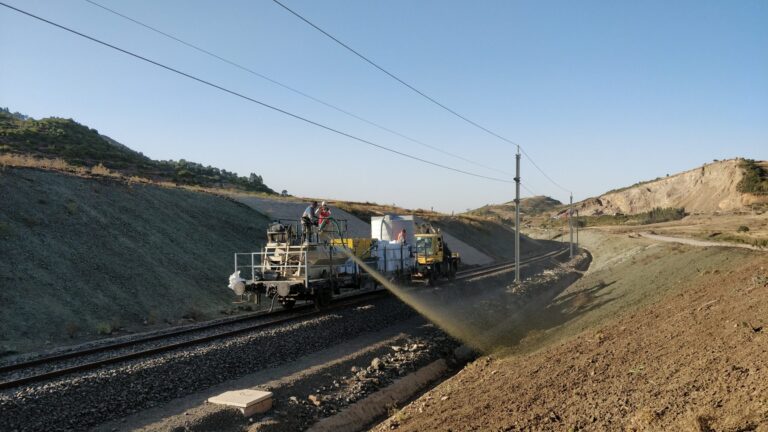
Revegetation of company premises and logistics areas

The geotechnical boundary

Hydraulic revegetation does not alter the engineered compaction of the fill.

The project began with confirmation, by the responsible engineering party, that the surface treatment zone was limited to the uppermost layer and would not involve ripping, deep tilling or other loosening measures that could reduce the specified density.

This boundary shaped every subsequent decision. Any system requiring meaningful decompaction, deep incorporation of organic matter or aggressive surface preparation was excluded from consideration before material selection began.

Drainage design, slope geometry and structural performance remained the responsibility of the civil and geotechnical engineers. The hydraulic system operated only within the surface zone released for vegetation.

A shallow-rooting establishment strategy

Because the compacted profile could not be loosened, the approach concentrated on creating a functional rooting environment within a thin surface zone rather than attempting to modify the fill itself.

This required:

The strategy accepted a structural constraint rather than attempting to circumvent it. Species and material choices were made to succeed within the available shallow zone, not to force deeper rooting into material that needed to remain dense.

Managing infiltration and surface sealing

Compacted fills are prone to surface sealing and crusting, particularly where fine material is present. A sealed surface reduces infiltration further and can prevent germination even where seed and nutrients are otherwise adequate.

The applied system needed to:

This balance—sufficient cohesion for erosion resistance without creating an impermeable crust—required the same tackifier, binder and fiber coordination described in other SRBT surface systems, adapted to the specific density and texture of the compacted fill.

Proprietary formulations and application rates remain project-specific.

Application considerations on an engineered fill

Application planning accounted for the fill's engineered geometry rather than treating it as a natural slope.

Coordination with the civil works schedule was necessary: treatment could not proceed until the fill had reached its final compacted profile and any remaining construction traffic on the treatment area had been confirmed complete.

Outcome and transferable lessons

No quantified performance result is published in this anonymized case study. It illustrates the methodology and design logic rather than claiming a universal establishment outcome.

Compaction requirements should be confirmed before material selection

Designing the vegetation system around a fixed structural constraint, rather than assuming it can be modified, avoids proposing measures that will be rejected by the engineering party responsible for the fill.

Species selection is a structural decision, not only an ecological one

On a compacted fill, root architecture must be evaluated against the physical limits of the available rooting zone, not selected primarily for aesthetic or successional criteria.

A thin functional rooting zone can still support vegetation

Establishing cover does not always require deep, uncompacted topsoil. A well-designed shallow zone can be sufficient where species and materials are matched to it deliberately.

Sealing risk must be managed on both sides

The compacted substrate and the applied surface system can each contribute to sealing. Material selection must avoid compounding an already infiltration-limited surface.

Surface treatment does not resolve structural requirements

Where a fill's design specification and vegetation objective genuinely conflict, that conflict must be resolved by the responsible engineering party—not worked around through the surface treatment.

The SRBT approach

SRBT develops vegetation-establishment systems for engineered fills from the confirmed structural constraints, substrate texture, drainage design and available rooting zone.

The process combines confirmation of compaction and structural boundaries with the responsible engineering party, substrate and infiltration assessment, species selection suited to shallow rooting, project-specific growth-medium and binder design, hydraulic application engineering, and coverage and establishment monitoring.

The objective is not to loosen or modify an engineered fill. It is to establish functional vegetation cover within the constraints the fill's design requires.

Proprietary formulations remain project-specific.

Methodological disclaimer

This anonymized case study illustrates transferable engineering principles. It does not identify or claim execution at a specific site, guarantee vegetation establishment or establish universal performance for shallow-rooting systems on compacted fills.

Actual results depend on compaction level, fill material, drainage design, climate, species selection, application quality and subsequent site management.

Related application

Railway track revegetation by hydroseeding
Difficult Revegetation

Application
Read more →
Alpine revegetation carried out by helicopter
Guide to Slope Stabilization

Engineering Guide
Read more →
Any questions?

A project, a partnership or a research collaboration — get in touch by phone or email.