Engineering Insight

Post-Fire Erosion Control: The First-Rains Window

Why burned slopes require rapid surface protection before rainfall mobilizes ash, soil and sediment

A wildfire does not end when the flames are extinguished. On severely burned ground, the loss of vegetation, litter and surface structure can leave an exposed slope with little resistance to rainfall and runoff.

The first significant rain events can mobilize ash, detach mineral soil and initiate rills or debris-laden flow paths. Once these processes begin, intervention becomes more difficult: applied materials may no longer remain in place, eroded areas require repair, and sediment may already have reached roads, drainage systems, reservoirs or surface water.

Post-fire erosion control is therefore governed by a narrow operational window. The objective is to restore an effective protective surface before the first erosive rainfall—not simply to seed a slope and wait for vegetation to develop.
Alpine revegetation carried out by helicopter

Technical guide

Three connected post-fire problems

Post-fire treatment must address three related but distinct problems.

1. Ash changes the soil environment

Wildfire ash is not one uniform substance and should not automatically be classified as hazardous contamination. Its properties depend on the vegetation burned, fire severity, soil, temperature and whether buildings, vehicles or other manufactured materials were involved.

Even in predominantly natural landscapes, ash can alter:

Ash can initially provide soluble nutrients, but concentrated loads or strongly altered chemistry may inhibit vegetation. Urban or industrial fire debris can introduce a different and potentially more hazardous contaminant profile and requires separate environmental assessment.

The relevant question is therefore not whether ash is universally beneficial or harmful. It is how the particular ash layer changes the substrate and whether it can safely remain, should be incorporated, must be contained or requires removal.

2. Loose ash can leave the site

Ash resting on an exposed surface can be transported by wind before rainfall occurs. Once rain begins, fine ash and dissolved constituents can enter runoff. This can affect:

Post-fire water-quality impacts can include increased sediment, nutrients, dissolved organic carbon, major ions and metals. The actual risk depends on burn severity, ash composition, rainfall, slope, drainage connectivity and the sensitivity of the receiving environment.

Keeping ash and surface particles in place during the first-rains window can therefore serve both an erosion-control and water-quality function.

3. The soil surface has lost its protection

Vegetation, litter and roots normally intercept rainfall, dissipate energy, slow runoff and stabilize the upper soil layer. Fire can remove much of that protection within hours. High-severity fire may leave:

The resulting erosion is not limited to the treated slope. Sediment can obstruct infrastructure, reduce reservoir capacity, damage downstream land and increase the consequences of later storms.

Why the first rains matter

In many Mediterranean and seasonally dry climates, the main wildfire period occurs during summer, while higher-intensity rainfall becomes more likely in autumn or winter. The interval between containment of the fire and the first erosive rain may therefore be only a few weeks.

This pattern is not universal. Convective storms can occur during or immediately after the fire season, and local forecasts may provide little reliable preparation time. The operational window must be assessed for each burned area.

Within that window, teams may need to:

A technically strong system mobilized too late may provide no protection during the event that causes the greatest damage.

Ground cover is the primary surface-control factor

Post-fire research consistently identifies ground cover as one of the most important factors controlling hillslope erosion. Cover intercepts raindrop impact, interrupts shallow flow and reduces direct detachment of soil particles.

This explains an important difference between full-surface treatments and point- or line-based measures.

Full-surface treatment

Mulch, hydromulch and hydraulic erosion-control matrices are intended to protect a substantial proportion of the exposed soil surface. Their functions can include:

Line- and point-based treatment

Contour-felled logs, wattles, fascines and check structures intercept runoff or store sediment at defined locations. They can be valuable where properly designed and installed, but they leave much of the surface between the structures directly exposed.

Their performance depends on spacing, continuous contact with the ground, anchoring, storage capacity, slope geometry, rainfall intensity, installation quality and maintenance after storms.

These structures may retain sediment generated upslope. They do not necessarily prevent that sediment from being detached in the first place.

Fascines and hydromulch are not direct substitutes

A fascine is a linear interception or sediment-storage measure. Hydromulch is a surface-cover system. Comparing their unit prices directly is misleading because fascines are normally priced by linear distance while hydraulic treatment is applied by surface area.

A meaningful cost comparison would require a site-specific design establishing required spacing between fascines, total contour length, labor and access requirements, anchoring and installation method, treatment area, application method, material system, expected storm loading and required maintenance.

For suitable, extensive burned areas, a hydraulically applied system can protect a large proportion of the surface at a fraction of the implementation effort—and potentially a fraction of the cost—of installing a dense network of manual line structures across the same slope.

That does not make fascines obsolete. Line structures may remain appropriate around drainage paths, below critical source areas or where sediment storage is required. The strongest design may combine broad surface protection with targeted structural measures.

Coverage must be real, not nominal

A specification may call for full treatment, yet the effective cover on the ground can be much lower. Coverage can be reduced by:

Inspection should therefore assess the installed system rather than the quantity dispatched from the machine or aircraft. Important quality indicators include continuity of cover, contact with the soil and ash layer, exposed flow paths, vulnerable edges, drainage transitions, material thickness and distribution, anchorage on steep surfaces, coverage beneath standing vegetation and early cracking or displacement.

The protected percentage of the actual ground surface matters more than the theoretical application area.

Hydromulch is a category, not one formulation

The term "hydromulch" describes a method of applying a water-based slurry. It does not identify one standardized material system.

A post-fire hydromulch may contain different combinations of:

Changing the type, quality or proportion of one component can alter pumpability, spray pattern, surface contact, curing, rainfall resistance, moisture behavior and functional service life. Results from one hydromulch formulation cannot therefore be transferred automatically to another.

Fiber is the protective framework

Fiber provides physical ground cover and forms the main mechanical structure of many hydraulic erosion-control systems. Depending on fiber length and morphology, the applied matrix can bridge small surface irregularities, absorb raindrop energy, retain fine ash and soil, create mechanical interlocking, hold water near the surface, provide protected microsites for germination and reinforce the binder or tackifier matrix.

Wood fiber, cellulose and blended fiber systems behave differently. Fine cellulose may provide good initial coverage but limited structural depth. Longer wood fibers can create a more three-dimensional matrix, although their effectiveness still depends on surface contact and compatible binding.

Fiber alone may not remain in place on steep or wind-exposed burned slopes. The selection of the tackifier or binder function is therefore critical.

Tackifier and binder perform different functions

A tackifier is selected primarily to hold freshly applied fibers, mulch and seed together and against the surface during the critical period after application. A binder is selected primarily to create longer-lasting cohesion within the surface system.

These are functional roles rather than completely separate material families. Depending on formulation and purpose, the same material class may contribute to both.

Guar-based tackifiers

Guar gum is an established plant-based hydromulch tackifier. When hydrated, it forms a viscous adhesive matrix that connects fibers and helps retain the freshly applied layer on the slope. Its plant origin and established compatibility with hydraulic application make it relevant where temporary fixation is required. Its functional life remains dependent on rainfall, temperature, microbial activity and formulation.

Anionic PAM

Anionic polyacrylamide is widely used as a synthetic tackifier and soil-aggregation component. It can connect fibers and fine particles and reduce detachment under suitable conditions. Performance depends on product quality, charge, residual monomer content, soil compatibility and water-related application requirements. PAM should be treated as an established tool requiring careful product selection—not as either a universally acceptable or universally unsuitable material.

Longer-term binders

Where the required protection period exceeds the expected tackifier function, an additional or differently formulated binder system may be required. Its persistence must be balanced against environmental behavior, later land use and the desired degradation period.

Proprietary formulations remain project-specific.

Ash retention and vegetation establishment are separate objectives

Keeping ash and sediment in place is an immediate objective. Establishing vegetation is a longer-term process.

Seed may be included where the restoration objective requires active revegetation, native regeneration is insufficient, suitable species and provenance are available, substrate chemistry permits germination, the seasonal timing is appropriate, water availability supports establishment and seeding will not conflict with habitat objectives.

Seeding alone does not provide immediate erosion control. Germination and root development take time, and post-fire studies have repeatedly shown that seed application does not necessarily increase ground cover quickly enough to affect first-season sediment loss.

Conversely, a hydraulic protection system does not always need seed. Some areas may be better suited to natural regeneration, particularly where an intact native seed bank remains or artificial seeding would disturb the ecological objective.

The immediate surface system and the long-term vegetation strategy should therefore be designed together but evaluated separately.

Field evidence must be interpreted at formulation level

Hydromulch can provide broad, rapid surface coverage, but its effectiveness is not automatic.

A frequently cited post-fire study evaluated an aerially applied bonded-fiber matrix consisting of approximately 40 percent shredded wood and 60 percent paper fiber with a guar-based tackifier. No seeding component or dry-mass application rate was documented, and the vegetation response measured in the study was primarily natural post-fire recovery.

The treatment therefore cannot be used as a direct performance benchmark for project-specific hydraulic growth media applied at a defined mass per unit area. It does, however, demonstrate an important implementation risk: aerial application produced uneven material distribution, and the initial installed coverage was not measured. After 121 mm of rainfall, only 55.8 percent hydromulch cover remained in the nominal full-coverage treatment, with substantially less remaining in the strip treatments.

The rapid loss of structural integrity within the first few months is also consistent with the functional distinction between a tackifier and a longer-term binder described earlier. A bonded-fiber matrix relying primarily on a tackifier for cohesion should be expected to lose function within a period of months rather than provide multi-year persistence. Where a longer service life is required, the material system must include a binder component selected for that purpose, not a tackifier alone.

The appropriate conclusion is not that hydromulch is inherently ineffective. It is that fiber composition, applied dry mass, surface contact, tackifier or binder function, application uniformity and rainfall exposure must all be documented before treatment performance can be compared.

Where hydromulch reaches its limits

Hydraulic surface protection should not be expected to manage every post-fire hazard. It does not replace:

Concentrated flow is particularly important. Once runoff gathers into a channel or deep rill, its shear force can exceed the resistance of a surface matrix. Upslope drainage and natural convergence zones must therefore be identified before treatment.

Hydromulch is most defensible where it is used for its intended function: protecting the exposed surface against raindrop impact, sheet flow, shallow rilling, wind and early-stage material movement.

Prioritizing treatment areas

It may not be technically necessary or economically realistic to treat every burned hectare. Prioritization should consider burn severity, slope angle and length, soil erodibility, water repellency, expected rainfall, drainage connectivity, proximity to streams and reservoirs, roads and settlements below the slope, critical infrastructure, accessibility, natural ground cover remaining, expected natural regeneration and the consequences of treatment failure.

High-risk source areas connected directly to sensitive receptors generally require the earliest attention. Lower-risk areas with residual cover or strong natural recovery may require monitoring rather than active treatment.

A post-fire assessment sequence

  1. 1. Identify values at risk

    Determine what could be affected by ash, runoff or sediment: people, roads, drainage systems, reservoirs, habitats, agricultural land or industrial facilities.

  2. 2. Map the source areas

    Assess burn severity, exposed mineral soil, ash depth, slope geometry and runoff connectivity.

  3. 3. Characterize ash and substrate

    Determine whether the ash originates mainly from natural biomass or includes potentially hazardous built-environment material. Assess pH, salinity and other relevant chemical constraints where they may affect treatment or vegetation.

  4. 4. Define the immediate function

    Clarify whether the priority is ash retention, erosion control, dust suppression, vegetation establishment or a combination.

  5. 5. Select the treatment pattern

    Determine where full-surface protection is required and where targeted line, point or drainage structures are necessary.

  6. 6. Validate the material system

    Evaluate fiber structure, tackifier, binder, water retention, application method and expected service life. Representative field testing should be used where time and conditions permit.

  7. 7. Mobilize and apply

    Coordinate equipment, water supply, materials, access, crew and logistics against the forecast rainfall window.

  8. 8. Inspect before and after rain

    Verify coverage before the first event and inspect for displacement, rilling, blocked drainage and exposed transitions afterward.

Why rapid activation matters

For post-fire erosion control, mobilization speed is part of the engineering response.

SRBT's Mediterranean delivery planning uses a 48-hour response-planning target for Greece, Italy and Portugal. This means initiating technical assessment, logistics coordination and mobilization planning rapidly once sufficient project information and authorization are available.

It is not a guaranteed 48-hour arrival or completed application commitment. Actual delivery depends on site access and safety, area and terrain, material availability, water supply, equipment and crew positioning, aviation or road permits, export and transport requirements, weather, regulatory approvals and scope confirmation.

The target reflects the operational reality of the first-rains window: losing several days at the beginning can remove a substantial part of the available treatment period.

The SRBT approach

SRBT develops post-fire surface systems from the burn condition, substrate, slope, rainfall exposure and downstream risk.

The process combines rapid site and risk assessment, ash and substrate characterization, treatment-area prioritization, project-specific fiber, tackifier and binder selection, water-retention and vegetation-establishment functions where required, hydraulic application engineering, coverage inspection and post-rain monitoring.

Hydromulch is not treated as a fixed recipe or a guaranteed solution. Proprietary formulations remain project-specific.

The objective is to restore sufficient surface protection before the first erosive rainfall while recognizing where structural, drainage or contamination measures must be delivered by other disciplines.

Related application

Alpine revegetation carried out by helicopter
Wildfire Recovery

Application
Read more →
Alpine revegetation carried out by helicopter
Stabilizing a burned watershed before the rains

Case Study
Read more →
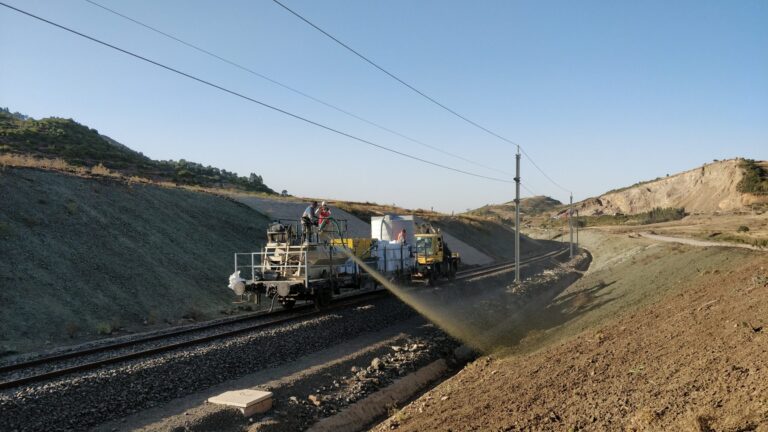
Railway track revegetation by hydroseeding
Water retention in hydraulic growth media

Engineering Insight
Read more →
Any questions?

A project, a partnership or a research collaboration — get in touch by phone or email.