Case Study

Alpine Slope Revegetation Under Freeze-Thaw Stress

Advisory work for a mountain resort operator combining seasonal timing, a coating-free fertilization strategy and a formal vegetation prognosis

Fields of application

Role

Technical advisory engagement for a mountain resort and lift operator

Elevation

Approximately 2,200 meters above sea level

Trigger

New ski-slope construction combined with a new lift installation

Substrates

Both humus-bearing and gravelly mineral areas within the same project

Construction window

Site works possible only from September

Deliverables

Seeding and fertilization strategy plus a formal vegetation prognosis for supporting authorities

Case study

The challenge

High-alpine construction projects operate within an extremely short window. At 2,200 meters, meaningful earthworks were not possible before September, leaving little time before winter conditions arrived. Within that constrained schedule, the project needed to establish vegetation across two very different substrate types within the same slope and lift corridor: humus-bearing areas retaining some natural soil structure, and gravelly, largely mineral areas with little organic matter or water-holding capacity.

Freeze-thaw exposure at this elevation adds a further stress. Repeated freezing and thawing can heave and displace surface material, disrupt seed contact with the substrate and damage roots before they are established enough to resist it. Any seeding strategy needed to survive this cycling through at least one full winter before active growth could begin.
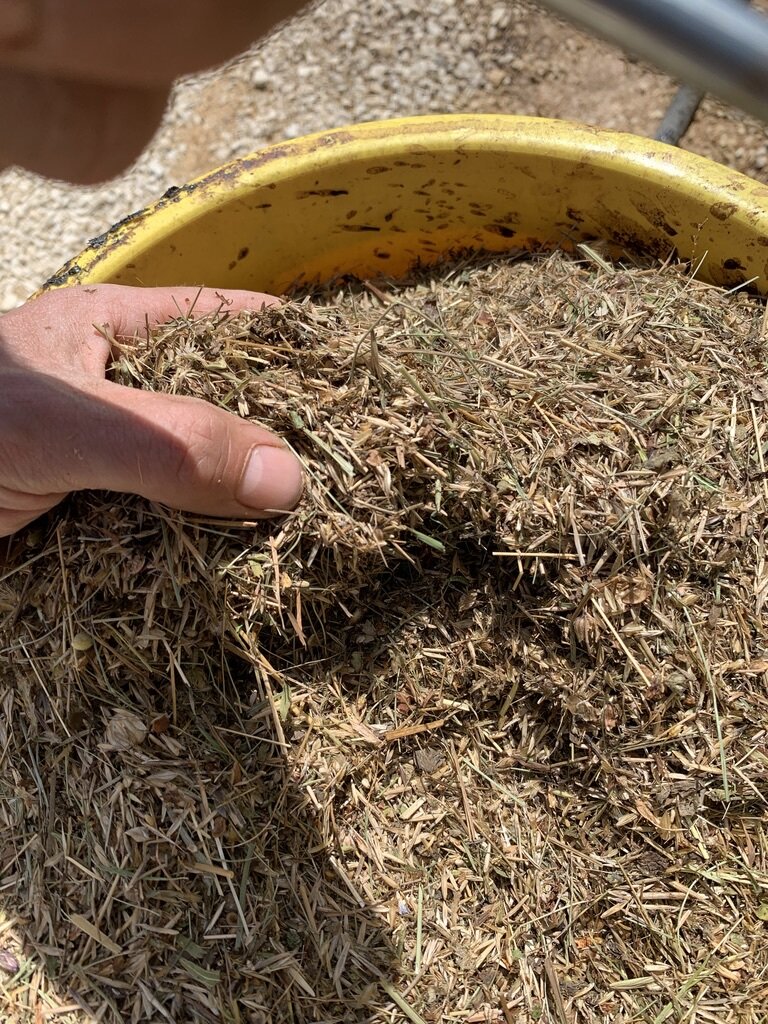
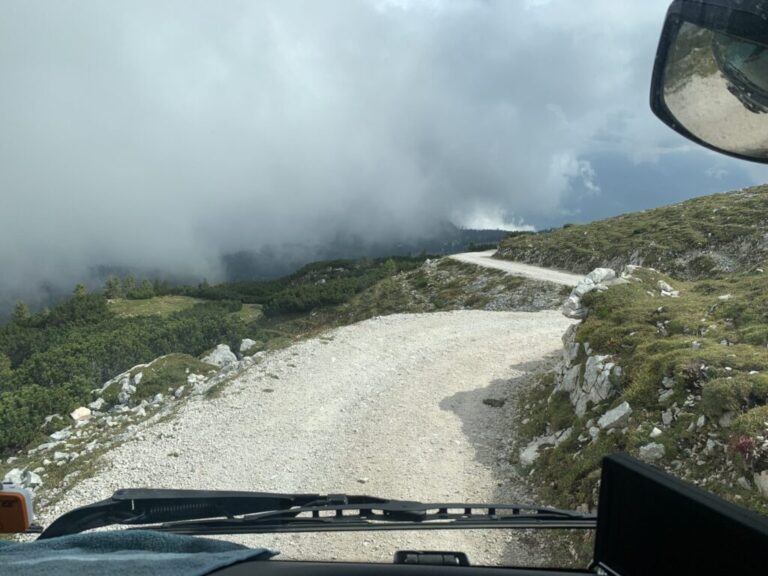
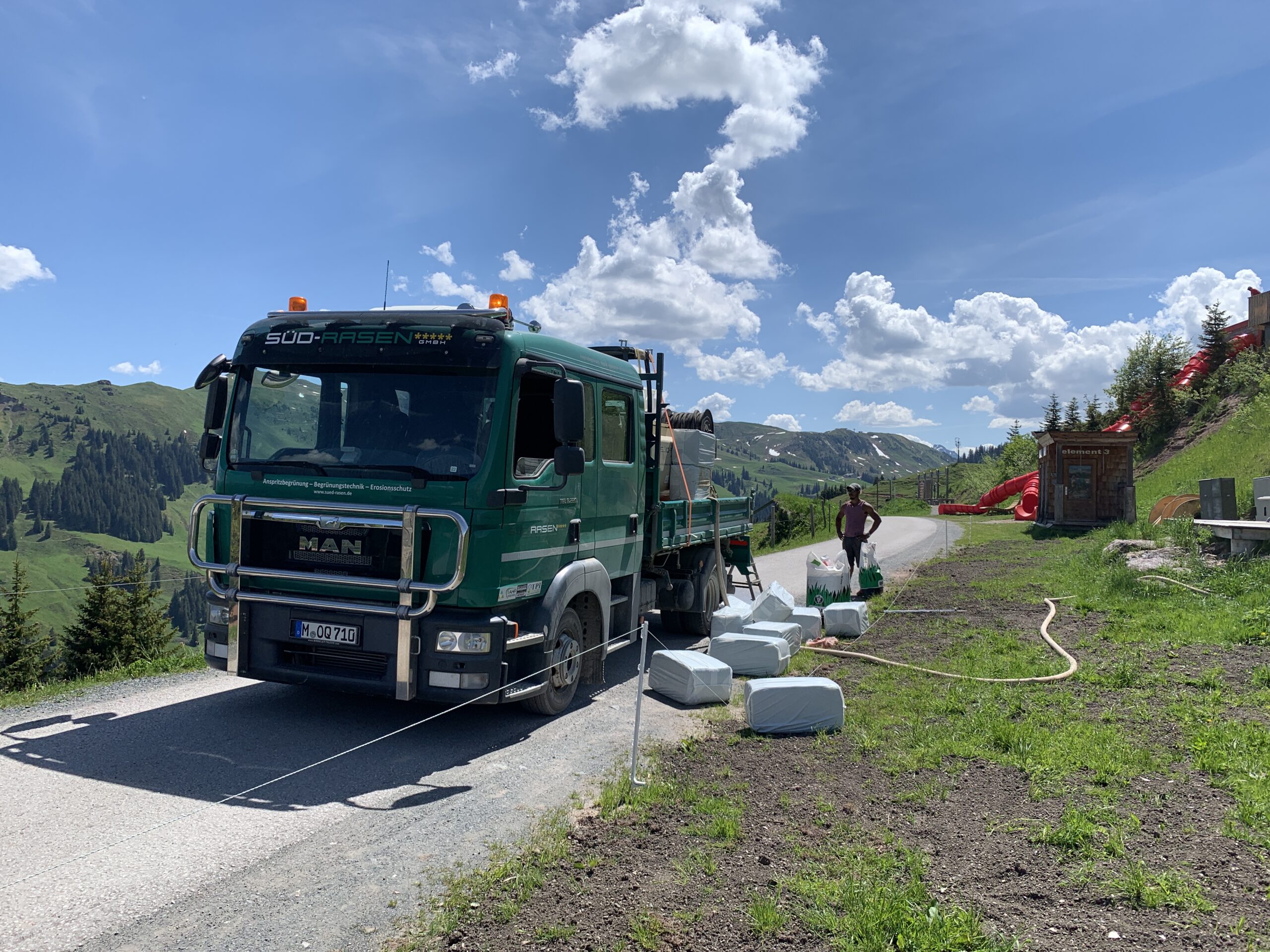
Service vehicle and mulch bales at a high-altitude revegetation site

Timing strategy: dormant seeding calibrated to the season

Given the September start and the altitude, the seeding date was set deliberately for October, calculated to satisfy two opposing requirements simultaneously.

Early enough that remaining site works at elevation could still be completed before the seeding operation. Late enough that ambient temperatures would no longer be sufficient to trigger premature short-term germination before winter set in.

This timing window meant the seed remained dormant through winter rather than attempting—and likely failing—to germinate immediately in autumn conditions unsuitable for seedling survival. It also positioned the project to take advantage of the following year's snowmelt as the primary water source for germination and early establishment, rather than depending on unreliable spring or summer rainfall at altitude.

Fertilization strategy: persistence without leaching or plastic coatings

The specific seed composition selected for this dual-substrate, high-elevation site required a fertilization approach designed around its particular germination and establishment needs. This is where the project's water-protection requirements became the central design constraint.

The fertilizer needed to persist in the substrate through the establishment period without significant leaching risk into surrounding alpine watercourses. At the same time, applicable water-protection requirements ruled out conventional synthetic fertilizers using urethane or similar polymer coatings for controlled release—a category increasingly scrutinized for its contribution to persistent coating residues in soil and water.

The resolution was a slow-reacting NPK fertilizer on an organic-mineral basis rather than a plastic-coated controlled-release product.

This choice benefited from a site characteristic that would normally be considered a limitation: the low biological activity typical of high-alpine mineral substrates. Reduced microbial activity, which elsewhere constrains nutrient cycling, here meant the organic-mineral fertilizer broke down significantly more slowly than it would in a biologically active lowland soil—extending its effective availability without relying on a synthetic coating to achieve the same result.

Proprietary seed and fertilizer formulations remain project-specific.

The vegetation prognosis: supporting the regulatory process

Beyond the seeding and fertilization design, the advisory scope included preparation of a vegetation prognosis intended to give the project's environmental authorities and accompanying specialist planners a defensible technical basis for their own assessments.

This type of forecast sets out the expected establishment trajectory, the reasoning behind timing and material decisions, and the technical basis for anticipated vegetation development under the specific altitude, substrate and climatic conditions of the site. Its purpose is to give regulators and other project stakeholders a documented, technically grounded expectation against which actual establishment can later be assessed—rather than leaving vegetation outcomes as an unstated assumption within the wider construction approval.

Producing a defensible prognosis required the same substrate, climate and timing analysis used to design the seeding and fertilization strategy, translated into a form suitable for review by parties without a hydroseeding-specific technical background.

Coordinating two substrates within one project

The humus-bearing and gravelly sections of the site were not treated identically. Humus-bearing areas retained some native water-holding capacity and biological activity, while the gravelly sections required greater reliance on the applied growth medium itself to provide moisture retention and a functional rooting environment.

The shared October dormant-seeding timing and the organic-mineral fertilization approach were applied across both substrate types, with the growth-medium composition and application adjusted to the differing water-retention and biological-activity characteristics of each.

Outcome and transferable lessons

No quantified performance result is published in this anonymized case study. It illustrates the advisory methodology and design logic rather than claiming a universal establishment outcome.

Seeding timing can be calculated, not simply scheduled by convention

The October window was derived from two opposing constraints—remaining site-work time and premature-germination risk—rather than selected from a standard regional seeding calendar.

Snowmelt can be designed into the water strategy, not treated as an incidental benefit

Timing dormant seeding to place germination after snowmelt turned a predictable seasonal water source into part of the establishment design.

A site limitation can become a design advantage

Low biological activity in alpine mineral substrates, generally a constraint, extended the functional life of an organic-mineral fertilizer without requiring a plastic coating.

Water-protection requirements can rule out otherwise-standard products

Coated controlled-release fertilizers are common in general horticultural practice but were unsuitable here on environmental grounds, requiring an alternative slow-release approach.

Advisory deliverables can extend beyond the material specification

A vegetation prognosis prepared for environmental authorities and specialist planners was as much a part of the engagement as the seeding and fertilization design itself.

Mixed-substrate sites require coordinated, not uniform, treatment

Humus-bearing and gravelly sections within the same project called for a shared timing strategy but substrate-specific growth-medium adjustments.

The SRBT approach

SRBT provides technical advisory support for high-alpine and other climatically constrained revegetation projects, combining substrate and climate analysis, seasonal timing calculation, environmentally compliant material selection and documentation suited to regulatory and stakeholder review.

The process combines substrate characterization across variable site conditions, dormant-seeding timing analysis based on local climate and construction schedule, fertilization strategy design within applicable water-protection requirements, and preparation of technical documentation such as vegetation prognoses to support environmental authorities and project planners.

Proprietary formulations remain project-specific.

Methodological disclaimer

This anonymized case study illustrates transferable advisory and engineering principles. It does not identify the specific operator or site, guarantee a particular establishment outcome or establish universal performance for dormant seeding or organic-mineral fertilization at other high-alpine sites.

Actual results depend on elevation, substrate composition, local climate and snowmelt timing, seed and fertilizer selection, application quality and subsequent monitoring.

Related application

Biodiversity areas established on a golf course
Climate Adaptation

Application
Read more →
Alpine revegetation carried out by helicopter
Guide to Slope Stabilization

Engineering Guide
Read more →
Any questions?

A project, a partnership or a research collaboration — get in touch by phone or email.