1. What the fiber has to do
Wood fiber in hydraulic application is not an inert filler. Within the applied system it performs three physically distinct jobs that run at the same time and interact with one another.
Splash protection is the most immediate effect: raindrops transfer kinetic energy to the soil surface. That energy detaches soil particles, carries seed away and starts erosion rills. A three-dimensional fiber mat absorbs the kinetic energy before it reaches the soil. How well it works depends directly on the structure of the mat — and that only forms if the fibers are long enough to build a stable three-dimensional network.
Water retention works over a longer period. Fibers store water in their cell cavities and release it by capillary action into the germination layer beneath — not as a one-off reservoir but as a continuous supply over hours and days. Water-holding capacity is the decisive figure, and it depends on fiber type, degree of refining and raw material.
Thermal buffering is the least discussed function. The fiber mat slows temperature swings at the soil surface — it dampens midday heat on south-facing slopes and delays cooling overnight. For sensitive seedlings in the first week after seeding, that effect can decide between survival and dieback, particularly in spring conditions and in high-altitude revegetation.
2. Fiber length: the underrated structural parameter
Fiber length is the single most important structural parameter of wood fiber — and at the same time the one most rarely specified in tenders.
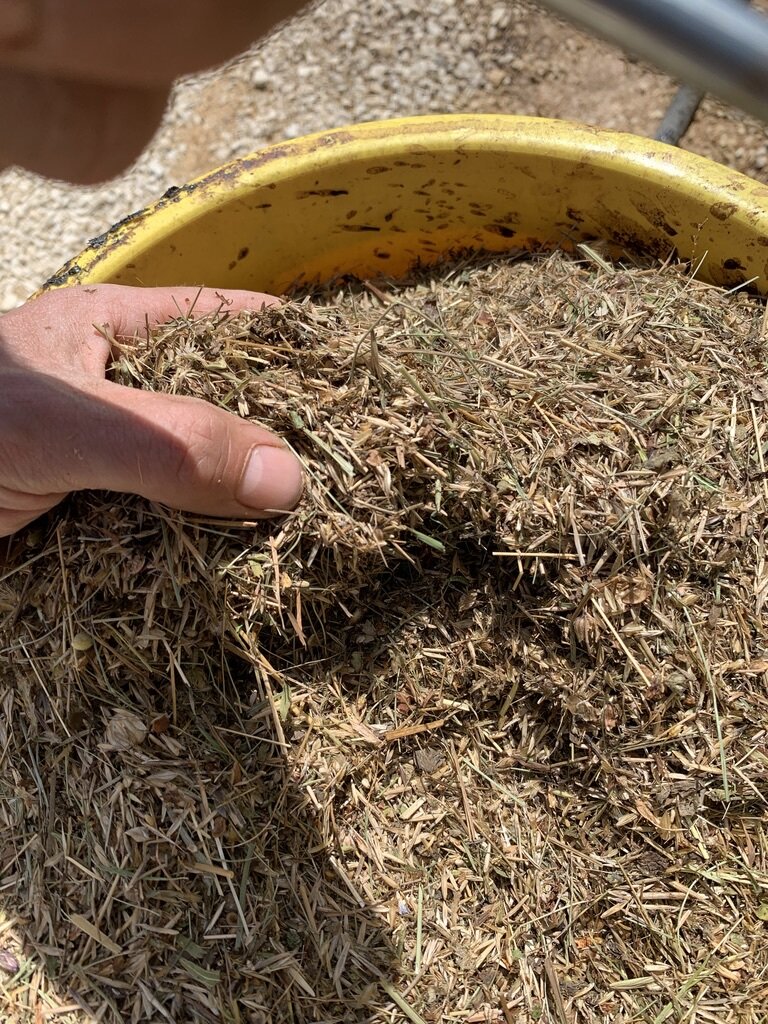
Fibers that are too short (under 3 mm) do not form a load-bearing three-dimensional mat after application. They lie flat on the soil surface, fill gaps, but create no spatial structure that can absorb kinetic energy. Visually the result looks much like a well-applied mixture — an even green-brown coating — but functionally it falls short. The first heavy rainfall event shows the difference: fine fiber is washed away, coarse fiber mats stay.
Fibers that are too long (over 12–15 mm) create the opposite problem: they block pumps, clump in hoses and spread unevenly across the area. The resulting application has uneven layer thickness — thinly covered spots show erosion rills and germination failures, over-covered spots form crusts that inhibit germination.
The range proven in practice for hydraulic mulch is a fiber length between 4 and 10 mm. Within that range the optimum length varies with the machine system (jet or agitator pump) and the application distance.
- No splash protection — erosion is unavoidable
- Low water retention — the fiber lies flat
- No 3D network — no mat structure
- Stable 3D network — splash protection
- Capillary water retention within the fiber network
- Even application, stable through the pump
- Clumping — uneven cover
- Pump and hose blockages
- Gaps between clumps — erosion
Optimal fiber length range for hydraulic application: 4–10 mm (depending on machine type). Fiber length is rarely specified in tenders — which makes bids incomparable
Fig. 1: schematic comparison of system performance at different fiber lengths in hydraulic application. Fibers that are too short and fibers that are too long both produce functional defects — for opposite reasons.
3. Degree of refining: what thermal treatment achieves
Wood fiber for hydraulic application is refined mechanically — the wood structure is broken up to produce pumpable individual fibers. Alongside mechanical refining, thermal treatment plays a decisive role that tendering practice barely acknowledges.
3.1 Biochemical oxygen demand and anaerobic processes
Fresh, thermally untreated wood material contains soluble organic compounds that soil microorganisms break down immediately. That microbial activity consumes oxygen in the germination layer. At high fiber application rates — particularly during the wet application phase — anaerobic conditions can develop directly beneath the mulch layer: oxygen deficiency, with methane and hydrogen sulphide as by-products. The result is inhibited germination that is invisible from the outside but lowers the germination rate significantly. Thermally treated fiber has markedly lower levels of soluble organic compounds — BOD₅ (biochemical oxygen demand after 5 days) is the relevant control criterion.
3.2 Germination-inhibiting substances
Certain wood species contain phenolic compounds, resins and tannins that inhibit germination in concentrated form. In good-quality industrial wood fiber, the refining and treatment process reduces those substances to harmless concentrations. In cheap material — particularly where sawn timber offcuts or mixed wood fractions are processed — that control can be absent. Phytotoxicity tests are the safest way to assess the risk before large-scale use.
3.3 Board-based mulch: a structural quality problem
A widespread problem in the mulch market is the use of recycled board and paper material marketed as wood fiber mulch. Board has different fiber geometry from wood fiber, swells considerably when mixed and produces a sticky suspension that pumps badly. The layer structure after application is more compact and less permeable to air than genuine wood fiber — with negative consequences for gas permeability in the germination layer. On top of that, the board content of a product is often not declared, because there is no standardized labelling requirement. The only reliable way to check quality before use is a laboratory analysis of the fiber composition.
4. Water-holding capacity: the decisive system figure
The water-holding capacity of a wood fiber states how much water it can store relative to its own mass. It is the single most important figure for supporting germination in hydraulic application.
Good thermally refined wood fiber reaches values from 1,000 to over 1,400 % — meaning one gram of fiber stores up to 14 ml of water. Inferior or board-based material is often below 500 %. At the same application rate in g/m², those materials deliver less than half the water reservoir in the germination layer — with direct consequences for the germination rate, especially in dry periods after application.
The germination layer dries out — germination failures in dry periods.
The germination layer stays moist — even germination even in heat.
Fig. 2: water-holding capacity across fiber qualities (schematic) and its effect on the germination layer during dry periods after application. The figures are simplified guide values — product-specific measurements vary.
5. Cellulose fiber as a complement: a different function
Cellulose fiber (produced from raw cellulose or recovered paper) is often positioned as a cheaper substitute for wood fiber. That is a mistaken assumption based on a false equivalence. Cellulose and wood fiber are not substitutes — they are functionally different and complement each other.
Cellulose fiber has a finer, more uniform structure and delivers more homogeneous coverage. Its strength is film formation: as a carrier medium for biopolymers it helps distribute binders more evenly across the area. Its water retention is lower than that of good wood fiber, but the water-holding capacity per unit weight of high-quality raw cellulose can be considerable.
Cellulose alone, however, does not deliver adequate splash protection on slopes — the fiber geometry is too fine to absorb the kinetic energy of raindrops. Using cellulose as a full substitute for wood fiber gives visually even coverage but mechanically insufficient erosion protection. The right combination of coarse wood fiber (structure and splash protection) and cellulose (coverage and biopolymer carrier) is a formulation question to be decided per site.
6. What is missing: quality assurance in practice
The quality differences described here are measurable — but in practice they are rarely measured. That comes down to a structural gap: there is no binding standard for the revegetation sector covering water-holding capacity, fiber length, BOD₅ and phytotoxicity of hydraulic mulch. Manufacturer figures are voluntary and rarely verified independently.
In countries with a mature tendering culture for revegetation work — particularly North America, where ASTM standards for erosion control mulch exist — the situation is different. In Germany and Austria, tendering practice on this point is still barely differentiated. The result: quality differences that show up measurably in revegetation performance are not reflected in the bid price, and the cheapest bidder wins — with materials that are not functionally equivalent.
7. Conclusion
Wood fiber is not a commodity that can be judged on price per tonne. Fiber length, degree of refining, thermal treatment and water-holding capacity are the parameters that decide how it performs in hydraulic application — and all four vary considerably between products offered on the market under the same name. Anyone who does not specify those parameters in the tender leaves the choice of material to the contractor, and therefore to market pressure towards the cheapest product. The consequences show up in the revegetation result, not in the bid.