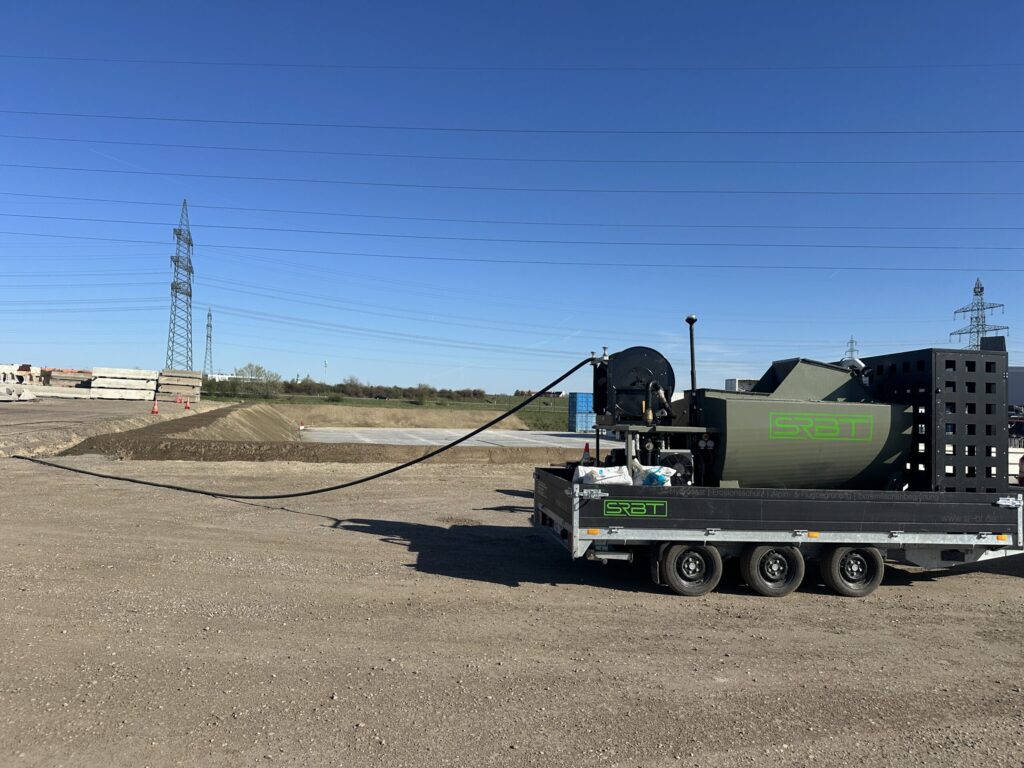
1. The problem: where conventional approaches run out
Unpaved working areas are a permanent problem in many sectors. In a gravel plant, heavy machinery strips fines off haul roads and generates particulate emissions that fall under TA Luft. On landfill surfaces and interim storage areas, wind moves fine particles uncontrollably — with consequences for neighbouring businesses and permit conditions. Site access roads turn to mud in the rain and to dust in dry weather, sometimes in the same week.
The conventional answers each fall short. Water spraying is the most widespread approach to dust control on working areas — and the most resource-intensive. In dry summer periods it has to be repeated several times a day. The water binds dust for hours, not days, and runs off uncontrolled on gradients. In regions with water scarcity or high water prices it is not a viable concept. Cement stabilization delivers lasting strength but is expensive to produce, requires heavy plant, cannot be removed once the area is worked out and changes the soil properties permanently. Bituminous surfaces have similar drawbacks — and on temporary areas they make neither technical nor economic sense.
2. How it works: how biopolymers stabilize surfaces
Biopolymers stabilize soil surfaces by a fundamentally different mechanism from cement or bitumen. They do not create a crust through chemical bonding between particles — they form a flexible network that envelops soil particles and links them together without closing the pore structure completely.
The principle works in two phases. On application the biopolymer is dissolved or suspended in water — the suspension penetrates the top few centimetres of the substrate and coats the particles. As it dries, the biopolymer contracts and forms thin elastic bridges between neighbouring grains. Those bridges raise the cohesion of the surface: they resist wind shear, dampen the impact of wheel and track loads and considerably reduce material abrasion.
Elasticity is the decisive point. A cement crust breaks brittly under dynamic loading — vehicle passes, frost expansion, settlement — and loses its protective effect abruptly. A biopolymer network is flexible: it yields under load without tearing, and takes up water again when unloaded, which renews the cohesion. That property makes biopolymer-based systems particularly interesting for temporary areas and for sites with changing loads.
- Elastic — yields instead of cracking brittly
- Pores stay open — gas permeability retained
- Biodegradable — no permanent intervention in the soil
- Brittle — cracks under dynamic loading
- Pores closed — the soil can no longer support growth
- Permanent intervention — laborious to remove
Fig. 1: the two principles compared. The biopolymer network links particles elastically and keeps the pore structure; the cement crust creates a rigid matrix that cracks brittly under dynamic loading.
3. Where sprayable stabilization makes sense
Sprayable biopolymer systems address areas with these things in common: a temporary or changing use, a fine dust problem from wind or vehicle traffic, and a requirement to leave the area able to support growth — or at least able to be reclaimed — once use ends.
3.1 Dust control on working areas
Gravel plants, recycling yards, bulk material stores and transfer areas generate particulate emissions that fall under TA Luft and require corresponding abatement. Biopolymer-based dust binders form a thin surface film that holds fine particles together and prevents wind lifting them. Compared with water spraying the water requirement is many times lower — the service life of one application is weeks to months depending on system and weather, not hours. That is not a theoretical promise: we have observed it in our trial series on gravel plant areas in the Bavarian Alpine foreland since 2025 under real operating conditions, and we are confident the service life achieved is reproducible on comparable sand substrates.
3.2 Track stabilization under traffic loading
Temporary access roads on construction sites, forest roads under timber haulage and haul roads in gravel pits are subject to heavy dynamic loading from vehicles with axle loads of 10 to 30 tonnes. Conventional crushed stone surfacing is expensive to build and to remove; water spraying is counterproductive on roads without side drainage. Sprayable stabilization systems can raise the cohesion of the road surface and reduce rutting — the mechanism is the same as for dust control, but the demands on layer thickness and penetration depth are higher.
On our test areas in the Bavarian Alpine foreland we have been testing different formulations on the haul roads of an active gravel pit under live operations since early 2025 — with heavy plant up to 28 tonnes axle load passing over them. The results are nuanced: on a well-compacted crushed stone base the applied layer showed visibly less rutting after several weeks of operation than untreated comparison sections. On soft, water-saturated ground the effect was limited, as expected — there, mechanical pre-compaction is needed before chemical stabilization can take hold. Those are clear findings, and they steer our further development work.
3.3 Interim cover on landfill bodies
Landfill operators are legally required to cover active landfill sections between delivery phases in order to minimize dust emissions and rainfall infiltration. Conventional cover materials — sheeting, geotextile, soil cover — each have drawbacks: sheeting is laborious to lay and to remove, soil cover requires heavy plant and creates extra work at the next delivery phase. A sprayable surface film that forms a water-resistant, dust-reducing layer within a few hours is an attractive approach in this context — provided the layer can be worked back in without difficulty at the next phase of use.
| Field of application | Primary objective | Type of loading | Service life (guide) | Trial status (own trials) |
|---|---|---|---|---|
| Dust controlgravel plant / heap | Dust abatement | Wind, lightvehicle traffic | Weeks to monthsdepending on substrate | Under trial since 2025Bavarian Alpine foreland ✓ |
| Track stabilizationworks / construction site | Reduce rutting,keep the road trafficable | Heavy axle loadsup to 28 t | Weeksdepending on compaction | Under trial since 2025Active gravel pit ✓ |
| Dust controlsandy soils / heathland | Wind protection onfine substrate | Wind, novehicle traffic | Monthsdepending on weather | Under trial since 2025Lüneburg Heath ✓ |
| Interim coverlandfill | Dust control +rainfall protection | Rainfall, windno vehicle traffic | Weeks to monthsdepending on system | In preparationField trials planned |
Fig. 2: fields of application for sprayable surface stabilization with system requirements and current trial status. Our own trial series have been running since 2025 on sandy areas in the Lüneburg Heath and in active gravel operations in the Bavarian Alpine foreland.
4. What we have learned on the test areas
Since early 2025 we have run trial areas on two fundamentally different substrate types: the sandy soils of the Lüneburg Heath and active gravel pit and landfill areas in the Bavarian Alpine foreland. The differences between those sites are instructive.
4.1 Lüneburg Heath: sandy soil, wind exposure, no vehicle traffic
On the heathland test areas we applied biopolymer-based formulations to open sand surfaces that were showing deflation and dust lift from wind exposure. The result after several treatment cycles: the surface film holds on these fine-grained substrates considerably longer than expected — a measurable cohesive effect was still evident after heavier rainfall. We are confident that biopolymer-based dust binders on sandy substrates without vehicle traffic can achieve a service life of several months per application, provided the formulation and the application rate are matched to the site.
4.2 Bavarian Alpine foreland: gravel pit, heavy axle loads, combined loading
The gravel pit test areas are more demanding. Dust exposure, heavy vehicle traffic and changing moisture conditions all come together here. What we have learned: the effect of the applied layer depends heavily on how well the underlying ground was compacted. Well-compacted wheel tracks showed less rutting after several weeks of operation with heavy vehicles than untreated comparison sections — a result that gives us confidence. On soft, poorly compacted material the effect was smaller: the layer stabilizes the surface but does not replace basic mechanical compaction. That is a clear limit of the system, and one we address explicitly in our further development.
The Alpine foreland tests also showed us something else: robustness of application under site conditions is a challenge in its own right. Changing water quality, different mixing temperatures and interruptions to mixing all call for formulations that stay stable under those conditions. We have made adjustments on that front and are continuing to test the revised systems.
5. The regulatory framework: what to bear in mind
The regulatory framework matters when using biopolymer-based stabilization systems on working areas — particularly for applications near water bodies or on landfill areas where leachate is a concern.
TA Luft: dust abatement on working areas is written into many permits as a condition. Biopolymer-based systems can — subject to material testing — be used as a suitable dust abatement measure, provided the materials used are not hazardous to water. The classification under AwSV (the German ordinance on installations handling substances hazardous to water) has to be checked for every substance used — biodegradable polysaccharides are generally classified in water hazard class 0 or 1, but that has to be verified per product.
BBodSchG: on areas where soil protection applies — particularly where there will be a later duty to reclaim — full biodegradability of the system used is a basic precondition. Systems with persistent synthetic polymers (PAM, polyacrylates) generally do not meet that requirement without a separate assessment.
6. Conclusion
Sprayable biopolymer systems for surface stabilization are not a future project — they are being actively trialled, on real working areas, under real loading. What we know so far: they work very well and reproducibly for dust control on sandy substrates without vehicle traffic. For track stabilization under heavy axle loads they deliver measurable improvements on compacted ground, but they do not replace basic mechanical compaction. The development work continues — with clear findings on what works, and equally clear findings on where work still lies ahead.