1. What pedogenesis means — and why it matters on a construction project
Pedogenesis is the sum of the physical, chemical and biological processes by which a functioning soil forms out of parent rock or sediment. Under natural conditions that process runs over decades to centuries — on a construction project it is disturbed, interrupted or reset to zero within weeks.
For revegetation planning that matters directly: a freshly profiled slope formation, a filled landfill body or a reshaped extraction area is not “soil” in the pedological sense. They are substrates at different stages of development, with heterogeneous physical and chemical properties that differ fundamentally from a developed soil profile — and they place correspondingly different demands on revegetation.
Anyone who ignores that difference at the planning stage is revegetating on a false premise. The consequences are typically: poor establishment, high remedial costs, persistent erosion damage, or bare areas despite work carried out to specification.
2. Soil-forming processes at a glance
Natural pedogenesis runs through several parallel processes whose intensity and speed depend on climate, parent rock, topography, vegetation and time. For classifying construction substrates the following processes are particularly relevant:
2.1 Weathering and mineral transformation
Physical weathering (freeze-thaw cycles, thermal expansion) and chemical weathering (hydrolysis, carbonate dissolution, oxidation) break down and alter primary minerals. That produces clay minerals, oxides and soluble ions that are decisive for nutrient availability and the buffering capacity of the soil. In fresh construction substrates that process has barely started — the parent rock still dominates the soil chemistry.
2.2 Humus formation and organic matter
The accumulation of organic matter is the pedogenetic process that matters most for revegetation. Organic matter improves water-holding capacity, aggregate stability, nutrient storage and microbial activity all at once. In natural soils the humus content builds up over decades through plant litter and microbial turnover. Freshly profiled raw soils on a construction project typically have humus contents below 0.5 % — functioning arable soils are at 2–4 %, structurally stable forest soils well above that.
2.3 Structure formation and aggregate stability
Soil structure develops through the interplay of clay minerals, organic matter, fungal mycelium and soil fauna. Stable aggregates improve hydraulic conductivity, reduce the tendency to slake and provide the physical framework for rooting. Substrates that have been moved and compacted by machinery have destroyed structure — aggregate stability has to build up again over annual cycles.
2.4 Translocation and profile development
In developed soils, soluble substances, clay particles and organic compounds are moved into deeper horizons by rainwater (lessivage, podzolization). That produces the characteristic soil horizons — A (topsoil), B (subsoil), C (parent rock) — visible in soil profiles. On a construction project those horizons are mixed, inverted or removed entirely by earthworks.
Fig. 1: schematic comparison of a developed soil profile with a fresh construction substrate. The differences in horizons, humus content and structural stability fundamentally determine what revegetation has to achieve.
3. Construction substrates and their pedogenetic starting point
Not all substrates on a construction project are the same. What matters for revegetation planning is classifying the substrate present by its pedogenetic stage of development and its physical and chemical properties. In modern soil science, anthropogenically relocated or technically built substrates undergoing active pedogenesis are classified as technosols (WRB classification, FAO 2014). The term is practically relevant on a construction project: it names precisely what is present on a freshly profiled slope or a landfill body — not soil in the developed sense, but a substrate that is only beginning the process of soil formation. The following technosol types occur regularly in infrastructure, landfill and extraction work:
3.1 Profiled raw substrate
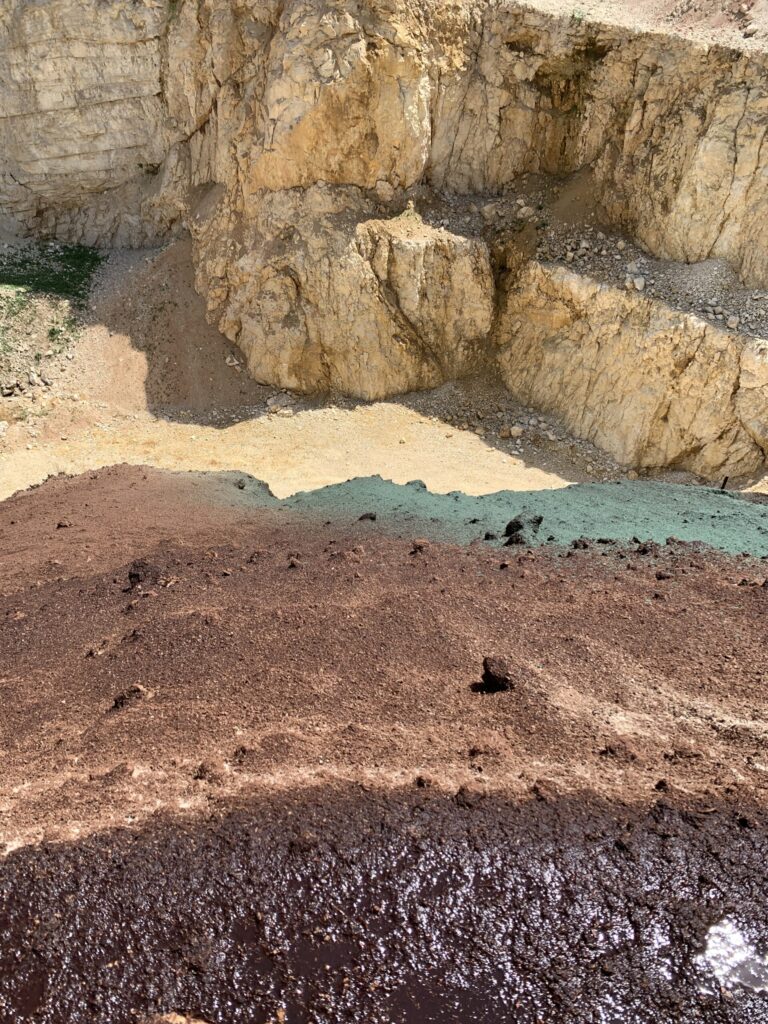
Created by slope shaping, embankment filling and cut-and-fill. The material has usually been moved by machine, contains hardly any organic matter and has no developed structure. pH and particle size distribution are determined by the parent rock. Compaction horizons from machinery are common and not always visible at the surface. This substrate corresponds to the starting condition of soil formation — pedogenesis begins here from new.
3.2 Topsoil from interim storage
Topsoil is regularly stripped on construction sites, stored and replaced once the work is complete. What is often underestimated: stored topsoil loses considerable quality through anaerobic conditions inside the stockpile, nutrient leaching and destruction of structure. Storage time is decisive: topsoil stored for more than 12–18 months under unfavourable conditions has a significantly reduced humus content and a markedly different biological activity potential from its original state. DIN 18915 sets a maximum stockpile height of 2 m for interim storage of topsoil — in practice that limit is frequently exceeded.
3.3 Spoil substrates and mine waste
Open-cast and underground mining produce substrates from deeper geological strata that lay for millennia with no contact with the biosphere. Their chemical properties can be extreme: very low pH from pyrite oxidation (sulphate weathering), very high pH in carbonate-rich limestone marls, high heavy metal contents in ore-bearing rock. These substrates require a thorough geochemical investigation before revegetation is planned.
3.4 Reclamation layers on landfills
Landfill bodies are covered with reclamation layers intended to act as a soil substitute. Their quality varies considerably: mixtures of excavated soil, green waste compost and mineral additives can produce functioning substrates — if composition, layer thickness and compaction are right. Gas permeability is critical: biogas escaping from the landfill body can impair germination and root growth in the reclamation layer even when nothing is visible at the surface.
4. Soil chemistry parameters and what they mean for revegetation
For revegetation planning on construction substrates the following soil chemistry parameters should be established as a priority:
| Parameter | Relevant range | Consequence of deviation |
|---|---|---|
| pH (CaCl₂) | 5.5 – 7.5 for most grass species | pH < 4.5: aluminium toxicity, nutrient fixation; pH > 8.5: micronutrient deficiency, chlorosis |
| Humus content | > 1.5 % for adequate germination support | Below 0.5 %: severely limited water retention, low nutrient supply, unstable structure |
| Particle size distribution | Sand content < 85 %, clay content < 40 % | Pure sand: no water retention; pure clay fraction: compaction, waterlogging, cracking |
| Conductivity (EC) | < 2.0 mS/cm for sensitive species | Raised salt levels (road salt, ash, slag) directly inhibit germination |
| Carbonate content | Species-dependent, 0–15 % for typical slope mixtures | High carbonate content: pH buffered upwards, phosphate availability limited |
| Nitrogen (Nmin) | Species-dependent — extensive mixtures: < 50 mg/kg | Excess: grasses dominate; deficiency where the substrate C/N is high (the straw problem) |
5. Supporting pedogenesis actively: what is possible on a construction project
Pedogenesis cannot be accelerated, but it can be supported — and it can be slowed down for good by the wrong measures. That gives rise to concrete options on a construction project.
5.1 Substrate preparation before revegetation
The most important measure before revegetating raw soil is mechanically loosening compacted horizons. Layer boundaries created by machinery form hydraulic barriers and prevent rooting to depth. Deep loosening down into the uncompacted subsoil — on slopes often 30–50 cm — is essential before revegetation wherever a compaction horizon has been established. The surface roughness affects the adhesion of hydroseeding mixtures and the contact between seed and substrate — the guide value for hydraulic application is a 3–5 cm rough profile.
5.2 Substrate additives and soil improvement
On extremely nutrient-poor or structureless substrates a targeted substrate addition can make sense: composts raise the humus content and improve the initial microbial population. Mycorrhizal inoculation can markedly increase the rate of rooting on raw soils. Secondary raw materials such as green waste compost, sewage sludge composts or technical peat substitutes are used per project. What matters: substrate additions change the starting condition, not the process of development. They accelerate the start but do not replace the time needed for stable humus accumulation.
5.3 Pioneer vegetation as a pedogenetic factor
Vegetation is not only the objective of revegetation but itself a soil-forming factor. Pioneer plants on raw soils — legumes, deep-rooting herbs, certain grasses — contribute actively to soil development through litter, root exudates and symbiotic relationships. They also act on physical soil parameters: grasses and herbs raise porosity and water-holding capacity earlier and more evenly than woody plants, because their fine root systems run through the whole germination layer and build macropore structures. The choice of seed mixture should therefore consider not only the target vegetation but also the pedogenetic contribution of the components during the development phase. Legumes such as Lotus corniculatus or Medicago lupulina in slope mixtures are not decoration — they are active nitrogen fixers that build the nutrient pool of the substrate and so create the precondition for self-sustaining vegetation.
5.4 What is counterproductive
Certain measures inhibit pedogenesis for good or delay it considerably:
- Sealing the surface through excessive binder dosing (a hard crust prevents gas exchange and rainfall infiltration)
- High straw application rates during seeding — the C/N problem was covered in the first article in this series
- Repeated heavy machinery use on freshly revegetated areas during consolidation
- Deep ploughing for remediation on slopes — the mechanical mixing destroys the macrostructure that is building up
6. Consequences for planning practice
Understanding pedogenesis leads directly to requirements for planning revegetation on a construction project:
Assess the substrate before planning: before fixing the method, the seed mixture and the binder system, the developmental stage of the substrate has to be known. On projects above a relevant size, a preliminary soil investigation (pH, humus, particle size, conductivity) is not an optional service — it is the precondition for a technically sound tender.
Differentiate by substrate type: fresh raw substrate, stored topsoil, spoil substrate and landfill reclamation layer are fundamentally different starting points. A single tender item covering all four types is not technically defensible.
The time axis of soil development: acceptance criteria for revegetation that refer solely to ground cover in the first growing season fall short. Pedogenesis on technosols is measurable but slow: the first structural features and recognizable humus enrichment typically appear within 1–5 years. A rudimentary Ah horizon becomes visible under favourable conditions after 10–30 years. A functional soil profile with a stable horizon sequence and meaningful water storage takes 50–150 years — provided the process is not interrupted by further intervention. Functioning soil development, the real basis for lasting vegetation, is not measurable in the first year. Quality assurance should take that time dimension into account explicitly and distinguish between short-term vegetation establishment and long-term substrate stabilization.
7. Conclusion
Pedogenesis is not an academic concept — it is the process that decides whether revegetation works in the long run or has to be made good after a few years. On construction projects that process is regularly reset to zero, rarely supported systematically and too seldom treated as a planning parameter in its own right.
Understanding soil development as a planning basis — rather than an afterthought — leads to better decisions on method, substrate preparation and quality assurance. That does not require elaborate investigation programmes but above all one thing to begin with: a willingness to know the substrate before working on it.